1916 Memorial, c.1940s

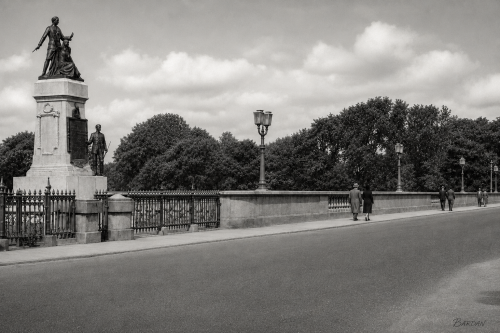
On Sarsfield Bridge in 1940s Limerick, the 1916 Memorial rises proudly beside the roadway, enclosed by green iron railings and watched over by elegant lamps. Its pale stone pedestal supports bronze figures commemorating the Rising, their solemn poses lending dignity to the riverside setting. Trees line the background, softening the urban scene and framing the monument against a bright open sky. Pedestrians in period dress walk along the bridge, suggesting ordinary city life continuing around a place of remembrance. The image captures civic pride, republican memory, and the enduring presence of national history within Limerick’s daily landscape and local identity.
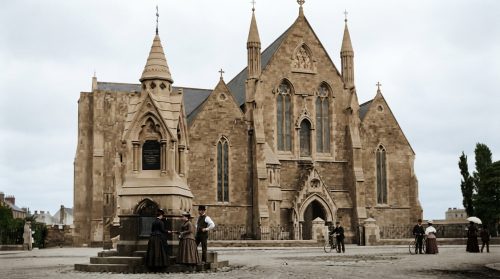
St. John’s Cathedral (Before Tower)

St. John’s Cathedral dominates Limerick’s skyline from John’s Square, crowned by Ireland’s tallest church spire. Designed by English architect Thomas Hardwick, the Gothic Revival cathedral opened for worship in 1859, replacing an earlier eighteenth-century chapel. Its celebrated limestone spire, completed in 1882 to designs by M. A. Hennessy, rises approximately 94 metres above the city. Inside, the cathedral contains a Carrara marble high altar, carved oak choir stalls, an episcopal throne and eight historic bells cast in Dublin. Major restoration projects in 1959 and 2003 preserved the building, which remains an enduring centre of Catholic worship and architectural heritage today.

Castlegarde Castle Through Time

Castlegarde Castle, near Cappamore in County Limerick, is regarded as Ireland’s oldest continuously inhabited castle. Established by the O’Brien family around 1190, its five-storey medieval tower rises from a limestone outcrop, strengthening its defensive position. Original features include an internal well and a murder hole above the entrance passage. In 1820, Waller O’Grady commissioned architects James and George Pain to add a castellated Gothic extension, harmonised with the ancient keep. A carved head of Brian Boru overlooks the entrance, while three unusual stone figures representing Bacchus, Pallas Athene and Aphrodite survive within the gatehouse. Today, it remains a private residence.

British Absence

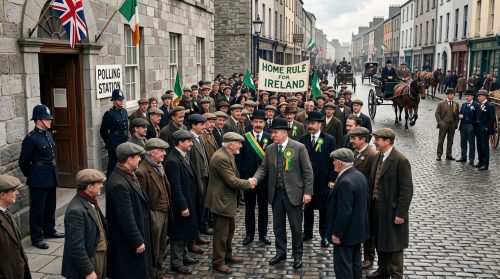
The completed general election has again demonstrated the weakness of the principal British political parties throughout nationalist Ireland. John Redmond’s reunited Irish Parliamentary Party has taken seventy-seven of Ireland’s 103 seats, while candidates standing directly for the British Liberal and Conservative parties made little impression across the south, west and much of the midlands. In Limerick, voters returned nationalist representatives without any prospect of an ordinary contest between the parties governing and opposing at Westminster. Irish political organisation remains shaped principally by the constitutional struggle between nationalism and unionism rather than by the divisions governing electoral life in Great Britain.

Glenduff Castle Restored

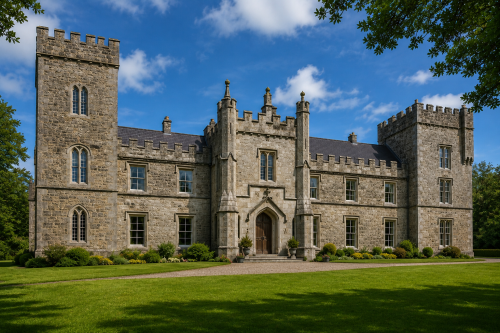
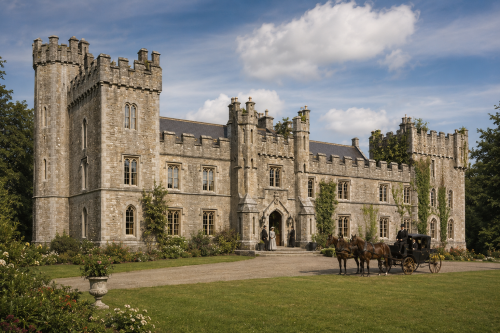
This reconstructed view presents Glenduff Castle in County Limerick as it may have appeared before its destruction in 1922. The imposing residence combines the fortified character of an earlier seventeenth-century tower house with the Gothic Revival additions created for the Ievers family around 1840. Tall crenellated towers, pointed windows, battlements and a formal central entrance give the building a commanding presence. Set within carefully maintained lawns and mature woodland, the castle reflects the scale and confidence of a nineteenth-century Irish country estate. The image offers a plausible visual impression rather than a definitive record of its original appearance or grandeur.

Bunratty Castle

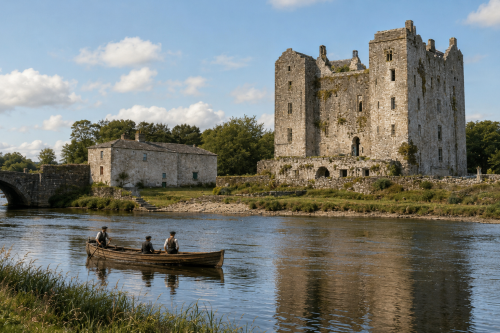
Bunratty Castle in County Clare is one of Ireland’s finest surviving medieval tower houses. The present fortress was built around 1425 by the MacNamara clan on a site occupied by three earlier castles. It later passed to the O’Briens, Earls of Thomond, and endured siege during the Confederate Wars. After the family moved to Dromoland, Bunratty declined into ruin under later ownership. Lord Gort purchased the roofless structure in 1953 and directed its careful restoration, furnishing it with medieval tapestries, furniture and artworks. Opened to visitors in 1962, the castle and adjoining Folk Park remain major heritage attractions worldwide.

Cannocks, George Street

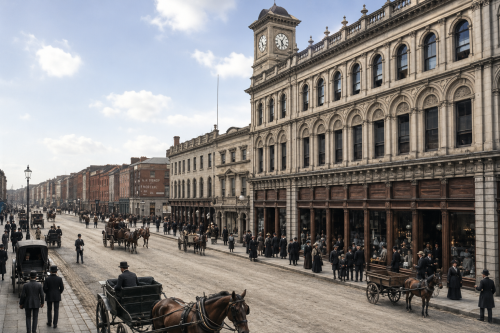
Before becoming Cannocks, the premises at 134 George Street, now O’Connell Street, housed a successful drapery business dating from around 1814. By the mid-nineteenth century, the shop was operated by Cumine and Mitchell and was regarded as a high-class retail establishment. In 1850, Scottish businessmen George Cannock and John Arnott purchased the property, establishing Cannocks and Company, which developed into one of Limerick’s best-known department stores. The business remained a prominent feature of the city’s commercial life for generations. In 1980, the store was sold to Penneys, which continues to occupy the historic site today on O’Connell Street in Limerick.

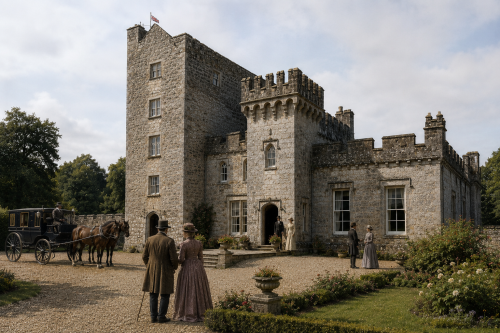
Glenduff Castle Restored

Glenduff Castle is shown restored to its former splendour, standing proudly amid landscaped gardens in rural County Limerick. Built around 1840 for the Ievers family, the castellated country house incorporated an earlier tower house dating from about 1600. Its battlements, flanking towers, arched entrance and long stone façade created a striking Gothic Revival residence. The scene imagines the estate before its destruction, with residents, visitors and a horse-drawn carriage bringing the grounds to life. Glenduff Castle was burned during the Irish Civil War on 29 June 1922, leaving the picturesque ivy-covered ruin that survives on private farmland near Broadford today.

Shoppers On William Street

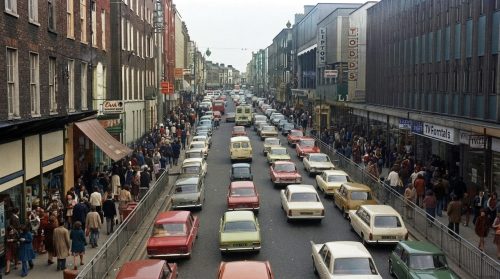
William Street, Limerick, appears busy and energetic in this view from 1975. Shoppers crowd the pavements beneath traditional shopfronts, while cyclists, buses and family cars compete for space along the roadway. Georgian buildings on the left stand opposite the modern commercial blocks of the period, including the prominent Lifts sign. Overhead street lighting and central pedestrian railings reflect changing approaches to traffic management in the city centre. The scene captures a transitional moment when long-established local businesses, older architecture and everyday street life existed beside post-war redevelopment, growing car ownership and a more modern retail environment within central Limerick itself.

Nationalist Defiance

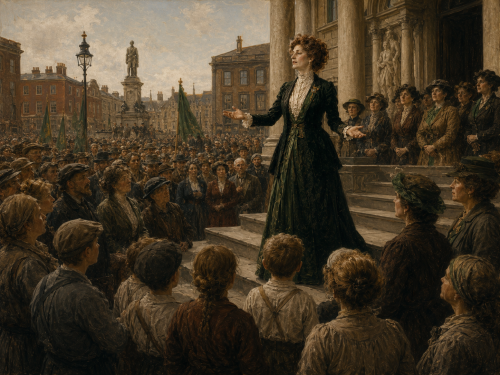
Maud Gonne and other advanced nationalists have organised determined opposition to Queen Victoria’s visit, rejecting official claims that the royal ceremonies represent the will of the Irish people. Gonne’s article “The Famine Queen,” published immediately before the monarch’s arrival, condemns the visit as an imperial and military demonstration conducted during the South African War. Her supporters have challenged loyal addresses, public decorations and attempts to present cheering crowds as evidence of national contentment. In Limerick, where nationalist opinion is strong, the campaign will attract attention among readers who regard Home Rule as insufficient and seek complete Irish independence.

Now Sharing: Articles (182) Images (603) Total Items Archived (785)
Our Mission: 100,000 Items Total Percentage Achieved (0.78%)