Archived: 2 November 2026
Abstract
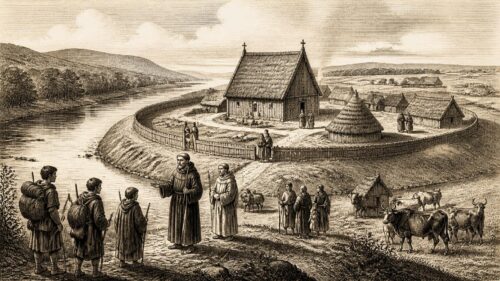
In 664 CE, Ireland entered a year remembered above all for the arrival of a devastating epidemic. The Irish annals place its coming on 1 August, stating with unusual precision that “the plague reached Ireland” and that it first raged at Mag Itha of Fotharta. This is one of the firmest dates attached to an early medieval Irish disease outbreak. Yet the surviving records are terse, copied and rearranged centuries after the events; their year headings do not always coincide exactly with modern chronological conventions. What can responsibly be said is that, during the calendar year 664, mortality reached Ireland,
Read Article
Archived: 2 November 2026
Abstract
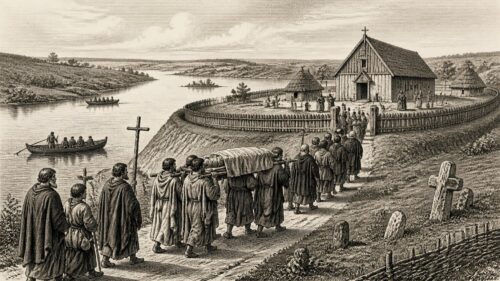
In 663 CE, Ireland’s annalistic record is dominated not by a famous battle or a royal inauguration, but by deaths: above all that of Guaire Aidne, remembered as king of Connacht, and by the loss of senior churchmen at Bangor and Ferns. The year is a useful reminder that early Irish history is often preserved in short, retrospective notices rather than continuous narrative. Those notices nonetheless reveal a society in which royal standing, kinship, monasteries and burial places were tightly interwoven. They also require care over dating. The Annals of Ulster preserve these notices under U663, while their internal year-equivalent
Read Article
Archived: 2 November 2026
Abstract
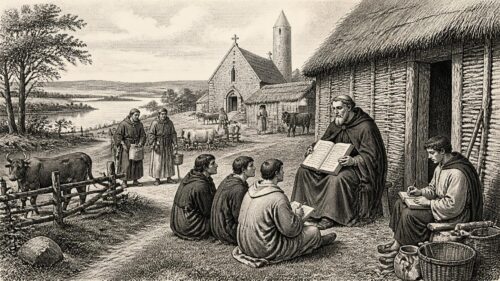
In 662 CE, Irish annalists associated a cluster of political deaths, a battle within the southern Uí Néill and the passing of a celebrated church scholar with this year. The evidence is unusually revealing but not perfectly uniform. The Fragmentary Annals explicitly place the battle of Ogoman, the death of King Máenach of Munster and that of Cummíne Fota in 662; other annalistic compilations place some of the same notices under adjacent year-headings. This is a familiar problem in early Irish chronology, not a reason to discard the events. It does mean that no day, season or sequence within the
Read Article


