Mag Itha664 CE
In 664, Irish annals recorded a devastating mortality arriving on 1 August at Mag Itha of Fotharta, though the disease and location cannot be identified with certainty. Later called the Yellow Plague, the epidemic formed part of a wider Irish Sea crisis also reported by Bede. Annalists linked it with an eclipse, fiery skies and uncertain earthquake reports, while recording deaths among dynasts and abbots without always attributing them to disease. The outbreak threatened interconnected monasteries and rural communities, amid active travel and religious exchange. The year also saw the Synod of Whitby and reports of conflict in Scotland, illustrating Ireland’s wider regional connections.
Dateline
In 664 CE, Ireland entered a year remembered above all for the arrival of a devastating epidemic. The Irish annals place its coming on 1 August, stating with unusual precision that “the plague reached Ireland” and that it first raged at Mag Itha of Fotharta. This is one of the firmest dates attached to an early medieval Irish disease outbreak. Yet the surviving records are terse, copied and rearranged centuries after the events; their year headings do not always coincide exactly with modern chronological conventions. What can responsibly be said is that, during the calendar year 664, mortality reached Ireland, was recognised as a grave public calamity, and began a crisis whose losses became still more visible in the annals for the following years.
An Epidemic Arrives
The annalists used the Latin mortalitas, “mortality” or “pestilence”, rather than offering symptoms, causes or a death toll. Later Irish tradition called the outbreak buide Chonaill, usually rendered the Yellow Plague. That name is securely attached to the wider epidemic in entries for 665, but it should not be treated as a clinical diagnosis for August 664. Modern historians and medical writers have proposed several possibilities, including forms of plague and other infectious diseases. The evidence does not allow the illness to be identified with certainty. What the sources establish is its speed, scale and feared character.
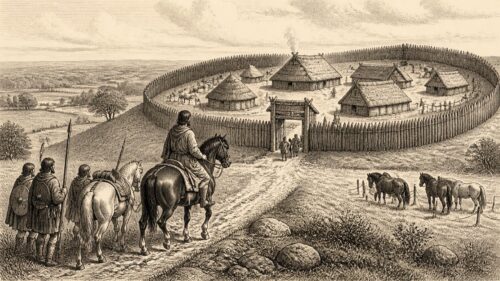
The location named in the annals is itself a warning against overconfidence. One tradition says that the mortality began in Mag Itha “of Fotharta”; the Annals of Tigernach associate Mag Itha with Leinster. These formulae preserve a geographical memory, but do not provide a modern map reference sufficiently secure to identify a particular townland or burial place. Nor do they reveal the route by which the disease entered the island. Ireland was, however, closely connected to western Britain, the Hebrides, Pictland and the Continent by sea travel, royal contacts, ecclesiastical networks and seasonal movement. A disease spreading through that wider Irish Sea world could reach communities which were far from any later urban centre.
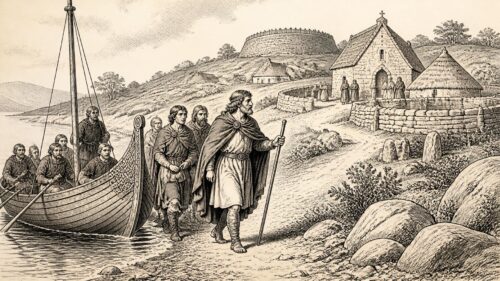
Bede, writing in Northumbria a generation later, independently reported that a sudden pestilence struck southern Britain, then Northumbria, and afflicted Ireland with equal severity. His sequence should not be forced into a precise epidemiological itinerary, but it corroborates the annals’ portrayal of an insular crisis rather than an isolated local sickness. The coincidence is important: 664 was a year in which the sea did not protect Ireland from events in neighbouring islands. On the contrary, the same maritime and religious connections that carried people, books and ideas also made movement possible for contagion.
Portents in the Record
The annals framed the epidemic amid striking signs in the heavens. They record darkness on 1 May at the ninth hour and add that, in the same summer, the sky appeared to be on fire. The first notice corresponds to a solar eclipse, although Bede gave a slightly different date, 3 May. The discrepancy is a useful reminder that early medieval chronology was compiled through different local systems rather than modern astronomical tables. The Irish annal’s exact day should be retained as its testimony, while the difference between sources should not be concealed.
To people living through the summer, an eclipse and an uncanny fiery sky could readily seem connected to later suffering. We cannot recover what most households thought, nor can we prove that the “fiery” sky denotes a particular natural phenomenon. It may have referred to an atmospheric display, an alarming sunset, or an annalistic convention of portent. Either way, its preservation beside the pestilence shows how writers ordered disaster: celestial disturbance, widespread death, conflict and the loss of eminent people belonged in the same moral and historical landscape.
One associated notice requires particular caution. The Annals of Ulster place an earthquake in Britain among the events of the year, while Chronicon Scotorum has an earthquake in Ireland. A modern study has argued that the British “earthquake” may be a misunderstanding of a figurative disturbance in the Northumbrian Church, rather than evidence for a literal seismic event. The conflict between the versions means that no Irish earthquake in 664 should be confidently proclaimed. It is safer to see the entry as evidence of how the annalistic tradition transmitted, and sometimes transformed, news from across the Irish Sea.
Churches Under Pressure
The immediate named losses in the 664 annals were significant in their own right. Cernach Sotal, son of Diarmait and grandson of Áed Sláine, died. His family belonged to the powerful Síl nÁedo Sláine branch of the southern Uí Néill, whose leaders dominated Brega and supplied joint high kings in this period. The annals do not say that he died from the new disease, and that must not be inferred. Still, the death removed a well-connected dynastic figure at a moment when illness was beginning to unsettle communities and, soon, political successions.
The same record notes the deaths of Comgán moccu Teimni and Berach, abbot of Bangor, together with that of Báetán moccu Cormaic, abbot of Clonmacnoise. Bangor in present-day County Down and Clonmacnoise on the Shannon were not secluded shrines but influential religious communities embedded in regional lordship, travel and learning. The annal does not attribute these three deaths to the epidemic. Their inclusion nevertheless reveals what a year’s obituary could mean in seventh-century Ireland: the loss of an abbot affected worship, authority, hospitality, education and the management of land and dependants, as well as the spiritual standing of a community.
Later entries make the scale of danger clearer. They assign the deaths of leading kings, abbots, bishops and “innumerable” others to the great mortality in 665, including Diarmait and Blathmac, the joint rulers associated with Síl nÁedo Sláine. Those deaths belong to the following year in the principal annalistic sequence, not to 664 itself. They should therefore be understood as consequences of the crisis inaugurated in August 664, rather than used to inflate the evidence for this calendar year. The epidemic was not a single-day event; 664 was its documented arrival and opening shock.
Learning and Hospitality
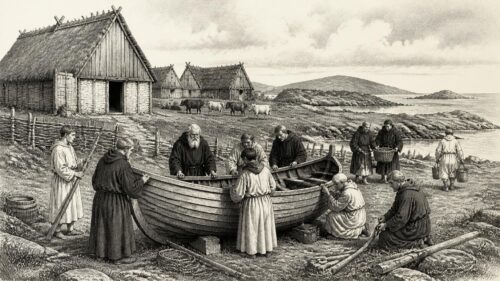
Illness struck an Ireland that was already an important destination for religious study. Bede says that many people from England, both nobles and those of lesser rank, had crossed to Ireland during the episcopates of Finan and Colman. Some entered monasteries; others travelled between teachers’ cells to study. His most memorable claim is that the Irish received them willingly, providing daily food, books and instruction without payment. This is Bede’s admiring account, not a survey of every school or every visitor, but it offers rare contemporary-minded evidence for Ireland’s reputation as a place of learning and hospitality.
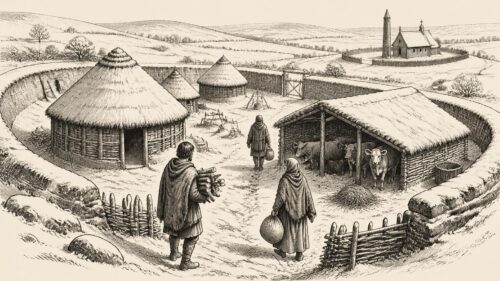
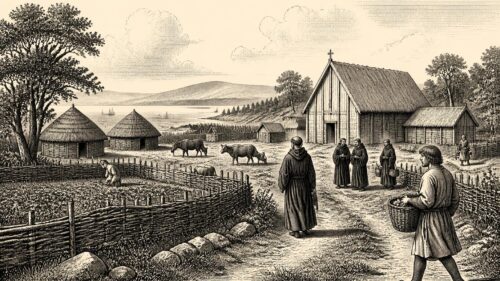
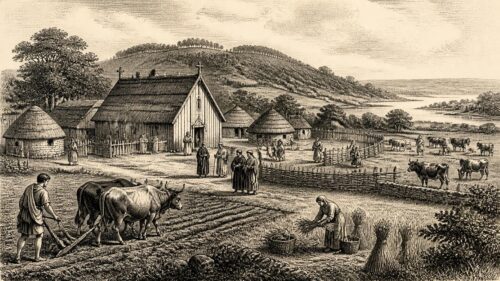
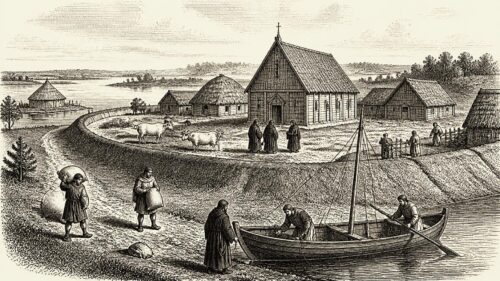
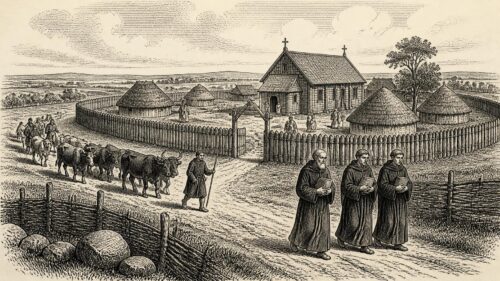
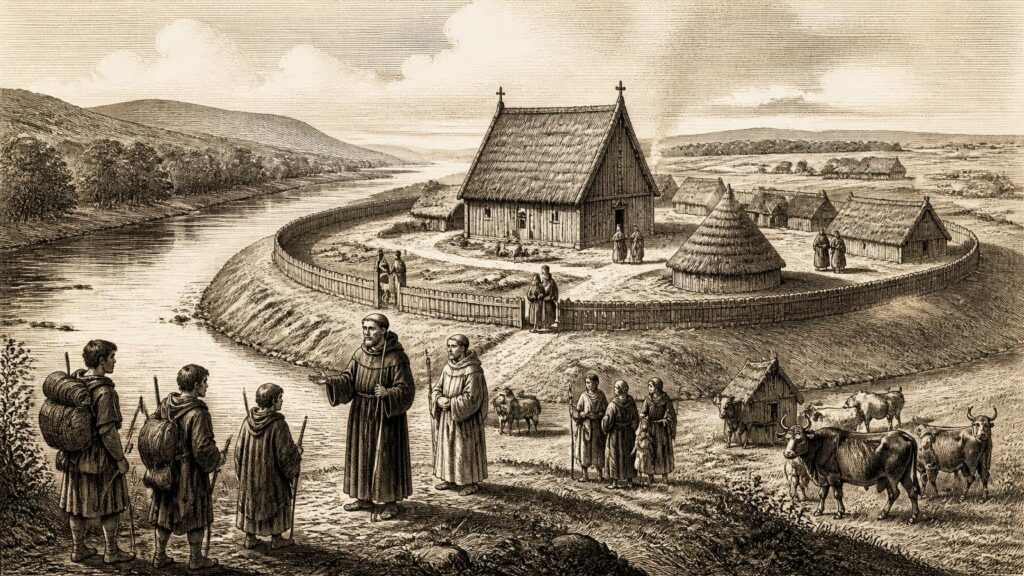
That reputation gives the epidemic a human dimension. Monasteries were religious houses, but also settlements where clergy, students, tenants, craftworkers, guests and livestock could be present within and around enclosed grounds. Their churches and dwellings were often constructed from timber, earth and, in some settings, stone; they depended on cultivated land, herds and the labour of surrounding communities. An outbreak among such interconnected households could disrupt food preparation, nursing, teaching, travel and the ritual calendar without leaving the detailed narrative that a modern reader might expect. The silence of the annals on these ordinary consequences is not evidence that they were slight.
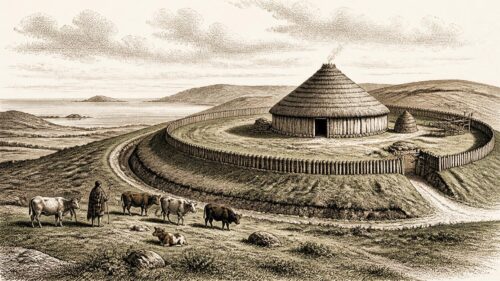
At the same time, it would be misleading to imagine all Ireland as a landscape of great monastic towns. Most people lived in dispersed rural communities, reliant on mixed farming, cattle and local kin groups. Political authority was layered: kings ruled small territories, stronger dynasties exacted allegiance, and ecclesiastical establishments held their own claims and relationships. The disease would have been experienced differently in a royal centre, a monastery, a farming settlement or a coastal landing place. The sources permit that inference from the social structure of early medieval Ireland; they do not allow a numerical reconstruction of mortality, population collapse or economic output.
Whitby and the Irish Sea
Events in Northumbria also made 664 an important year for Irish-connected Christianity. At the Synod of Whitby, King Oswiu accepted Roman customs for calculating Easter and for the clerical tonsure in his kingdom. The dispute was not a simple contest between a united “Celtic Church” and Rome. Irish churches did not all follow one practice: southern Irish ecclesiastics had already adopted the Roman Easter calculation, while Iona and communities linked to its Columban tradition maintained an older reckoning.
Colman, bishop of Lindisfarne, defended the practice associated with Columba and Iona. After Oswiu’s decision, Bede says that Colman departed with those unwilling to accept the change and returned to the Scottish community of Iona, taking part of Aidan’s relics with him. The decision applied to Northumbria, not to Ireland, and it did not instantly settle Irish observance. Its direct relevance to Ireland lay in the authority of Iona, the movement of clerics across the sea, and the fact that Irish religious traditions were being debated at a royal Northumbrian assembly. The ecclesiastical sea-lanes remained active even as pestilence moved through the same world.
A Narrow Window on Crisis
One further annalistic notice records a battle at Luith Feirn in Fortriu, in what is now Scotland. No participants or outcome are supplied. It cannot bear the weight of a detailed political narrative, but its presence alongside Irish events demonstrates the range of information preserved by the chronicle: Ireland’s historians watched warfare and rulership in the northern British world as well as affairs at home. In 664, that wider horizon was especially consequential. News of battle, disputes over Christian practice, unusual skies and disease crossed the same connected region.
The historical importance of 664 CE, then, is not that every aspect of Irish life can be documented in equal detail. It is that the sources fix a moment when a major mortality arrived, while preserving the names of clerics and a dynast, the vulnerability of institutions, and Ireland’s deep involvement in the Irish Sea world. The annals’ August date is precise; the human scale remains immeasurable. Their restraint is part of the evidence. Behind a few compressed lines lay anxious households, disrupted communities and a crisis that would reshape the following years.
Primary Sources
- The Annals of Ulster, Year U664
- The Annals of Ulster, Year U665
- The Annals of Tigernach, Annal T664
- Chronicon Scotorum, Annal CS664
- Chronicon Scotorum, Latin Text for Annals CS664–CS667
- Annala Rioghachta Eireann: Annals of the Kingdom of Ireland by the Four Masters
- Fragmentary Annals of Ireland, Annals FA 28–FA 34
- Ecclesiastical History of the English People
- Ecclesiastical History of England, Book III Chapter XXVII
- An ‘Earthquake’ in Britain in 664
- Chronological Synchronisation of the Irish Annals
- Exploring the Irish Annals
- From Blefed to Scarnach: Pestilence in Early Medieval Ireland
- The Identification of Some Pestilences Recorded in the Irish Annals
- The Plague and Its Consequences in Ireland
- How the Synod of Whitby Settled the Dates of Easter
- Early Christian Monasteries
- Christian Ireland 5th–8th Centuries
- Early Monastic Churches
- Imarcaigh Sund Ar Gach Saídh