Archived: 2 November 2026
Abstract
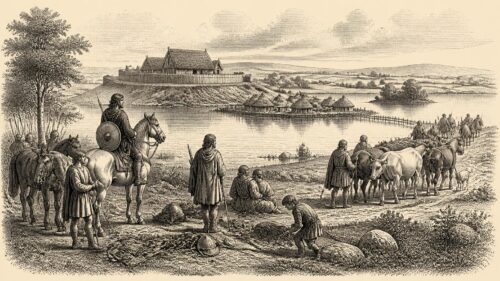
In 677 CE, the most consequential Irish event securely associated with the conventional year was a battle near Loch Gabair, modern Lagore in County Meath, where Fínshnechtae Fledach, king of Tara, defeated the Laigin. It was a victory on the frontier of his own Brega heartland, not a conquest of Leinster, and that distinction matters. The surviving annals are terse, while their chronological headings are not wholly straightforward: the Annals of Ulster place the relevant dossier under an annal numbered 677 but give an equivalent of AD 676, whereas the Fragmentary Annals and modern biographical reference works conventionally date the
Read Article
Archived: 2 November 2026
Abstract
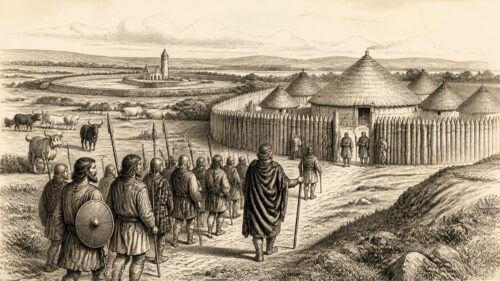
In 675 CE, a battle brought down Cenn Fáelad mac Blathmaic and raised his cousin Fínnechta Fledach mac Dúnchada to the kingship of Tara. The event was a decisive change within the dominant southern branch of the Uí Néill, rather than the founding of a new Irish state or the conquest of a unified island. The contemporary annalistic tradition is terse but emphatic: Cenn Fáelad was killed, Fínnechta was victorious, and Fínnechta then began to reign. For a year with few securely dated Irish happenings, this violent transfer of power is its central historical fact.A Battle With Uneasy GeographyThe principal
Read Article
Archived: 2 November 2026
Abstract
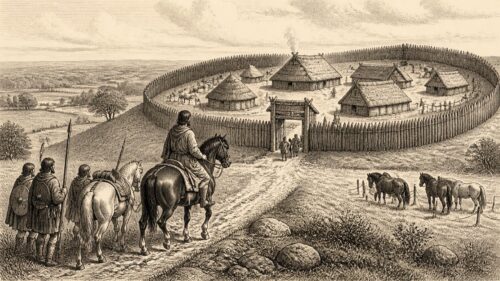
In 671 CE, the most consequential recorded Irish event was the killing of Sechnassach mac Blathmaic, king of Tara, at the beginning of winter. The terse notice in the Irish annals is unusually revealing despite its brevity: it names his killer, Dub Dúin of Cenél Cairpri, and preserves a four-line verse remembering the king’s household as rich in bridles, horse-switches and surplus. The same annalistic year also records a battle at Druim Cepais, the death of Fergus son of Crunnmael, the death of Bran Finn of the Déisi in one source, and Máel Ruba’s sea-voyage from Ireland to Britain. Together
Read Article
Archived: 2 November 2026
Abstract
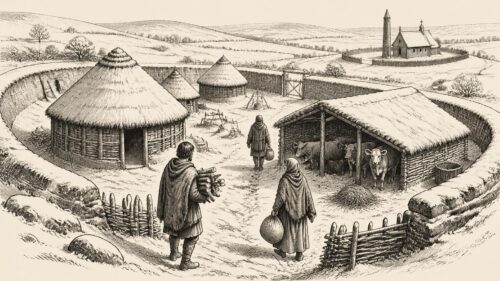
In 670 CE, Ireland’s surviving annalistic record preserves a stark notice: “Great snow fell. A great famine occurred.” The entry, in the Annals of Tigernach, is brief enough to conceal almost everything a modern reader wants to know: how long the snow lay, which districts suffered most, whether harvest stores failed, and how many people died. None of that can responsibly be supplied. Yet the pairing of exceptional snowfall and famine is itself important. In an overwhelmingly agrarian society, winter weather could turn stored food, fodder, livestock and labour into matters of survival. The year is therefore best approached through
Read Article


