Sechnassach’s Killing671 CE
In 671, Sechnassach mac Blathmaic, king of Tara and member of Brega’s Síl nÁedo Sláine, was killed by Dub Dúin of Cenél Cairpri. An elegiac verse recalls his household’s horses, equipment and abundance, reflecting aristocratic status. His brother Cenn Fáelad succeeded later. Annals also note the uncertain death of Déisi ruler Bran Finn, Fergus son of Crunnmael, and the unexplained Battle of Druim Cepais. Máel Ruba voyaged to Britain, preceding his foundation at Applecross in 673. These fragmentary records reveal competitive kingdoms, maritime church links and a rural economy underpinning political power.
Dateline
In 671 CE, the most consequential recorded Irish event was the killing of Sechnassach mac Blathmaic, king of Tara, at the beginning of winter. The terse notice in the Irish annals is unusually revealing despite its brevity: it names his killer, Dub Dúin of Cenél Cairpri, and preserves a four-line verse remembering the king’s household as rich in bridles, horse-switches and surplus. The same annalistic year also records a battle at Druim Cepais, the death of Fergus son of Crunnmael, the death of Bran Finn of the Déisi in one source, and Máel Ruba’s sea-voyage from Ireland to Britain. Together these notices show a country of competing kingships, aristocratic households and active maritime religious connections.
Reading the Year Carefully
The evidence must be handled with care. The Annals of Ulster and Annals of Tigernach preserve closely related material, but their chronological apparatus is not always identical with modern calendar dating, and later annalists sometimes redistributed events among neighbouring years. The killing of Sechnassach is conventionally placed in 671 and is independently treated as such in modern reference scholarship. By contrast, the Ulster annal’s inclusion of the death of the Northumbrian king Oswiu illustrates the problem: Bede dates Oswiu’s death to 15 February 670, so that entry should not be treated as an event of Irish calendar-year 671. This article therefore centres on developments securely assigned to 671, while identifying uncertain items as such rather than converting an annal-heading into a false exact date.
The Killing of a King of Tara
Sechnassach belonged to Síl nÁedo Sláine, a leading branch of the southern Uí Néill whose power-base lay in Brega, the rich central and eastern plain around the lower Boyne. He had succeeded his father Blathmac, one of the joint rulers who dominated Tara in the middle decades of the seventh century. Calling him “king of Tara” mattered greatly. Tara was an old ceremonial and political landscape in modern County Meath, and the title expressed a claim to precedence among Irish rulers. Yet it did not mean that Sechnassach governed a united Irish state. Ireland remained a patchwork of kingdoms, lordships, churches and kin-groups. A king of Tara could demand recognition, tribute and military support, but his influence rested on relationships that had to be constantly maintained.
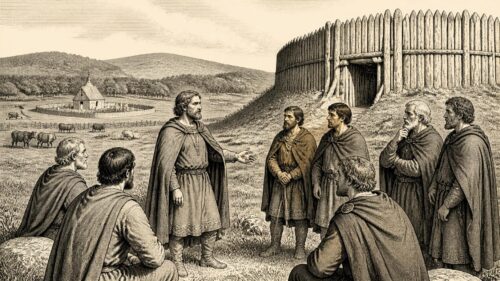
The annals say that Dub Dúin, king of Cenél Cairpri, killed Sechnassach “at the beginning of winter”. A modern biographical treatment places the death in November 671, but neither surviving annal supplies a day or a place. Cenél Cairpri was a comparatively small southern Uí Néill people, associated with the upper Boyne region and the country near Clonard. That the killer was himself called king is significant. This was not an impersonal act of criminal violence recorded from below; it was a political killing involving rulers within the wider Uí Néill world. The annals offer no narrative of motive, battle or settlement. They do, however, establish that the death of Tara’s king came through the agency of a lesser neighbouring dynasty, a sharp reminder of the limits of supposedly supreme authority.
A short elegiac quatrain follows the notice. Its language is difficult in places, but its central images are clear: Sechnassach’s house had bridles and horse-switches, and it possessed abundant remnants or surplus. The verse should not be read as a literal household inventory. It is commemorative poetry, designed to present a dead ruler as generous, well-equipped and socially consequential. Even so, it opens a window onto elite expectations. Horses and riding gear evoked mobility, martial display and lordly status; plenty implied a ruler able to feed followers and visitors. Kingship was made visible in hospitality, gift-giving and the maintenance of an armed retinue as much as in titles or genealogies. The poem mourns a household whose redistributive capacity had suddenly been interrupted.
Succession Without Security
Sechnassach’s death did not end Síl nÁedo Sláine’s hold on Tara immediately. The annals place the beginning of the rule of his brother, Cenn Fáelad mac Blathmaic, in the following annalistic year. That succession is clearly connected to the killing of 671, but it should not be forced into the earlier calendar year: the source does not date the accession more precisely. What can responsibly be said is that dynastic continuity was initially preserved. A brother succeeded where no recorded son did. This was a practical solution, but not proof of stability. Cenn Fáelad’s later overthrow and death would show how exposed the Brega dynasty remained.
The same annalistic dossier records the death of Bran Finn son of Máel Ochtraig. Tigernach identifies him as king of the Déisi of Munster, while Ulster gives only his name and patronymic. This is valuable evidence that southern regional rulers mattered to annalists, not merely the holders of Tara. But a difficulty must be acknowledged: Chronicon Scotorum places the slaying of a Bran Find, king of the Déisi, under 667. Whether this reflects chronological displacement, variant transmission or a problem of identification cannot be resolved from these notices alone. Bran Finn’s death belongs to the annalistic tradition surrounding 671, but it cannot bear the same weight as Sechnassach’s securely dated killing.
Two other Irish notices are even less interpretable. Fergus son of Crunnmael is simply said to have died, without office, kin-group or locality. The Battle of Druim Cepais is named but no sides, outcome or location are supplied. These entries are important precisely because they demonstrate the limits of the record. A battle certainly occurred in the annalist’s source tradition, but there is no responsible basis for claiming that it decided a provincial struggle, involved Sechnassach’s assassination, or caused wider devastation. Silence about such matters is not permission to fill it with a plausible story.
Máel Ruba Takes to Sea
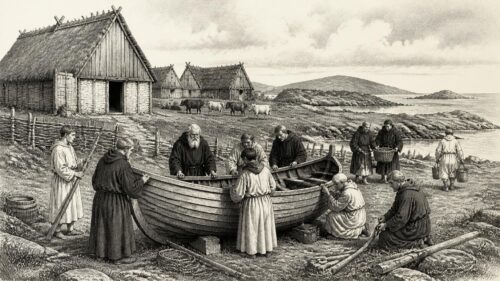
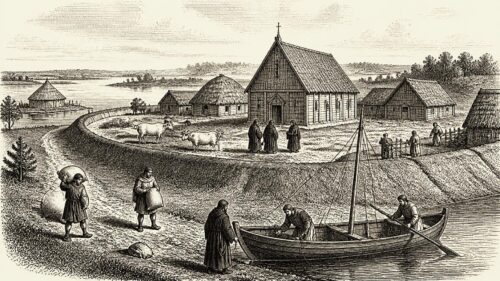
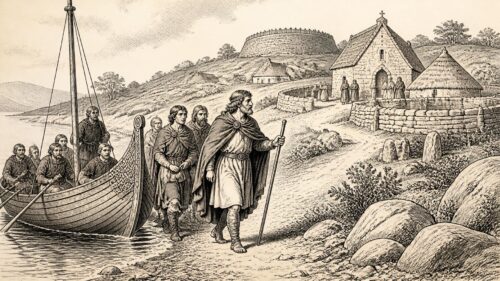
More expansive implications arise from the notice that Máel Ruba “voyaged to Britain”. This was an Irish religious journey across the North Channel and western seas, not an emigration into an alien or disconnected world. Irish churches, monasteries and aristocratic families had long-standing links with the Hebrides, Dál Riata, Pictland and Northumbria. The word “Britain” in the annal does not specify a landing place, companions, vessel or route, and it should not be translated into a modern national label without qualification. Still, Máel Ruba’s departure is firmly associated with 671 in both Ulster and Tigernach.
Its later consequence is unusually well documented. Under 673, the annals record Máel Ruba’s foundation of the church of Apor Crosán, generally identified with Applecross in western Ross. That foundation must not be backdated to 671: the voyage and the foundation are separate notices, two years apart in the annalistic sequence. Yet the connection makes the earlier crossing historically important. Máel Ruba’s move shows that Irish ecclesiastical culture was carried by people, boats, books, relics and institutional loyalties across the sea. Later tradition connects him with Bangor, though particular genealogical claims about his family require caution. What is secure is the pattern: an Irish churchman crossed to Britain in 671 and soon became associated with a durable religious centre there.
Life Beyond the Annals
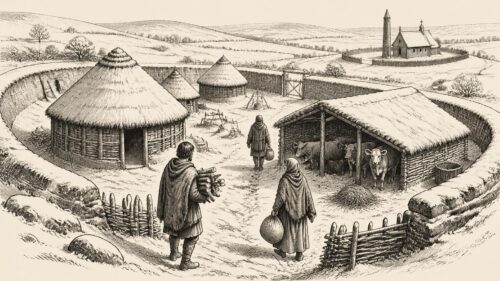
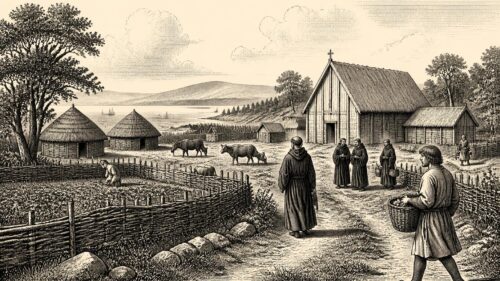
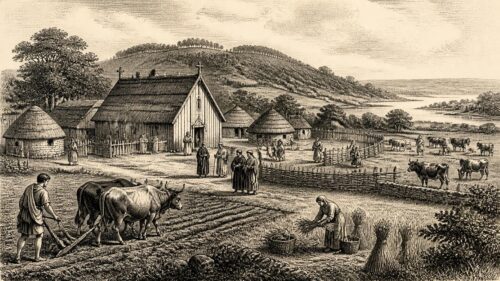
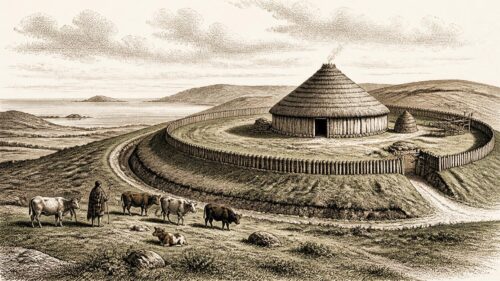
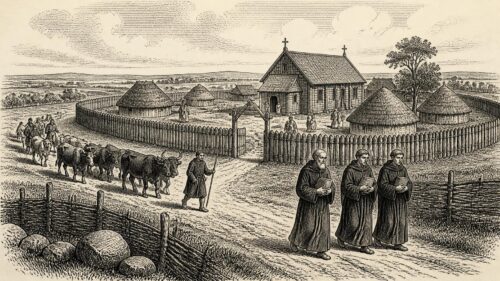
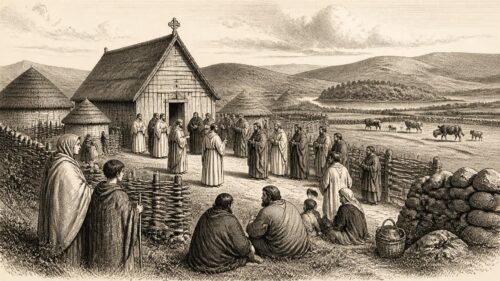
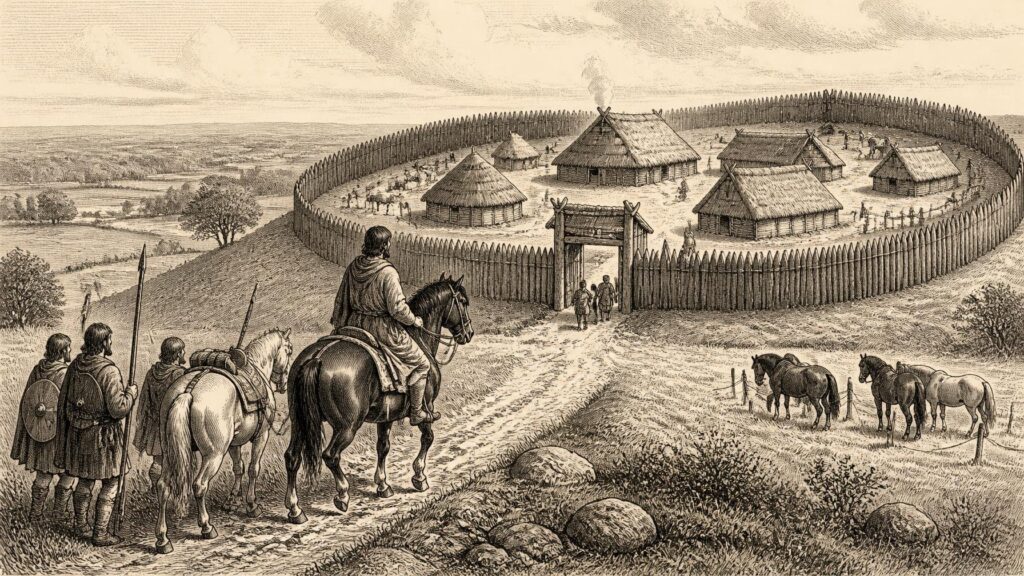
The annals chiefly preserve kings, churchmen, battles and extraordinary deaths; most people living through 671 remain unnamed. Archaeology supplies the necessary wider setting, though not a diary of this particular year. Much of rural Ireland consisted of dispersed farmsteads, often marked by ringforts or raths: enclosed spaces containing houses, working structures and storage, associated especially with prosperous farmers and local lords. Mixed agriculture supported these communities. Cattle carried economic and social importance, while cultivation, cereal-drying and water-powered milling were already substantial features of pre-Viking Ireland. Churches ranged from major landed communities to smaller local foundations, participating in habitation, farming, craft activity, worship and learning.
There is no direct evidence that ordinary rural life was transformed across all Ireland in 671. The preceding annalistic year had been marked by a report of great snow and famine, but that cannot simply be extended into 671 without evidence. Nor do Sechnassach’s assassination or Máel Ruba’s voyage tell us what every household ate, planted or traded. They do show the frameworks within which everyday life was negotiated: kings depended on food-renders and followers; households could be exposed to warfare and changing lordship; and churches connected local landscapes to wider Irish Sea networks.
Thus 671 is best understood not as a year of island-wide revolution but as a moment when the fragility of power became visible. The king of Tara was killed by a ruler from a smaller Uí Néill kingdom, while his household was memorialised in the language of horses and plenty. Elsewhere, a Déisi ruler’s death was remembered with uncertain chronology, an obscure battle left only its place-name, and Máel Ruba embarked on a voyage whose institutional legacy would lie across the water. The surviving record is narrow, but its surviving fragments are enough to reveal a politically competitive, economically grounded and maritime Ireland.
Primary Sources
- The Annals of Ulster: Year U671
- CELT Project: The Annals of Ulster
- The Annals of Tigernach: Annals T668–T683
- CELT Project: The Annals of Tigernach
- Chronicon Scotorum: Annals CS666–CS668
- CELT Project: Chronicon Scotorum
- Sechnassach mac Blathmaic: (d. 671), high-king of Ireland
- Máel Ruba m Elganaig of Applecross
- Landscapes of Kingship in Early Medieval Ireland, AD 400–1150
- Nation and Kingship in Ireland in the Earlier Middle Ages
- Exploring the Irish Annals
- Annals of the Four Masters
- Annals of Inisfallen
- Fragmentary Annals of Ireland
- Lebor na Cert: The Rights of the King of Tara
- Ringforts / Ráthanna
- Irish Field Monuments: Ringforts
- Technological Change in the Agrarian Economy of Early Medieval Ireland: New Archaeological Evidence for the Introduction of the Coulter Plough
- How Did Early Church Sites Differ from One Another? A Comparative Approach Within the Kingdom of Fir Maige, Ireland
- Animals and the Economy of Medieval Ireland: A Zooarchaeological Analysis of the Faunal Remains from Caherconnell Cashel, Co. Clare