Snowfall Famine670 CE
In 670, the Annals of Tigernach recorded great snowfall and famine in Ireland, indicating severe environmental and subsistence pressure without revealing its precise extent or causes. In a rural economy dependent on crops, cattle and stored food, scarcity tested households, rulers, kin networks and churches. The year also saw several killings and deaths, reflecting persistent local political conflict. The assassination of Sechnassach, king of Tara, is dated to 670 by the Annals of Ulster but to 671 by Tigernach, illustrating chronological uncertainty. Ireland remained connected to Britain through ecclesiastical and maritime networks, despite hardship and political instability.
Dateline
In 670 CE, Ireland’s surviving annalistic record preserves a stark notice: “Great snow fell. A great famine occurred.” The entry, in the Annals of Tigernach, is brief enough to conceal almost everything a modern reader wants to know: how long the snow lay, which districts suffered most, whether harvest stores failed, and how many people died. None of that can responsibly be supplied. Yet the pairing of exceptional snowfall and famine is itself important. In an overwhelmingly agrarian society, winter weather could turn stored food, fodder, livestock and labour into matters of survival. The year is therefore best approached through this recorded environmental and subsistence crisis, while recognising that the annals do not provide a full national survey.
A Severe Winter in the Record
The phrase “great snow” should not be treated as a modern meteorological measurement. Medieval annalists selected unusual events, and their language conveys remembered severity rather than temperatures or snowfall totals. Nor does the entry prove that every part of Ireland experienced identical conditions. It does show that conditions were remarkable enough to be entered alongside political deaths and killings. The accompanying famine may have followed the snow directly, but the terse wording does not establish the mechanism. Snow could obstruct movement, limit access to fuel and grazing, weaken animals, delay spring work and make food difficult to distribute; equally, famine might have reflected shortages already developing before winter. The safest conclusion is that contemporaries connected severe weather and acute scarcity within the same year.
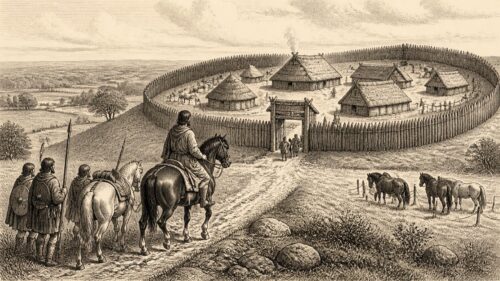
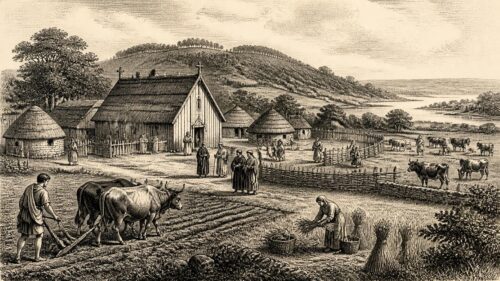
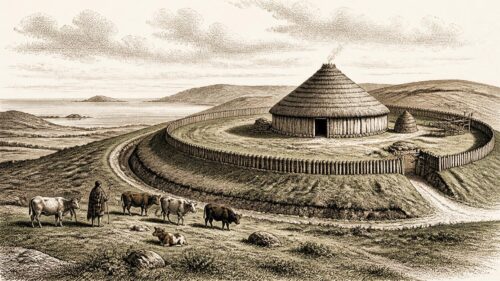
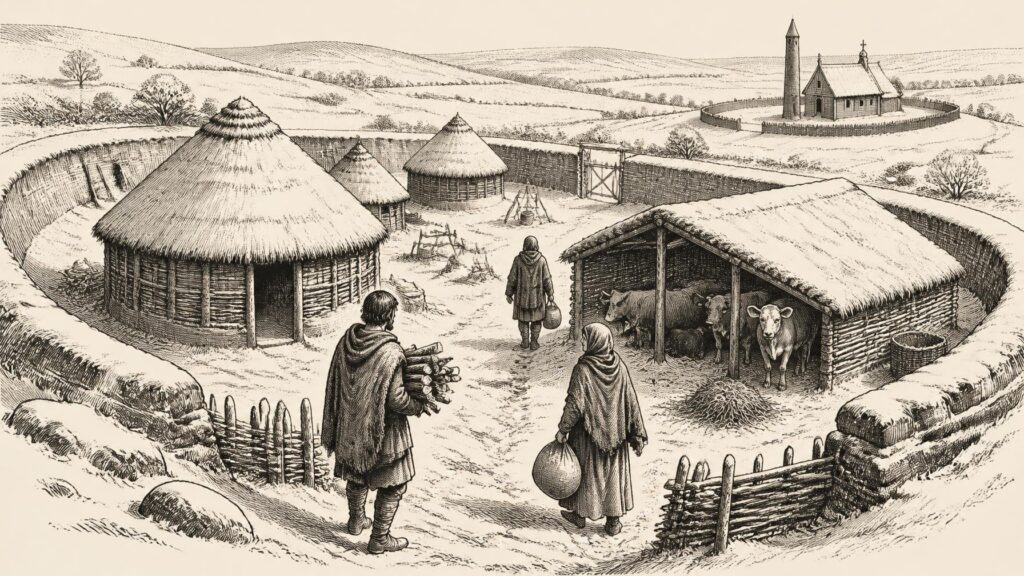
For ordinary households, the consequences would have been immediate. Most people lived in dispersed rural settlements, in and around enclosed farmsteads, depending on cattle, dairy produce, crops and access to communal resources. Cattle represented both food and movable wealth, while grain and dairy production depended upon seasonal routines that could be badly disrupted by weather. A household with adequate stores and strong kin connections might endure a difficult winter; poorer dependants, travellers and people without secure access to land or livestock were less protected. Famine was not merely hunger in the abstract. It exposed the unequal distribution of resources and tested the obligations of kings, church communities, landholders and kin-groups.
Famine, Authority and Obligation
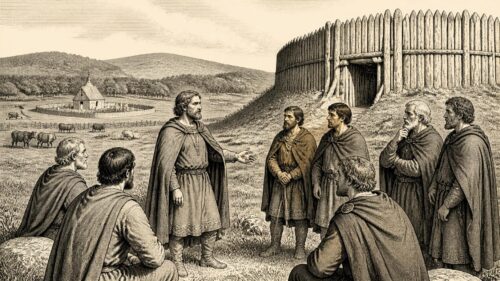
Early Irish kingship was intensely local and hierarchical. Ireland was divided among many petty kingdoms, overkingdoms and competing dynasties rather than governed by a single state. A ruler’s standing rested partly on military success and ancestry, but also on his capacity to maintain order, provide hospitality, reward followers and protect clients. In a year of scarcity, those expectations became harder to meet. Food renders, cattle payments and hospitality underpinned political relationships; a shortage could strain every one of them. The annal does not tell us which rulers acted effectively in 670, nor whether relief was organised. It would be wrong to imagine a centrally directed response. Still, the famine provides a necessary material background for understanding why power, patronage and access to provisions mattered so much.
The sources also record violence in 670, though with the same limits of detail. Tigernach notes the killing of Máel Dúin, grandson of Rónán, the death of Blathmac son of Máel Coba, the killing of Cúana son of Máel Dúin son of Cellach, the killing of Bran Finn son of Máel Fothartaig, and the death of Dúnchad, grandson of Rónán. These notices identify casualties but rarely explain motives, locations or wider consequences. They should not be combined into an invented island-wide war. Rather, they reveal a political world in which lethal disputes were common enough to be memorialised one name at a time, even amid weather and food stress.
The Problem of Dating a King’s Death
A much more consequential killing is attached to 670 by the Annals of Ulster. Under its heading for AD 670, it records the assassination, “at the beginning of winter”, of Sechnassach son of Blathmac, described as king of Tara; his killer was Dub Dúin, king of Cenél Cairpri. A short verse portrays Sechnassach’s household as rich in riding equipment and surplus. The poem is not a neutral inventory, but it makes clear that royal reputation was expressed through horses, equipment, hospitality and visible abundance. In a year remembered elsewhere for snow and famine, its imagery of plenty has particular force, even if it cannot be read as evidence that Sechnassach himself was immune from scarcity.
There is, however, an essential chronological warning. The Annals of Tigernach places Sechnassach’s killing in its annal for 671, whereas the Annals of Ulster places it under AD 670. This is a familiar difficulty with early Irish annals: their year headings and the modern calendar do not always align perfectly. The event can safely be connected with the turn of 670–671, and Ulster’s notice specifically places it at the beginning of winter, but a precise modern date cannot be recovered. It should therefore not be treated as an unquestionably, independently dated event within 670 itself. What is certain is that Sechnassach’s death ended the rule of a leading member of Síl nÁedo Sláine, a southern Uí Néill dynasty centred on Brega.
Tara Without a Capital
Calling Sechnassach “king of Tara” does not mean that Tara functioned as the capital of a unified Irish kingdom in a modern sense. The Hill of Tara retained immense ideological importance as the premier royal seat associated with the Uí Néill and with claims to pre-eminence in Ireland. Kings did not necessarily reside there continuously, and their authority varied sharply across regions. Sechnassach’s position nevertheless represented more than local Brega rule. He inherited a politically powerful but vulnerable dynastic legacy after the plague deaths of his father Blathmac and his uncle Diarmait in 665. His killing by Dub Dúin shows that prestigious kingship did not guarantee personal security or uncontested supremacy.
The succession that followed is clearer only in retrospect. Tigernach records that Sechnassach’s brother Cenn Fáelad began to rule in 672. That later notice must not be made to prove exactly what happened in 670, but it demonstrates the immediate dynastic consequence of the crisis around Sechnassach’s death. The continuity of the brothers’ line was temporary, not secure: the political history of Brega and the wider Uí Néill was shaped by recurring rivalries among close kindreds as well as by challenges from outside them. A royal assassination was therefore not an isolated court drama. It affected alliances, tribute, military followings and the authority claimed over subordinate peoples.
Churches, Learning and the Irish Sea
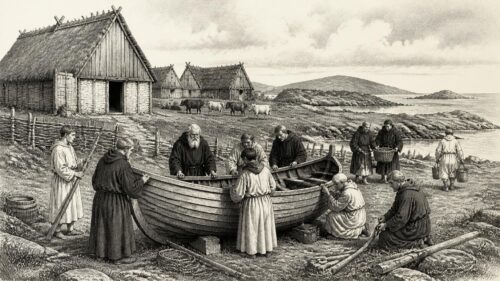
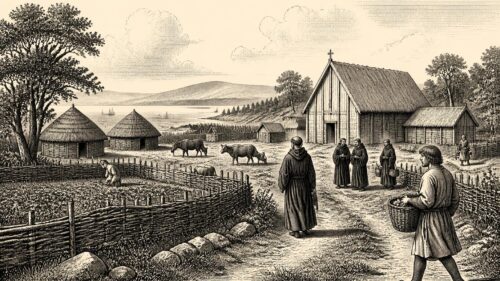
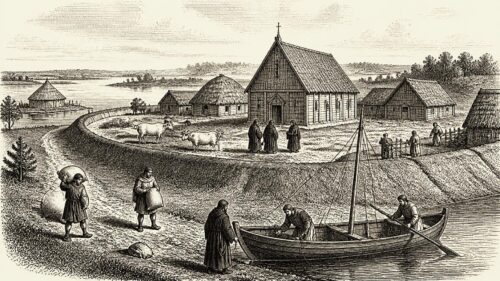
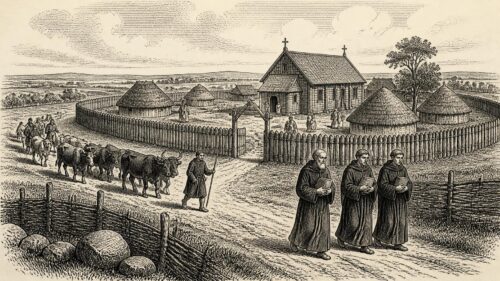
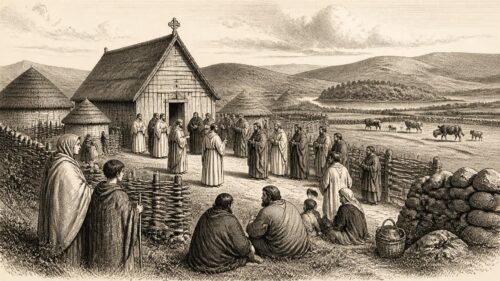
The churches of Ireland were deeply embedded in this political and economic landscape. Major ecclesiastical communities were places of worship, learning, production, hospitality and landholding, linked to secular patrons and kin networks. Their inhabitants included not only clerics but dependants, craftspeople, labourers and visitors. In a hungry year, such communities may have been important places of refuge and redistribution, but the annals give no evidence for specific relief measures in 670. It is better to recognise their potential resources without turning that potential into an undocumented story of organised famine aid.
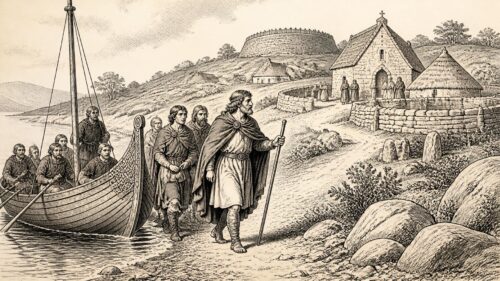
Irish religious and intellectual connections also stretched across the sea. The Ulster annal for AD 670 records the death of Oswiu, king of Northumbria, a major figure in the neighbouring Anglo-Saxon world. His death did not constitute an Irish event, but it mattered to a region tied to Ireland through monasteries, clerics, dynastic contacts and sea routes. In the same annal, Máel Ruba is said to have voyaged to Britain. Tigernach places that voyage in 671, and records his foundation of the church at Applecross only in 673. Thus 670 cannot safely be presented as the year Applecross was founded. The entries do, however, illuminate an Irish Sea world in which religious people, ideas and communities moved between Ireland and Britain.
A Year of Scarcity and Uncertainty
The record for 670 is unusually valuable precisely because it resists an overly tidy narrative. Firmly entered under that year in Tigernach are great snow and famine, alongside several deaths and killings whose contexts remain unknown. The royal assassination traditionally associated with 670 belongs to the same immediate historical moment but is assigned to 671 by another major annal. A battle at Druim Cepais is also listed by Ulster under AD 670, but no participants, outcome or location are supplied; it cannot bear more historical weight than the source allows. These silences are part of the evidence.
What emerges is not a portrait of a settled island advancing uniformly through an “age of saints and scholars”. Ireland in 670 was a society of productive farms, cattle wealth, powerful churches and far-reaching maritime connections, but also one exposed to winter hardship, hunger and political killing. Great snow and famine brought the dependence of daily life on land, animals and stores into sharp relief. At the same time, uncertainty around Sechnassach’s death reminds us that the annals are carefully preserved records, not transparent calendars. Their compressed notices preserve the pressure of the year while leaving modern readers to respect the limits of what can be known.
Primary Sources
- The Annals of Ulster
- The Annals of Ulster, entry for AD 670
- The Annals of Tigernach
- Annals of the Four Masters
- Fragmentary Annals of Ireland
- Chronicon Scotorum
- Annals of Inisfallen
- Exploring the Irish Annals
- Blathmac
- Early Christian Ireland
- Ireland in the Seventh Century: A Tour
- The Powers of Kings
- Agriculture, Settlement and Society in Early Medieval Ireland
- The Economy of Early Medieval Ireland
- Early Medieval Ireland: Archaeology, History and Society
- Forts and Fields: A Study of ‘Monastic Towns’ in Seventh and Eighth Century Ireland
- Reassessing the Irish ‘Monastic Town’
- Isle of the Saints: Monastic Settlement and Christian Community in Early Ireland
- What Do We Really Know About the Early Irish Church?
- Christian Virgins and Their Churches in the Sixth Century: The View from the Seventh