Membership is completely free, giving members unlimited access to all available resources, services, features, and benefits without any restrictions or fees.
Welcome back. Sign in to continue enjoying unlimited access to all available resources, services, features, and member benefits at no cost.
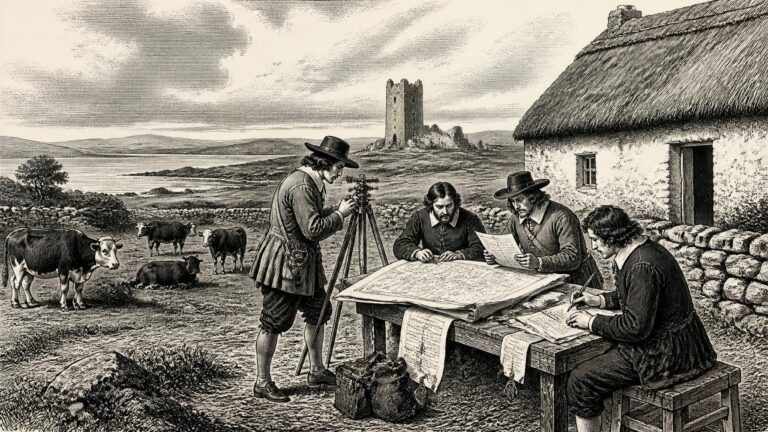
The central firmly dated development came on 8 June, when the Westminster parliament passed An Act for the Assuring, Confirming and Settling of Lands and Estates in Ireland. The long title reveals its purpose. Since the Act for the Settlement of Ireland of 1652, land had been seized, surveyed, assigned, adjudicated and re-assigned through a dense succession of ordinances, instructions and local decisions. The 1657 act confirmed those earlier proceedings. It was intended to give a more dependable legal foundation to the distribution of Irish land among creditors of parliament, army officers and soldiers, Protestant purchasers, and others whom the regime recognised as entitled to grants.
The most firmly dated business of the year concerns transplantation: the Commonwealth policy of removing many Irish Catholic proprietors and others judged liable to forfeiture from Leinster, Munster and Ulster into Connacht and County Clare. This programme had been framed in earlier legislation and orders; 1655 was not its beginning. Yet the surviving proclamations show that it was being pressed, adjusted and policed in that calendar year. On 27 February the Irish government extended the time allowed for transplantation until 20 May, expressly because heavy rains had impeded movement. The detail is revealing. Removal on paper meant travel on winter and spring roads, across rivers and through a landscape made difficult by weather, livestock, carts and the need to find somewhere to live.
The most pressing date was 1 May 1654. Under the Commonwealth settlement, persons judged liable to transplantation were required to remove themselves, their families, dependants, livestock and movable goods to Connacht or County Clare by then. The policy was rooted in the Act for the Settlement of Ireland of August 1652 and instructions issued during 1653; it was not an order born suddenly in 1654. Yet the arrival of the deadline made its implications acute in communities across Leinster, Munster and Ulster. Catholic proprietors and others classed by the regime as transplantable faced the prospect of abandoning inherited estates east of the Shannon for allotted land in the designated western zone.
The year opened with the remnants of the wars still visible in Ulster. Sir Phelim O’Neill, a leading figure in the rising of 1641, had continued resistance after the collapse of larger Catholic armies. Betrayed in Tyrone in February 1653, he was carried to Dublin before the Commonwealth’s high court of justice. The authorities offered him pardon if he would implicate the dead Charles I in the origins of the 1641 rebellion. He refused. On 10 March he was executed for his alleged part in the killings of Protestant settlers during the opening violence of the rebellion; his remains were displayed at Dublin, Drogheda and Dundalk. The execution was intended both as punishment and as a political statement: the new regime would present itself as the avenger of 1641 as well as the conqueror of Ireland.
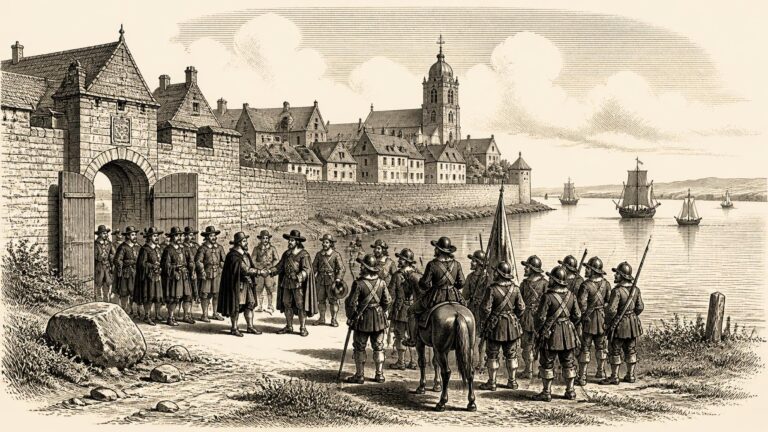
Galway had been under severe pressure since 1651. Sir Charles Coote’s parliamentarian force enclosed it from the landward side, while Commonwealth warships helped deny relief by sea. The town was more than a local stronghold. Its merchants connected western Ireland with Iberia, France and the wider Atlantic; its walls, civic institutions and Catholic elite made it one of the last substantial centres of the Confederate cause. Thomas Preston, an experienced Catholic commander, served as its military governor. The prolonged siege compounded the shortages already experienced by inhabitants and displaced people who had reached the city during the war.