Petty’s Survey1655 CE
In 1655, Cromwellian rule in Ireland advanced from conquest to practical settlement through transplantation, social control, land measurement and changing leadership. Government orders extended deadlines for Catholic proprietors removed to Connacht and Clare, punished noncompliance, restricted Shannon crossings, and expelled Catholics from Dublin. Debate between Vincent Gookin and Richard Lawrence exposed disagreement over transplantation’s economic costs and security aims. Henry Cromwell’s arrival in July made him effective governor after Fleetwood’s departure, altering political balance. William Petty began the Down Survey, using former soldiers and local knowledge to map forfeited land for army arrears and adventurer claims, embedding dispossession in administration.
Dateline
In 1655, Ireland was no longer the principal battlefield of the Cromwellian conquest, but the settlement imposed after the wars entered one of its most consequential working phases. The year’s importance lies less in a single dramatic encounter than in the movement of people, the measurement of land and a change at the centre of government. Orders issued from Dublin made displacement more immediate; William Petty began the immense survey that would turn forfeiture into mapped, distributable property; and Henry Cromwell arrived to become the effective head of an administration still formally led by Charles Fleetwood. For people across the country, peace meant neither security nor a return to the old order. It meant that official decisions reached farms, towns, parish boundaries and family prospects with new force.
Deadlines Across the Shannon
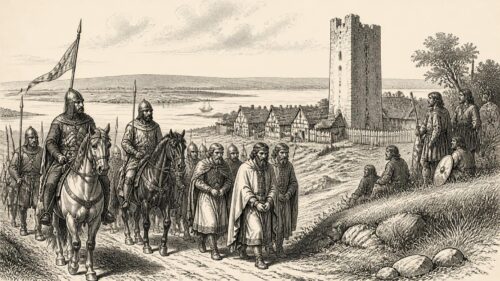
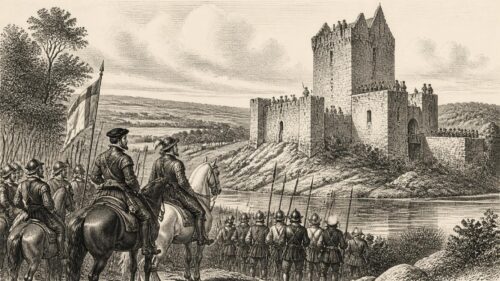
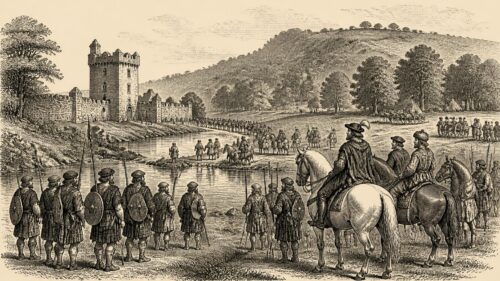
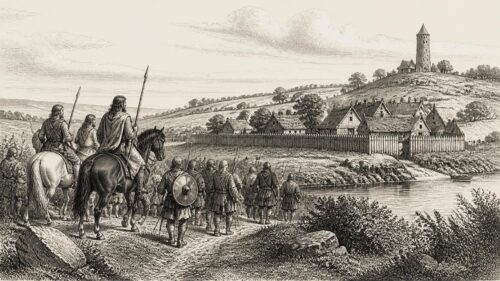
The most firmly dated business of the year concerns transplantation: the Commonwealth policy of removing many Irish Catholic proprietors and others judged liable to forfeiture from Leinster, Munster and Ulster into Connacht and County Clare. This programme had been framed in earlier legislation and orders; 1655 was not its beginning. Yet the surviving proclamations show that it was being pressed, adjusted and policed in that calendar year. On 27 February the Irish government extended the time allowed for transplantation until 20 May, expressly because heavy rains had impeded movement. The detail is revealing. Removal on paper meant travel on winter and spring roads, across rivers and through a landscape made difficult by weather, livestock, carts and the need to find somewhere to live.
Other orders expose the coercive economy of the process. On 7 March, corn belonging to people who had not complied with transplantation requirements was ordered for sale. On 3 April, transplanted people were forbidden to cross back over the Shannon without special licence. Such measures made food, mobility and obedience inseparable. They also caution against treating transplantation as a completed, uniform expulsion. It was a long, uneven administrative project, involving classifications, certificates, exemptions, delays, local bargains and repeated enforcement. Some people were assigned land in the west; others remained under protection, escaped the intended categories, or navigated the system through petitions and patronage. But for those compelled to move, the threat to livelihood and kinship was real and immediate.
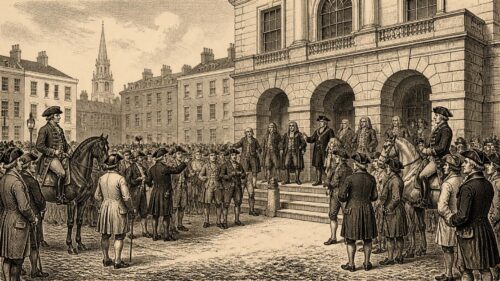
Dublin itself was subjected to sharper social sorting. An order of 12 February authorised the removal of “popish recusants and others” from the city within forty-eight hours. The phrase comes from the state’s own hostile language, but the effect was practical: Catholic residents could be ordered out of the principal administrative and military centre at short notice. The city was not merely a port and market. It was the seat of the council, a garrisoned capital and a place where the governing regime sought to control access, intelligence, worship and political contact. On 24 January a commission had also been authorised to try “tories” and other Irish rebels, evidence that armed resistance and official fears of it had not vanished with the larger campaigns.
A Policy Argued Over
Transplantation was fiercely debated within the victorious interest. In 1655 Vincent Gookin published The Great Case of Transplantation in Ireland Discussed, a pamphlet arguing that the wholesale removal of the Irish population was impracticable and damaging. His objections were not a rejection of English Protestant dominance or of confiscation. Rather, he argued from the needs of settlement: soldiers receiving land often lacked money, stock and agricultural experience, while the removal of established cultivators could leave holdings waste. The pamphlet is important because it recognises, even from within the colonising project, that land could not simply be seized on paper and expected to yield profit.
Richard Lawrence answered in the same year with The Interest of England in the Irish Transplantation Stated, defending the policy in explicitly security-minded terms. The exchange makes clear that the dispute was not between conquest and peace, but over how conquest should be secured. Advocates of removal wanted a Protestant interest less exposed to revenge, rebellion and Catholic influence. Critics feared depopulation, agricultural decline, administrative expense and the failure of newly planted soldiers to make viable farms. The language of the pamphlets was partisan and frequently dehumanising; nevertheless, it records a central fact of 1655. The settlement’s architects knew that the social and economic consequences of transplantation could undermine the very order they sought to build.
Henry Cromwell in Dublin
In July Henry Cromwell, Oliver Cromwell’s third son, reached Dublin to take up duties on the Irish council and as major-general of the forces. His arrival did not instantly make him lord deputy. Charles Fleetwood still held that office, but returned to England in September and did not resume residence in Ireland. From then Henry Cromwell was the effective governor, though he did not receive the formal title of lord deputy until November 1657. That distinction matters: 1655 marked a transfer of practical authority, not a clean constitutional handover.
The change brought a shift in political emphasis. Fleetwood had been closely associated with army radicals and with the most sweeping versions of transplantation. Henry Cromwell sought support among older Protestant landholders and office-holders, including Roger Boyle, Lord Broghill, as well as among more moderate Protestant interests in Dublin. He needed the army, whose arrears and land claims drove much of the settlement, but he also wanted government to look less like the rule of an occupying military interest alone. The direction was tentative and constrained by London, by the Irish council and by Fleetwood’s continuing patronage. Still, the shelving of the most comprehensive transplantation ambitions began in this altered political climate.
Religious life reflected the same tensions. Roman Catholic clergy and worshippers endured a regime which treated Catholicism as politically dangerous; the February removal order in Dublin was one visible expression of that hostility. Yet Protestant Ireland was far from united. Independents, Baptists, Presbyterians and more conservative Protestants disputed the proper shape of church and civil authority. In early 1655 Samuel Winter, provost of Trinity College Dublin and a leading Independent minister, helped establish the Dublin and Leinster Association, an attempt to unite moderate Puritan congregations against radical sectarian influence. The issue was not theological abstraction alone. Control of pulpits, church property, education and state favour helped determine who could speak for the new order.
Chains, Compasses and Claims
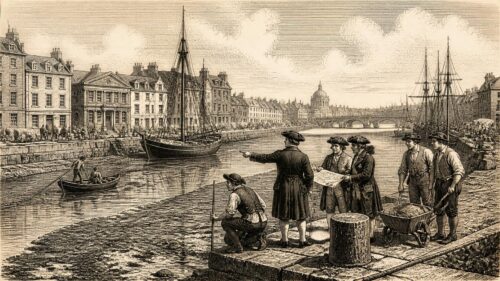
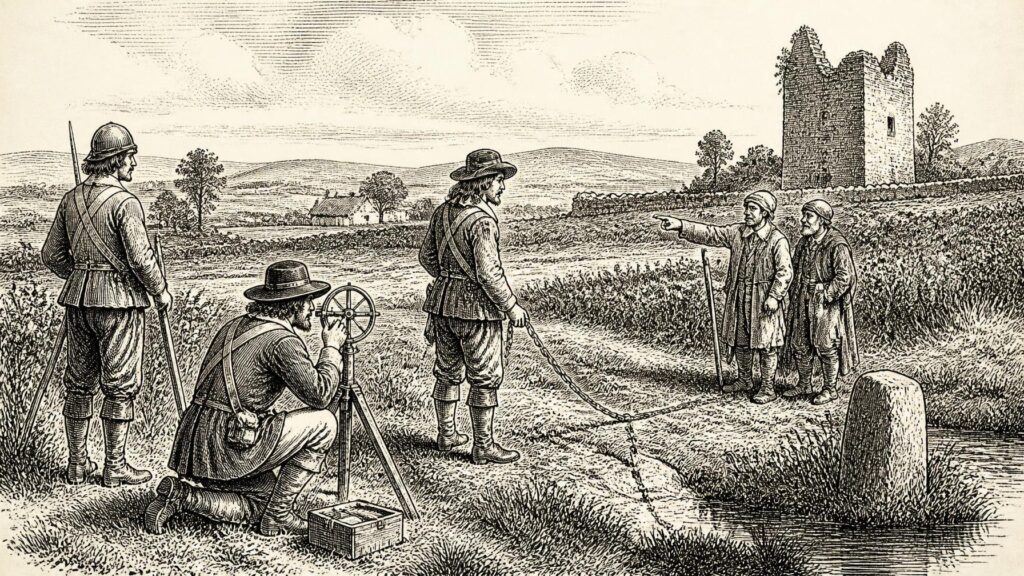
While people were being ordered westward, the state began to make the conquered country legible for redistribution. Petty had secured the contract for a new survey in December 1654, and the work began on 1 February 1655. Detailed instructions of 12 April required the preparation of books of reference giving the information needed for a clear account of forfeited profitable land in each barony. This was the beginning of the enterprise conventionally called the Down Survey: “down” because measurements and topographical detail were laid down on maps, rather than retained merely in written descriptions.
The survey was intended to identify and value land that could satisfy the claims of soldiers owed arrears and of “adventurers”, financiers who had advanced money for the parliamentary war in Ireland. Its ultimate results belong chiefly to 1656–59, and it would be misleading to pretend that Ireland was completely mapped or redistributed during 1655 alone. But the launch year was decisive. Petty’s system combined measuring chains, compass-like circumferentors, standard forms and teams drawn heavily from former soldiers. It transformed military manpower into surveying labour. Men trained to march, endure rough lodging and cross difficult ground were deployed to measure parishes and baronies.
This apparently technical work depended on local knowledge. Surveyors needed people who could identify established bounds, landmarks and the names attached to places and holdings. Irish inhabitants therefore entered the process not simply as passive subjects but, under deeply unequal conditions, as guides, jurors, informants and “meersmen” able to point out boundary marks. Their knowledge helped create the records through which their land might be confiscated. The survey registered townlands, arable and pasture, bogs, rivers, roads, churches, castles and other features that mattered to valuation and control. It was a remarkable exercise in measurement, but its precision served a dispossessing settlement.
A Landscape Reordered
The year thus joined two forms of rule. Transplantation sought to reorder where people could reside; surveying sought to reorder who could claim the ground beneath them. Both worked through documents, deadlines, licences, certificates and local testimony, backed by garrisons and courts. Their effect varied by province. Connacht and Clare were designated as the principal zone for transplanted Catholics, while much of the land surveyed elsewhere was being prepared for allocation to the army and adventurers. The distinction was not simply geographical. It reshaped patterns of landlordship, tenancy, market access and political power that would outlast the Commonwealth.
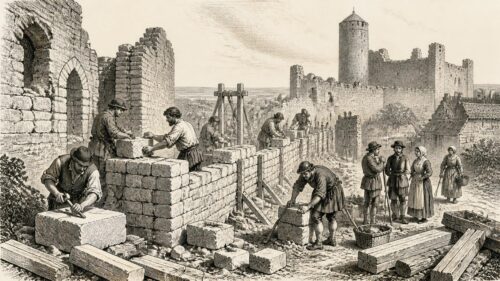
For ordinary households, the evidence permits no single universal story. Some communities were depleted by war, disease and migration inherited from the preceding decade; some former owners fought claims or sought protection; some soldiers looked anxiously for the land promised in lieu of pay; and some settlers required Irish labour, livestock and knowledge to make their grants productive. What can be said securely is that 1655 made the new settlement more concrete. A rain-delayed deadline, a confiscated store of corn, a licence to cross the Shannon, a removal order from Dublin, a chain stretched over a field: these were the instruments through which a conquered Ireland was being remade.

Primary Sources
- Cromwell, Henry | Dictionary of Irish Biography
- Fleetwood, Charles | Dictionary of Irish Biography
- Petty, Sir William | Dictionary of Irish Biography
- Winter, Samuel | Dictionary of Irish Biography
- Lawrence, Richard | Dictionary of Irish Biography
- Statute Law Revision Act 2015
- The Transplantation to Connacht, 1654–58
- The Transplantation To Connacht 1654–1658
- The Down Survey of Ireland
- Petty Papers: ‘Down Survey’ of Various Baronies in Ireland, 1655–1659
- Petty's Instruments: the Down Survey, Territorial Natural History and the Birth of Statistics
- History of the Down Survey (Petty 1851)
- The Civil Survey AD 1654–56, Volume VII: County of Dublin
- The Great Case of Transplantation in Ireland Discussed
- The Interest of England in the Irish Transplantation, Stated
- The Cromwellian Settlement of Ireland
- The Transplanters' Certificates and the Historiography of Cromwellian Ireland
- Ireland Under the Commonwealth: Being a Selection of Documents Relating to the Government of Ireland from 1651 to 1659
- By the Lord Protector: A Proclamation Declaring His Highness Pleasure and Command for Putting in Execution the Laws, Statutes and Ordinances Made Against Jesuits and Priests
- Abstracts of Cromwellian Grants of Land in Ireland, 1653–1659
- The Down Survey: Queenes County and County of Kilkenny
- The History of the Survey of Ireland: Commonly Called the Down Survey, A.D. 1655–6