
Archived: 26 September 2026
Abstract
In 2003, Ireland debated neutrality as United States forces continued using Shannon Airport during the Iraq invasion, prompting protests, parliamentary conflict and an unsuccessful legal challenge. Northern Ireland’s devolved institutions remained suspended despite British-Irish initiatives and IRA decommissioning; November’s election advanced the DUP and Sinn Féin. The Special Olympics World Summer Games, hosted across Ireland, celebrated athletes with intellectual disabilities and volunteering, while Tyrone won an Ulster all-Ireland final. Slowing Celtic Tiger growth nevertheless brought housing construction, immigration and pressure on services. Government plans for smoking restrictions provoked debate, and the Derrybrien peat slide exposed risks associated with wind-energy development.
Read Article

Archived: 10 October 2026
Abstract
In 1849, the Great Famine continued as blight, hunger, eviction, overcrowded workhouses and disease devastated Ireland. Cholera killed 772 of 1,077 recorded cases at Ballinasloe Union Workhouse, illustrating inmates’ vulnerability. Relief depended heavily on inadequate local rates; the May rate-in-aid redistributed Irish, rather than British, resources. The Incumbered Estates Act signalled restructuring of landownership, while emigration, consolidation and evictions altered rural life. Young Ireland leaders were transported, and unrest persisted; Dolly’s Brae exposed sectarian tensions. Victoria’s tour, new Queen’s Colleges and the Dublin–Cork railway projected progress, yet famine, political conflict and social upheaval still continued across the island’s fractured communities.
Read Article
Archived: 17 October 2026
Abstract
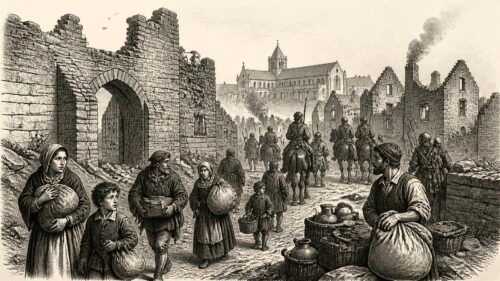
In 1572 Sir Edward Fitton’s Galway court and arrest of the earl of Clanricarde provoked Ulick and John Burke’s rebellion across Connacht. Supported by gallowglasses and Scottish mercenaries, they attacked castles, towns, trade routes and government allies, devastating Athenry and threatening Galway. The crown released Clanricarde to restore peace, but negotiation merely suspended disputes over succession and authority. Meanwhile, rebels unsuccessfully aided James fitz Maurice during the siege and eventual fall of Castlemaine Castle, a key stage in the first Desmond rebellion. Deaths of churchmen, learned men and civilians, alongside reported human and cattle mortality, reflected insecurity amid Tudor rule.
Read Article




