Membership is completely free, giving members unlimited access to all available resources, services, features, and benefits without any restrictions or fees.
Welcome back. Sign in to continue enjoying unlimited access to all available resources, services, features, and member benefits at no cost.
The year’s most dramatic Irish political episode occurred on 1 February, when Daniel O’Connell met John Norcott D’Esterre in a pistol duel at Bishopscourt, near Naas, County Kildare. The immediate quarrel grew from O’Connell’s condemnation of Dublin Corporation as “beggarly”, language that offended members of the city’s Protestant municipal establishment. D’Esterre, a former Royal Marine officer and Dublin merchant, issued the challenge. Both men fired; O’Connell wounded D’Esterre in the hip, and D’Esterre died two days later.
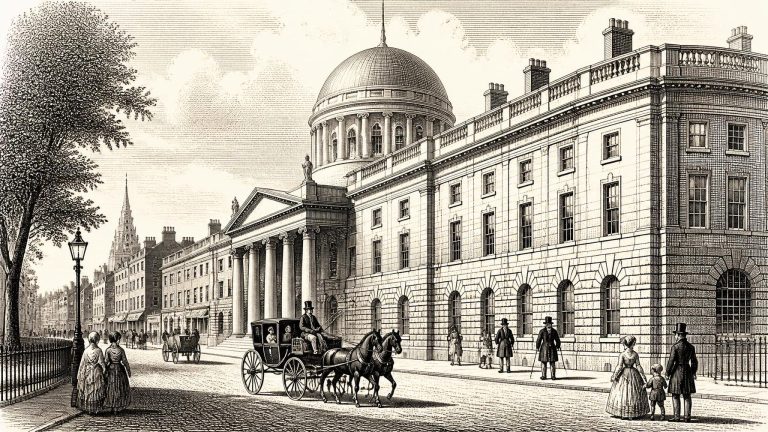
The most eloquent architectural symbol came at College Green. In June, the Bank of Ireland opened its banking hall in the former Irish Houses of Parliament. The bank had acquired the building in 1803; its public opening as a bank in 1808 transformed the working home of the pre-Union legislature into a financial institution. The change did not erase the building’s political associations. Its great chambers, designed for Lords and Commons, continued to proclaim the scale and confidence of the eighteenth-century parliament that had disappeared in 1801. But their new purpose demonstrated a hard fact of the Union: Dublin’s former national legislature had no legislative successor within Ireland.