Ralegh’s Departure1617 CE
In 1617 Ireland was being reshaped by Atlantic commerce, plantation, religious pressure and cultural debate. Sir Walter Ralegh’s Guiana fleet provisioned at Cork before departing, demonstrating the port’s capacity. The Crown, under Lord Deputy Oliver St John, extended administration through land disputes, grants and titles, including Hamilton’s Strabane barony within the incomplete Ulster Plantation. In Munster, the Barrymore family shifted its seat to Castlelyons. An October proclamation renewed action against Catholic clergy, though Catholic practice endured. Gaelic poets contested regional honour and historical authority, while Barnabe Rich’s satire criticised colonial society. These developments reveal negotiated change rather than settled peace.
Dateline
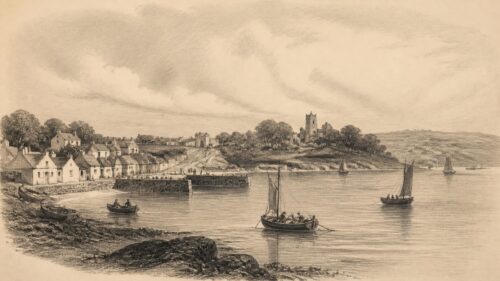
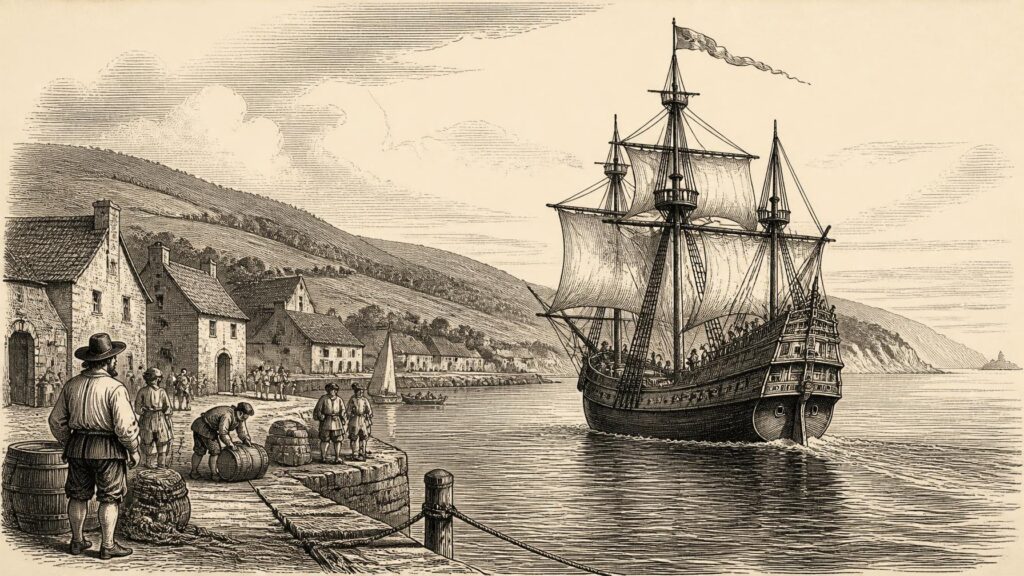
In late summer 1617, Cork briefly became the last Irish shore seen by Sir Walter Ralegh’s expedition to Guiana. Ralegh, long associated with Munster through the estates he had acquired after the Desmond wars, had been released from the Tower of London to lead a venture seeking the fabled wealth of the Orinoco region. Storm and delay brought his fleet into Cork harbour. By 19 August, according to the standard Irish chronology, it had sailed westward again. The departure was a firmly dated Irish episode in an enterprise whose consequences would be felt in London, Madrid and South America rather than in Ireland itself. Yet it also showed how a Cork port, its merchants and suppliers were plugged into the Atlantic world.
Accounts associated with Ralegh’s last Irish visit describe the practical business behind the spectacle: victuals, drink, metal goods and ready money were required for a fleet whose men faced a hazardous transatlantic crossing. Richard Boyle, soon to become earl of Cork, later recalled assisting him. The episode therefore belongs not merely to the biography of a famous adventurer, but to the commercial capacity of southern Ireland. Cork’s harbour could shelter and provision ships undertaking long-distance voyages, even as its hinterland remained shaped by the unsettled inheritance of war, confiscation and plantation.
A Crown Still Reordering Land
James I was king in 1617, and Ireland was governed in his name by Sir Oliver St John, lord deputy since the previous year. The island had emerged from the Nine Years’ War without a fresh general rebellion, but peace did not mean continuity. Dublin Castle’s authority depended increasingly on sheriffdoms, courts, land surveys, patents, military garrisons and individual interventions in local disputes. A letter of 10 April illustrates this administrative reach. The English privy council asked St John to investigate claims made by Florence MacCarthy concerning mortgaged and occupied lands in Munster. MacCarthy’s petition referred to losses suffered during ‘the troubles’ and to his own restraint in England. It is a small, specific record, but an instructive one: landholding, debt, wartime dispossession and access to royal officials could all be entangled in one lawsuit.
On 8 May, James Hamilton, Master of Abercorn, was created Baron Hamilton of Strabane in the Irish peerage. He was only about thirteen. The honour gave the Scottish Hamilton interest a formal place among Ireland’s titled political class and was closely connected with the family’s substantial position around Strabane in County Tyrone. His father, the first earl of Abercorn, had secured plantation proportions in the barony. The new title was thus more than ceremonial. It advertised the Crown’s intention that newly favoured landowning families should put down durable roots in the former O’Neill heartland.
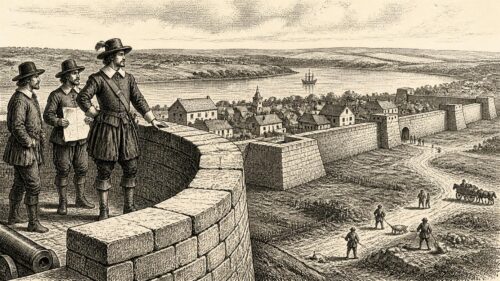
That intention should not be confused with an instant transformation of Ulster. The official plantation, planned after the Flight of the Earls and implemented from 1610, covered Armagh, Cavan, Donegal, Fermanagh, Tyrone and the territory renamed County Londonderry. Undertakers from England and Scotland received large blocks of land on conditions that they introduce British Protestant tenants, build defensible houses or bawns, and help create settled, market-orientated communities. Servitors, selected Gaelic grantees, the established church and Trinity College Dublin also benefited. But the rules were applied unevenly. Although undertakers were formally forbidden Irish tenants, Irish people continued to live and work on many estates. In 1617, the new landscape was real but incomplete: castles, planned villages and farmsteads stood amid older townlands, kin networks and forms of husbandry.
Settlement, Work and Local Power
The year therefore falls within a period of demographic movement rather than at a single dramatic turning point. Scottish settlement in particular was gathering pace during the 1610s, though the larger influx evident in later musters should not be projected too confidently backwards into 1617. Newcomers needed labourers, tenants, artisans, timber, grain, livestock and routes to market; established inhabitants retained vital local knowledge and economic roles. Plantation was a project of displacement and restriction, but it was also a daily negotiation over rent, service, employment and survival.
In Munster, a more local change followed the death of David FitzJames de Barry, Viscount Buttevant, on 10 April. Barryscourt near Carrigtwohill had long been the principal seat of the Barrymore branch of the de Barry family. In 1617 it ceased to be their main residence, with Castlelyons assuming greater importance. The shift should not be exaggerated into a wholly new building programme completed in that one year: the elaborate Barrymore Castle associated with the next generation belongs principally to the 1620s. Nevertheless, the transfer of the family’s centre of gravity is securely connected with 1617 and conveys a wider truth. Old landed families were not simply swept away by the new order; they adapted their residences, marriages, legal titles and alliances to it.
Such adjustments were visible in the built environment. Tower houses and bawns still offered security and status, but political influence increasingly depended on patents, leases, English legal procedure and connections at Dublin or Westminster. The contrast between Strabane’s plantation peerage and the Barry succession in east Cork is revealing. Both involved land, lineage and power, but one marked the Crown’s remaking of an escheated northern lordship, while the other demonstrated the resilience and repositioning of a long-established Munster family.
Pressure on Catholic Ministry
Religion remained inseparable from government. The Church of Ireland had adopted its strongly Reformed Irish Articles in 1615, but its institutional ambitions ran far ahead of widespread religious conformity. Most of the population continued to adhere to Catholic worship, while Catholic bishops, priests, religious orders and continental colleges maintained networks that crossed the Irish Sea and reached Rome, Spain and the Low Countries.
An anti-Catholic proclamation issued by the lord deputy and council in October 1617 made that tension explicit. The surviving printed edict is dated 13 October; some later chronologies place the measure on 17 October. The safer conclusion is that an October proclamation renewed enforcement against Catholic bishops, clergy and others exercising authority derived from Rome, including those educated abroad. It was not the beginning of legal hostility to Catholic ministry, nor proof that the government could eliminate it. Rather, it was a renewed assertion of state power over a religious majority that it could supervise only imperfectly. A Catholic memorial of 1619 recalled that proclamations had been posted widely in the preceding year, an indication both of official pressure and of the continuing visibility of the clergy targeted.
For ordinary people, this religious contest was experienced less through abstract theology than through attendance at worship, the availability of priests, household hospitality, schooling, rites at birth and death, and the risks attached to public office. The Crown’s insistence on conformity also had a political purpose: foreign-trained clergy and papal jurisdiction were treated as possible channels of disloyalty in a kingdom still haunted by memories of Spanish intervention and Irish war.
The Bards’ Unsettled Argument
Irish-language learned culture was meanwhile making its own response to political change. During 1617, the controversy known as Iomarbhágh na bhFileadh, the Contention of the Bards, reached a notable stage. It had begun before that year and would continue afterwards, so it should not be presented as a single June event. What can be placed in 1617 is Tadhg Mac Dáire Mac Bruaideadha’s proposal, in a letter to Lughaidh Ó Cléirigh and northern poets, for a face-to-face disputation that might settle the quarrel. Whether such a meeting took place is not known.
The poems debated the relative honour of the northern and southern halves of Ireland, their dynasties and their inherited claims. Tadhg’s southern perspective was linked to the O’Briens of Thomond; Lughaidh Ó Cléirigh spoke from a northern learned world closely associated with the displaced Ulster aristocracy. The dispute was intellectually elaborate, drawing on genealogy, pseudo-history, poetic precedent and strict professional rules. It could be witty and scornful, but it was also serious cultural work. In a period when traditional Gaelic patrons had been defeated, exiled or reduced, poets debated who had the authority to narrate Ireland’s past and to define its proper hierarchy.
That continuity should not obscure loss. The bardic system still possessed highly trained writers, manuscripts and patrons, but the political world that had sustained it was contracting. The proposed disputation of 1617 is therefore poignant: it demonstrates confidence in the authority of poetry even while the social foundations of that authority were under strain. It also warns against imagining that English administration had silenced Irish intellectual life. The argument was conducted in Irish, on Irish historical terms, and across the regional divisions sharpened by recent conquest.
Print, Ports and a Changing Society
Another writer recorded a very different Ireland. Barnabe Rich published The Irish Hubbub, or the English Hue and Crie in 1617. Rich was an ageing soldier and polemicist who had spent much of his adult life in and around Irish affairs. His book was not an impartial social survey. It was a satire, hostile to Catholicism and prone to sweeping judgement. Still, its targets are revealing: the behaviour of English colonists, Dublin fashions and the widespread use of tobacco. Rich complained that English settlement had not automatically produced moral improvement; indeed, he portrayed colonists as carrying English vice across the water.
His ‘hubbub’ belongs beside the other evidence from 1617. Ralegh’s departing fleet connected Cork to the Atlantic; plantation grants and titles connected Ulster to Scottish and English interests; the October proclamation sought to regulate faith; and the poets’ controversy preserved a learned Gaelic public sphere. These were not separate worlds. They overlapped in towns, estates, households and courts. Ireland in 1617 was not at peace in the sense of being settled. It was being reordered—by shipping and commerce, by legal claims and land grants, by religious coercion, and by competing languages of memory and belonging.
Source References
Hover over a number to see the source. Select it to open the source.

- [1] State Papers Ireland 1509–1782: government papers on Irish affairs
- [2] Statute Law Revision Act 2015
- [3] Edict publié contre les Catholiques d'Irelande, par le Viceroy Olivier Sainct-Jean et le Conseil
- [4] Letter Book of Florence Mac Carthy Reagh, Tanist of Carbery, Mac Carthy Mór
- [5] Ralegh, Sir Walter
- [6] CELM: Sir Walter Ralegh
- [7] Ralegh's Last Voyage: Being an Account Drawn Out of Contemporary Letters and Relations
- [8] The Ulster Plantation
- [9] Plantation People
- [10] Movement of British Settlers
- [11] Letter of James I to Sir Oliver St John concerning the undertakers of Strabane Barony, 18 October 1616
- [12] Iomarbhaidh na bhFileadh: The Contention of the Bards
- [13] The O'Gara Manuscript: Its History and Literary Contents
- [14] Ó hEódhusa (O'Hussey), Eochaidh
- [15] Rich, Barnaby (Barnabe)
- [16] The Irish Hubbub, or, The English Hue and Crie
- [17] A Looking for Her Majesty, Wherein to View Ireland
- [18] James Ussher
- [19] Barryscourt Castle
- [20] Unpublished Cork Inquisitions in the Royal Irish Academy
- [21] Barryscourt, Cork
- [22] Annals of the Four Masters
- [23] Jones, Roger
Primary Sources
- State Papers Ireland 1509–1782: government papers on Irish affairs
- Statute Law Revision Act 2015
- Edict publié contre les Catholiques d'Irelande, par le Viceroy Olivier Sainct-Jean et le Conseil
- Letter Book of Florence Mac Carthy Reagh, Tanist of Carbery, Mac Carthy Mór
- Ralegh, Sir Walter
- CELM: Sir Walter Ralegh
- Ralegh's Last Voyage: Being an Account Drawn Out of Contemporary Letters and Relations
- The Ulster Plantation
- Plantation People
- Movement of British Settlers
- Letter of James I to Sir Oliver St John concerning the undertakers of Strabane Barony, 18 October 1616
- Iomarbhaidh na bhFileadh: The Contention of the Bards
- The O'Gara Manuscript: Its History and Literary Contents
- Ó hEódhusa (O'Hussey), Eochaidh
- Rich, Barnaby (Barnabe)
- The Irish Hubbub, or, The English Hue and Crie
- A Looking for Her Majesty, Wherein to View Ireland
- James Ussher
- Barryscourt Castle
- Unpublished Cork Inquisitions in the Royal Irish Academy
- Barryscourt, Cork
- Annals of the Four Masters
- Jones, Roger