dairy farmers

Dairy Expansion

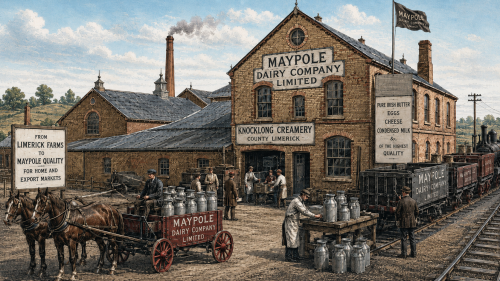
County Limerick’s dairy economy was changing rapidly around 1900 as the Maypole Dairy Company strengthened the connection between rural milk production and large-scale commercial retailing. At Knocklong, where the company had built a creamery during the mid-1890s, farmers delivered milk for mechanical separation and butter-making rather than producing every finished article within their own homes. The operation linked surrounding farms with a business selling provisions across Britain. For local suppliers, the creamery offered regular access to a wider market, while the company gained a dependable source of Irish butter for an expanding network of urban shops.
Creamery Rivalry

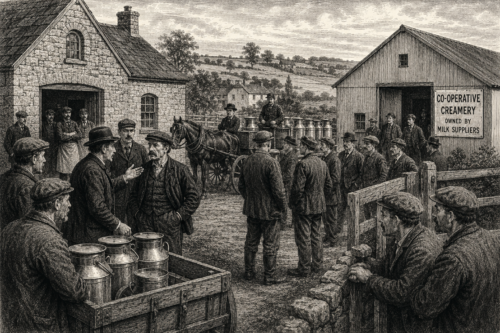
Local disputes are arising between co-operative creameries owned by milk suppliers and privately operated concerns seeking to retain control of established dairying districts. The rivalry is especially significant in County Limerick, where cattle, milk and butter provide income for farmers, labourers, carriers and merchants. Co-operative organisers argue that producers should collectively own the machinery through which their milk is processed and marketed. Private proprietors answer that independently managed businesses can offer efficient service without requiring farmers to invest capital, accept committee authority or assume responsibility for commercial losses.

Creamery Contest

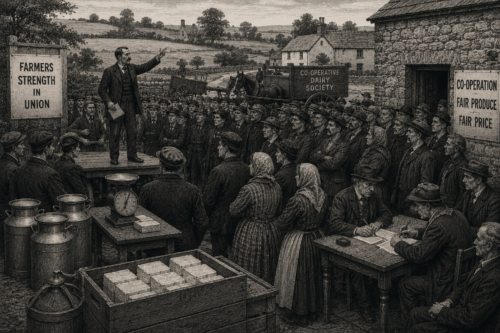
Agricultural co-operation is challenging the private commercial control long exercised over Irish butter production and marketing. Farmer-owned creameries allow milk suppliers to combine their resources, process milk by machinery and sell butter through organisations answerable to their members. The movement carries particular importance in County Limerick, where dairying supports farmers, labourers, carriers, merchants and rural households. Supporters argue that producers should receive a greater share of the value created from their milk instead of remaining dependent upon private creamery proprietors, butter buyers and commercial intermediaries whose interests may not coincide with those of farming communities.