


Related Archive: George Berkeley

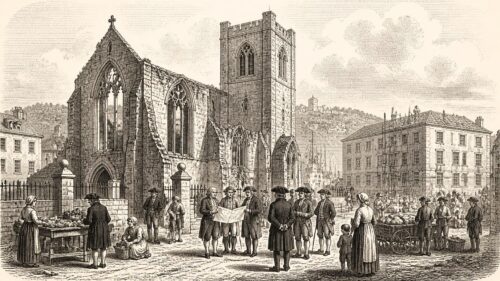
Cork Workhouse

Cork Workhouse

Archived: 13 October 2026

Abstract

In 1735, Ireland’s Protestant governing system addressed poverty, security and economic improvement through parliamentary proposals, proclamations and print. Dublin’s parliament, constrained by Poynings’ Law and dominated by property-owning Protestants, considered measures reinforcing Catholic exclusion from juries and restricting mixed marriages. Cork advanced plans for St Fin Barre’s reconstruction and a workhouse combining relief, labour discipline, foundling care and Protestant instruction; legislation passed in 1736. Road schemes and liquor-credit regulation reflected social concerns. Proclamations pursued robbers across counties. George Berkeley’s Querist promoted debate on employment, consumption and national resources, while Protestant schooling and Ulster Scots print illustrated confessional and cultural currents.

Read Article

Mercer's Hospital

Mercer's Hospital

Archived: 13 October 2026

Abstract

In 1734, Ireland’s Protestant governing order reinforced religious exclusion while managing finance, charity and urban growth. Parliament, restricted by property, Protestant franchise and Poynings’ Law, aided creditors after the failure of Burton’s banking partnerships and barred Catholic-connected converts from magistracy. George Berkeley became bishop of Cloyne, beginning an episcopate later associated with social concerns. Dublin’s Mercer’s Hospital opened ten beds for sick poor people, supported by voluntary philanthropy and unpaid medical service. Cultural life expanded through Faulkner’s Swift edition, newspapers and the Aungier Street theatre, after damage at Smock Alley. Official proclamations against crime indicated anxieties over security and disorder.

Read Article