Mercer’s Hospital1734 CE
In 1734, Ireland’s Protestant governing order reinforced religious exclusion while managing finance, charity and urban growth. Parliament, restricted by property, Protestant franchise and Poynings’ Law, aided creditors after the failure of Burton’s banking partnerships and barred Catholic-connected converts from magistracy. George Berkeley became bishop of Cloyne, beginning an episcopate later associated with social concerns. Dublin’s Mercer’s Hospital opened ten beds for sick poor people, supported by voluntary philanthropy and unpaid medical service. Cultural life expanded through Faulkner’s Swift edition, newspapers and the Aungier Street theatre, after damage at Smock Alley. Official proclamations against crime indicated anxieties over security and disorder.
Dateline
In 1734, Ireland’s public life was shaped less by a single dramatic crisis than by a sequence of revealing developments: legislation that tightened the Protestant state’s religious boundaries, a new bishop’s arrival in Cloyne, the opening of a small hospital for Dublin’s sick poor, and signs of an increasingly busy urban culture in print, theatre and news. The year belongs to an Ireland governed under George II, whose authority was exercised through Dublin Castle, an established Church of Ireland and a restricted Irish parliament. It was also an Ireland whose Catholic majority remained subject to the accumulated disabilities usually called the penal laws.
Several dates can be fixed. The parliamentary session ended on 29 April; George Berkeley was consecrated bishop of Cloyne on 19 May; and by 17 August ten beds had been prepared for patients at the new Mercer’s Hospital in Stephen Street. Other details require more caution. We can use the year’s acts, proclamations, surviving newspapers and later institutional histories to see what contemporaries regarded as pressing concerns, but they do not furnish a complete account of every parish, household or farm in Ireland.
A Parliament of Property
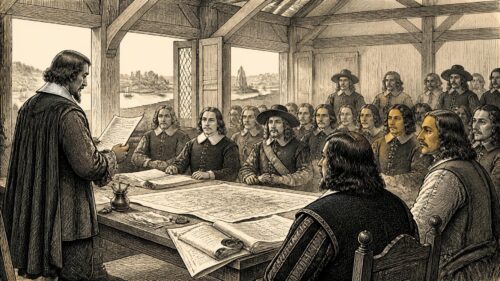
The Irish parliament sitting in Dublin was not a representative national assembly in a modern sense. Its Lords included peers and Church of Ireland bishops; its Commons was elected on a narrow Protestant property franchise, with many boroughs controlled by patrons. Under Poynings’ Law, legislation required prior approval through the English-based machinery of government. Yet the parliament was important to the Protestant political class: it dealt with local finance, private estates, public administration and legislation, while its members remained acutely sensitive to the limits placed upon Irish legislative autonomy.
The session that closed on 29 April 1734 demonstrated the practical, property-centred work of this system. One measure dealt with the collapse and liquidation of banking partnerships associated with Samuel Burton, Daniel Falkiner, Benjamin Burton and Francis Harrison. The legislation protected creditors and heirs while arranging the disposal of substantial assets. Such an act is a reminder that Dublin’s commercial world rested not only on shop counters and quays, but on credit, marriage settlements, landed security and family networks. The statutory record gives the debt connected with Burton’s bank as more than £65,000, a very large sum.
This was no Bank of Ireland: that institution lay decades in the future. Rather, it was a world of private bankers whose failure could entangle merchants, landowners, widows, children and creditors. Parliament’s intervention was therefore both an economic necessity and an assertion that private financial failure had public consequences. For most labouring people, who possessed neither parliamentary influence nor large deposits, the immediate economy remained local: rents, wages, seasonal employment, food prices, petty credit and the availability of work. But the bank-relief act shows the wider monetary structure on which elite property and urban trade depended.
Religious Boundaries Reinforced
The same closing day brought an act directed at converts from Roman Catholicism. It disqualified a convert from serving as a justice of the peace if his wife was Catholic or if children under sixteen were educated as Catholics. Its effect was particularly pointed because conversion could offer a route around exclusions imposed upon Catholics. The state now sought to police not merely an office-holder’s formal conformity, but the religious life of his household.
This measure should not be mistaken for a new general prohibition on Catholic worship; instead, it reinforced a long-standing legal architecture of exclusion. Catholics could not sit in parliament and faced restrictions affecting land, education, office-holding and the professions. The law also exposed an anxiety within the governing order: nominal conformity, it feared, might conceal continuing Catholic family and community ties. In January 1733/34, Primate Hugh Boulter had acknowledged in correspondence that enforcement against Catholic solicitors was difficult, owing to the danger and unpopularity of informing. The act of April 1734 thus belongs to a continuing attempt to make confessional identity administratively legible and enforceable.
Its human meaning was intimate. Education, marriage and the upbringing of children were matters negotiated inside homes as well as proclaimed in statute. The law made them tests of political trustworthiness. It also illustrates a central paradox of eighteenth-century Ireland: the regime was secure enough to experience a long period without large-scale warfare, but remained anxious about land, loyalty and religion after the upheavals of the preceding century.
Berkeley Comes to Cloyne
On 19 May, George Berkeley was consecrated in St Paul’s Church, Dublin, as Church of Ireland bishop of Cloyne. Born near Kilkenny in 1685 and educated at Trinity College Dublin, Berkeley was already internationally known for philosophical writing that challenged conventional ideas about matter and perception. His appointment placed a celebrated thinker in a modest south Munster diocese, stretching across parts of Cork and east Cork’s hinterland.
The consecration was firmly dated; the significance that later attached to it should be stated as later development, not projected backwards too easily. Berkeley had only begun his episcopate in 1734. Nonetheless, the appointment mattered because he would spend most of the rest of his life associated with Cloyne, combining pastoral responsibilities with writing and, in time, schemes concerned with Irish poverty, health and employment. His later instructions encouraging clergy to use Irish where appropriate are especially suggestive of the linguistic realities of the diocese. In 1734, however, the immediate fact was institutional: a new Church of Ireland bishop took charge of a rural see in a kingdom where the established church served a minority.
Ten Beds in Stephen Street
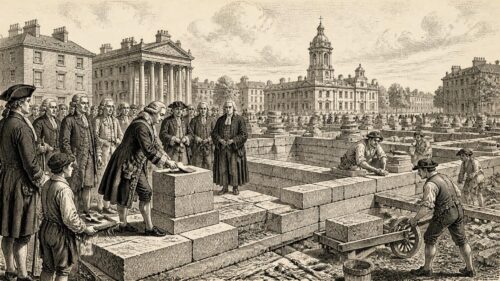
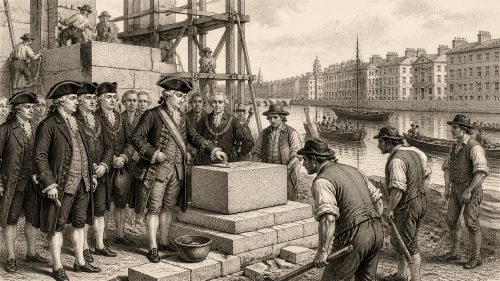
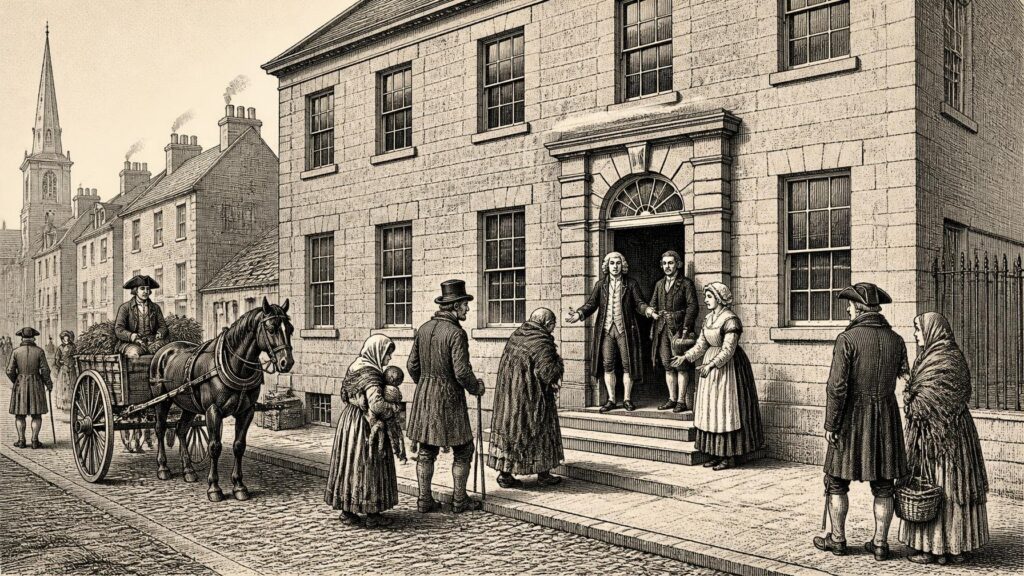
The most tangible new institution of the year was Mercer’s Hospital. Mary Mercer, a Dublin woman of means, had provided a stone house in Stephen Street that had previously served poor girls. With the assistance of clergy, civic figures, surgeons and subscribers, it was converted for the reception of sick poor people. By 17 August 1734, ten beds had been fitted and, according to later accounts drawing on the hospital’s early history, were immediately occupied.
Ten beds may sound slight, and it was slight beside the scale of sickness and poverty in an expanding city. That is exactly why the foundation is revealing. Hospital care was not a universal public service. Most illness was managed at home, if a home and family support were available; medical attention and medicines depended heavily on money, patronage, charity, religious institutions and voluntary subscriptions. Mercer’s offered an organised refuge for people whose illness was serious enough to require sustained attention and who lacked the means to pay privately.
The hospital’s early model joined philanthropy to professional service. Physicians and surgeons acted without fee, while donors helped supply medicines and equip the premises. It stood within a small but growing Dublin network of voluntary hospitals: the Charitable Infirmary had been founded earlier, and Dr Steevens’ Hospital had opened in 1733. Mercer’s was not simply a benevolent gesture by one benefactor. It depended on the continuing cooperation of governors, medical men, churchmen, civic authorities and subscribers. Its endurance would depend on that fragile mixture of charitable wealth and voluntary labour.
Mary Mercer’s wider charitable intentions also need context. Her endowment supported a Protestant educational project for poor girls, later associated with Rathcoole. Such philanthropy did real practical work, but it also reflected the confessional assumptions of the age. In 1734, care for the poor was rarely detached from the aim of shaping moral, religious and working lives. The opening of a hospital therefore offers both an important story of relief and a window onto the ordered, Protestant charitable culture of Dublin.
A City of Prints and Performances
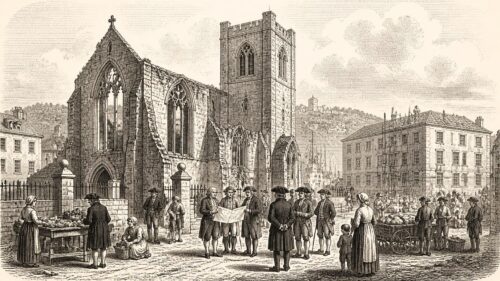
Dublin’s cultural institutions were active but physically precarious. In March, part of the upper gallery at the ageing Smock Alley Theatre collapsed. Evidence describes it as a partial collapse rather than a catastrophe on the scale of earlier failures at the site; reports do not responsibly permit a precise casualty narrative. The incident nevertheless exposed the risks of an old entertainment building erected on ground near the Liffey. It also accelerated a shift in the city’s theatrical geography. A new Theatre Royal in Aungier Street opened in March, while the old Smock Alley premises were later rebuilt.
The episode mattered because theatres were social spaces as well as stages. Audiences were divided by price and position: boxes, pit and galleries brought together elite patrons, middling urban spectators, apprentices and servants. A gallery failure was a material reminder that urban pleasure, crowding, property speculation and safety could collide. Dublin in 1734 was already a city where commercial amusement had a visible place, even if access remained unequal.
Print made a different sort of public arena. In November, the printer and stationer George Faulkner began issuing a Dublin edition of Jonathan Swift’s Works. The enterprise was ambitious: Swift was dean of St Patrick’s Cathedral, Ireland’s most famous living writer, and a politically charged figure after the Drapier’s Letters and A Modest Proposal. Faulkner’s project was promoted as a corrected text and developed into a multi-volume edition. It marked the capacity of the Dublin book trade to produce prestigious editions rather than merely receive London publications.
Newspapers similarly connected the capital to wider worlds. The Dublin Evening Post, printed from 1732, carried shipping, commercial and foreign intelligence alongside local notices. News arrived through correspondence and ships, and Dublin printers freely reprinted reports from London and continental gazettes. A surviving issue from late September 1734 gives a rare physical trace of this information culture. For merchants, officials, readers in coffee houses and those able to purchase or hear newspapers read aloud, Ireland was being linked daily to Atlantic, European and imperial events.
Connections Beyond Ireland
One Irish-born financier’s disappearance in 1734 underlines those connections. Richard Cantillon, probably born in County Kerry and active in French, English and international finance, vanished after a fire destroyed his London house on 14 May. He was presumed dead, but later evidence has led historians to treat his fate as uncertain. It is therefore wrong to state simply that he died in 1734. His later-published Essai sur la nature du commerce en général became a landmark of economic thought, but in the year itself the relevant point is the reach of an Irish Catholic family into the banking networks of Paris, London, Amsterdam, Cadiz and beyond.
By year’s end, Dublin Castle was still attending to security. Proclamations in August offered pardon and reward in connection with the murder of Paul Farrell; in December, orders called on named categories of robbers and rapparees to surrender. These notices should not be inflated into evidence of a nationwide uprising. They do show, however, that state authority was unevenly experienced and that crime, violence and fears of disorder remained part of official business.
Thus 1734 in Ireland was a year of constrained governance and incremental institution-building. Parliament protected creditors and policed religious households; Berkeley entered a diocese that would shape his later public concerns; and Mary Mercer’s converted house received its first sick poor. Meanwhile, a theatre’s failing gallery, a printer’s Swift edition and a newspaper’s columns revealed an urban society in motion. The year’s clearest legacy was not a battle or constitutional settlement, but the modest opening of ten hospital beds: a practical intervention in a city where need was widespread and organised care still scarce.

Primary Sources
- Berkeley, George | Dictionary of Irish Biography
- Cantillon, Richard | Dictionary of Irish Biography
- The Correspondence of George Berkeley
- A Swift’s Chronology | Jonathan Swift Archive
- An Introduction to Gulliver’s Travels | Jonathan Swift Archive
- Faulkner, George | Dublin Music Trade
- News Gathering | Ask About Ireland
- Holdings: The Dublin Evening Post | National Library of Ireland
- Holdings: Extracts from ‘The Dublin evening-post’, mainly relating to social life for the years 1734–1736 | National Library of Ireland
- History of Parliament in Ireland | Houses of the Oireachtas
- Oireachtas L&RS Display Case | Houses of the Oireachtas
- Introduction: Background to Eighteenth-Century Ireland | Ulster Historical Foundation
- Religion: Background to Statutes | Ulster Historical Foundation
- Statutes Passed by the Irish Parliament, 1692–1800: Relief of Creditors of Burton’s Bank | Ulster Historical Foundation
- The Irish Popery Laws: A Study of Eighteenth-Century Legislation and Behavior | The Review of Politics
- A History of the Penal Laws against the Irish Catholics
- Statute Law Revision Act 2015
- Pre-Union Irish Statutes | Irish Statute Book
- The Statute-Law of Ireland Common-Placed | Folger Shakespeare Library
- Survey of Hospital Archives in Ireland | National Archives of Ireland
- The Picture of Dublin for 1811
- Further Hospital Histories | Chapters of Dublin
- Glebe House, Main Street, Rathcoole | Buildings of Ireland
- Smock Alley Theatre: Research Guide for Archival Sources
- For Gen’ral Satire Was the Stage Design’d | Revista de Estudos Anglo-Americanos