

Related Archive: Valentia Island

Cullen’s Red Hat, Valentia Wire

Cullen’s Red Hat, Valentia Wire

Archived: 10 October 2026

Abstract

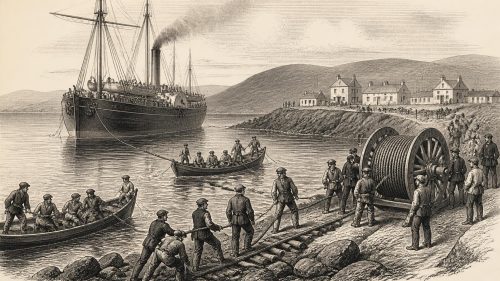
In 1866, Ireland experienced political repression alongside religious, educational and technological change. Parliament suspended habeas corpus amid fears of Fenian conspiracy, enabling 752 arrests and weakening republican organisation before the failed 1867 rising. Fenian raids into Canada highlighted nationalism’s Atlantic dimension, while Paul Cullen’s elevation as Ireland’s first cardinal symbolised Catholic institutional confidence, also visible in Belfast’s St Peter’s Church. Anne Jellicoe founded Alexandra College, extending advanced educational opportunities for women. Railway expansion to Westport and changing livestock agriculture altered rural life. Most dramatically, the successful Valentia–Newfoundland telegraph cable connected Ireland to North America, making Kerry a global communications hub.
Read Article

Valentia Signals, Lombard Oaths

Valentia Signals, Lombard Oaths

Archived: 10 October 2026

Abstract

In 1858, Ireland experienced political, technological and social change. James Stephens founded the secret Irish Republican Brotherhood in Dublin, supported by Irish-American networks and committed to republican revolution. Valentia Island became the Irish terminus of the first transatlantic telegraph cable, briefly linking Britain and North America before failure. Post-Famine society continued to be reshaped by emigration, altered farming, poverty administration and Griffith’s Valuation. Infrastructure included Ballinacourty lighthouse, while Edward James Harland acquired Belfast’s Queen’s Island shipyard. Dundalk opened a free public library. These developments revealed uneven modernisation, connecting Ireland more closely with Atlantic migration, imperial commerce, industry and revolutionary politics.

Read Article