
Cullen’s Red Hat, Valentia Wire1866 CE
In 1866, Ireland experienced political repression alongside religious, educational and technological change. Parliament suspended habeas corpus amid fears of Fenian conspiracy, enabling 752 arrests and weakening republican organisation before the failed 1867 rising. Fenian raids into Canada highlighted nationalism’s Atlantic dimension, while Paul Cullen’s elevation as Ireland’s first cardinal symbolised Catholic institutional confidence, also visible in Belfast’s St Peter’s Church. Anne Jellicoe founded Alexandra College, extending advanced educational opportunities for women. Railway expansion to Westport and changing livestock agriculture altered rural life. Most dramatically, the successful Valentia–Newfoundland telegraph cable connected Ireland to North America, making Kerry a global communications hub.
Dateline
A Year of Contrasts
In 1866 Ireland stood at a remarkable intersection of coercion, religious confidence and modern connection. The island was still governed from Westminster through Dublin Castle, and official fears of Fenian conspiracy brought an extraordinary curtailment of civil liberty. Yet the same year supplied striking signs of institutional growth: Paul Cullen became the first Irish cardinal; Alexandra College opened a new path in women’s advanced education; a major Catholic church was dedicated in industrial Belfast; and the Atlantic cable made the remote Kerry coast a gateway for messages between Europe and North America. These were not parts of a single national programme. They belonged to communities with different loyalties, resources and hopes. Together, however, they show an Ireland whose political future was deeply contested while its religious, educational and communications worlds were being remade.
Suspicion and Suspension
The most immediate political fact of 1866 was the Fenian alarm. The Irish Republican Brotherhood had been badly damaged by the September 1865 suppression of its newspaper, The Irish People, and by the arrests and convictions of leading organisers. James Stephens’s escape from Richmond Bridewell in Dublin in November 1865 nevertheless revived official anxiety. The end of the American Civil War also mattered greatly. It released large numbers of Irish-born or Irish-American veterans with military experience, while Atlantic networks of money, travel, newspapers and personal contacts made the prospect of assistance from the United States seem both possible to republicans and dangerous to the authorities.
On 17 February 1866 Parliament suspended habeas corpus in Ireland. This did not suspend every law or establish martial law, but it empowered the Irish executive to arrest and detain people suspected of conspiring against the Crown and government without the ordinary prompt judicial challenge associated with the writ. Ministers presented the measure as a response to a revolutionary organisation preparing violence; its opponents regarded it as a drastic assertion of executive power over a country already alienated by its political subordination. The practical result was a wide police operation against known and suspected Fenians, extending beyond the small circle of newspaper defendants captured in 1865.
The figures later placed before Parliament indicate the breadth of the crackdown. By the end of November 1866, 752 people had been arrested under the suspension legislation; this total should not be read as proof that all were active conspirators, but it conveys the scale of official suspicion and disruption. Local organisations lost organisers, couriers and prospective recruits. Some men were imprisoned; others went into hiding, left for Britain or America, or abandoned the movement. The suspension was renewed in August, confirming that Dublin Castle and Westminster did not regard the danger as passing. It is important not to project the Fenian Rising backwards into 1866: the failed insurrection occurred in March 1867. But 1866 was the year in which preventive arrests, surveillance and detention decisively shaped the ground on which that later rising would be attempted.
An Atlantic Republican Cause
Fenian politics in 1866 were never confined to Ireland. Across the Atlantic, the Fenian Brotherhood had split between rival leaderships and strategies. One current remained more closely aligned with James Stephens and preparations in Ireland; another embraced an audacious effort to strike Britain through its North American colonies. In late May and early June, Fenian forces crossed from the United States into Canada West, now Ontario. They won an initial engagement at Ridgeway on 2 June but could not hold their position and withdrew to the United States shortly afterwards.
The raids did not liberate Ireland, and they exposed divisions, weak co-ordination and the limits of American governmental tolerance. Still, they were directly relevant to Ireland. Their participants included Irish emigrants and veterans whose nationalism had been formed by exile, civil war and the memory of the Famine. News travelled back across the ocean, feeding British fears that Ireland could be supplied with trained men and arms. For people at home, the episode was a reminder that Irish political arguments were increasingly transnational: the emigrant was not simply someone lost to the island, but potentially a source of remittances, information, ideology and armed intervention.
Fenianism also posed a challenge to established Catholic leadership. Cardinal-to-be Paul Cullen strongly opposed oath-bound revolutionary societies, judging them dangerous to religion, social order and the constitutional interests of Catholics. His position did not make Irish Catholics politically uniform, nor did it erase resentment at landlordism, limited representation or the privileged constitutional position of the Established Church. It did, however, underline a major division within nationalist Ireland: whether national advancement should be pursued through disciplined constitutional action, clerically approved community institutions, or secret preparations for a republic won by force.
Cullen and the Catholic Public Sphere
On 22 June Pope Pius IX created Paul Cullen, Catholic archbishop of Dublin, a cardinal priest of San Pietro in Montorio. Cullen was the first Irishman raised to the cardinalate. The honour had a significance far beyond personal prestige. After decades spent in Rome and then at the head of the Irish hierarchy, Cullen had worked to make Irish Catholicism more centrally organised, more closely connected to the papacy and more assertive in education, charitable provision and public morality. His elevation recognised both his standing in Rome and the growing institutional strength of the Church in Ireland.
The new cardinal’s outlook was resolutely ultramontane: Rome, not local political enthusiasm, was to be the principal religious authority. That could bring him into conflict with liberal Catholics, nationalists and those who disliked clerical influence. Yet it also reflected the experience of a Catholic population that had built churches, schools, religious orders and devotional networks on a formidable scale since emancipation. Cullen’s red hat was therefore a symbol of changed circumstances. A church long restricted in public status now possessed the personnel, buildings and confidence to claim a commanding place in Irish life, even though the Church of Ireland remained established and supported by state arrangements.
That expanding Catholic presence was visible in Belfast on 14 October, when St Peter’s Church on Derby Street was opened. Built in Gothic style from Scrabo stone, with its twin towers intended to be seen on the approaches to the growing town, it was a substantial assertion of Catholic permanence in a place usually associated with Protestant commercial and industrial power. The congregation packed the church before the dedication began. It would be misleading to imagine Belfast in 1866 as neatly divided into fixed blocs, but the building’s scale and conspicuous setting register the demographic and civic confidence of the city’s Catholic community.
Learning Beyond Custom
Another quieter but consequential foundation came in Dublin, where Anne Jellicoe established Alexandra College in 1866. A Quaker educational reformer, Jellicoe sought advanced instruction for women at a time when Irish universities did not admit them to degrees. The college’s early ambition was not a promise of immediate equality: opportunities depended heavily on class, religion and family means, and most Irish girls had no access to such education. Nonetheless, its curriculum and purpose challenged the assumption that female education should stop at accomplishments suited to domestic life or governess work.
Alexandra College belongs in the history of 1866 precisely because it reveals another Ireland operating alongside the drama of conspiracy and repression. Reform was being pressed through voluntary initiative, denominational networks and private philanthropy. Its foundation predated the later campaigns that opened examinations and degrees to women, but it helped create the intellectual preparation and institutional precedent those campaigns required. In an era when education was entangled with denominational rivalry, the college also illustrates the particular role that Quaker and Protestant reformers could play in widening social possibilities.
Rails, Cables and Rural Change
On 28 January the Midland Great Western Railway reached Westport. The extension strengthened the link between Mayo and Dublin’s commercial world, reducing the isolation of a western market town and making travel, mail and the movement of goods more predictable. Railways did not abolish the disadvantages of peripheral regions, nor did they rescue households with too little land or income. They did, however, alter the practical geography of the island. For farmers, traders, seasonal workers and emigrants, access to a railhead could reshape the journey between parish, port and city.
Irish agriculture remained the foundation of most livelihoods, but it was changing. Official returns recorded about 3.022 million cattle, 4.029 million sheep and 1.236 million pigs in 1866, all higher than in 1865. The figures point to the continuing movement towards livestock and pasture that had accelerated after the Famine, although mixed farming and tillage remained important. At the same time, the acreage under crops fell compared with the preceding year. Such national totals cannot tell us whether an individual smallholder prospered: rural Ireland still contained sharp inequalities of holding size, security and income, while emigration continued to drain villages and families of younger people.
Animal disease was an additional concern. Parliament’s Cattle Disease Act for Ireland, passed in March, prepared a system of local rates and compensation should rinderpest, then devastating herds in Great Britain, appear in Ireland. The Act should not be mistaken for evidence of a comparable Irish outbreak in 1866; it was a precaution against one. Its existence nevertheless shows how exposed a livestock economy was to events beyond the island, and how the state increasingly used statistics, inspectors, policing and local administration to manage economic risk.
Valentia’s Global Shore
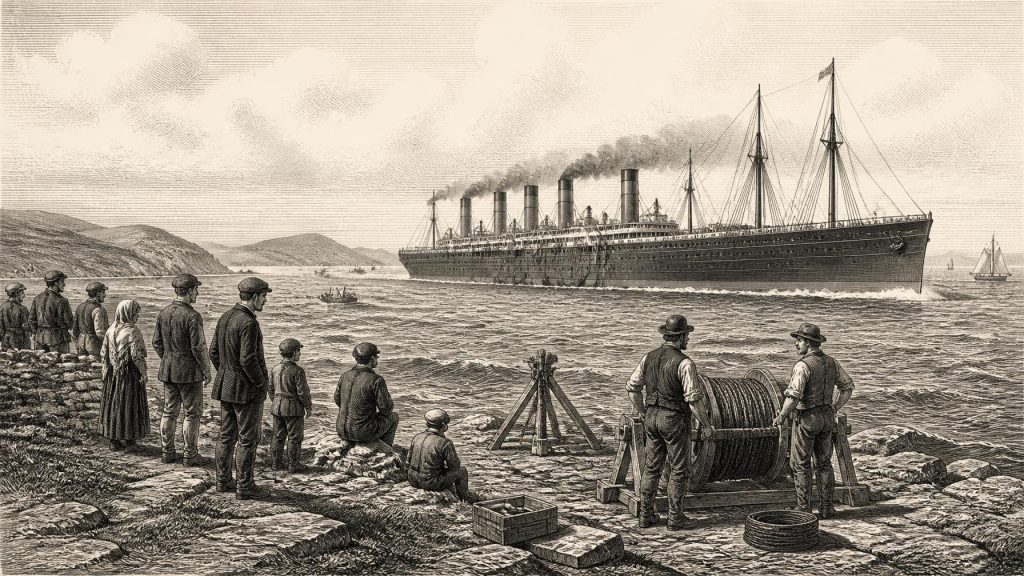
The year’s most dramatic technological event began from Valentia Island, County Kerry. On 13 July the Great Eastern set out carrying a new transatlantic telegraph cable. On 27 July it reached Heart’s Content, Newfoundland, completing a durable telegraphic link between Ireland and North America. A message that had depended on a sea crossing of roughly ten days or more could now be transmitted in minutes. The ship subsequently recovered and completed the cable lost in 1865, so that by September two working lines crossed the Atlantic.
For Ireland, Valentia’s importance was both local and symbolic. The cable station brought skilled work, wages, visitors and an unusual degree of global attention to the Iveragh peninsula. More broadly, an island often represented in British politics as troublesome, poor or remote had become an indispensable landing point in the infrastructure of an international communications revolution. The cable did not dissolve political distance: Westminster still governed Ireland, and the Fenian crisis still produced arrests rather than settlement. But it compressed the Atlantic world in which Irish migration, commerce, church organisation and nationalist politics all operated. In 1866, coercion and connection advanced at the same time.
Primary Sources
- Habeas Corpus Suspension (Ireland) Bill—Leave
- Disturbances in Ireland
- Habeas Corpus, Imperial Rendition, and the Rule of Law
- Historical Documents: Foreign Relations of the United States, 1866, Part I, Document 59
- Focus on the Fenians: the Irish People trials, November 1865–January 1866
- Stephens, James
- O’Leary, John
- O’Donovan Rossa, Jeremiah
- O’Mahony, John
- The Fenians: Irish Rebellion in the North Atlantic World, 1858–1876
- Rebels on the Niagara: The Fenian Invasion of Canada, 1866
- Celebrating Irish Americans: The Fenian Brotherhood
- Cullen, Paul
- The Irish Cardinal
- Our History: St Peter’s Cathedral, Belfast
- St Peter’s Pro-Cathedral (RC), Belfast
- History & Ethos: Alexandra College
- Reform of Women’s Higher Education
- Great Eastern and Atlantic Cable: Particulars at Noon Each Day, 13–27 July 1866
- History of the Atlantic Cable & Submarine Telegraphy: Great Eastern
- The Steamship Great Eastern Laying the First Successful Atlantic Cable
- Transatlantic Telegraph Cable: Valentia Island
- Cattle Disease Act (Ireland) 1866
- Agriculture Statistical Yearbook of Ireland 2020: Crops and Livestock
- Farming Since the Famine: General Details
- Brady, Maziere