
Healy Street
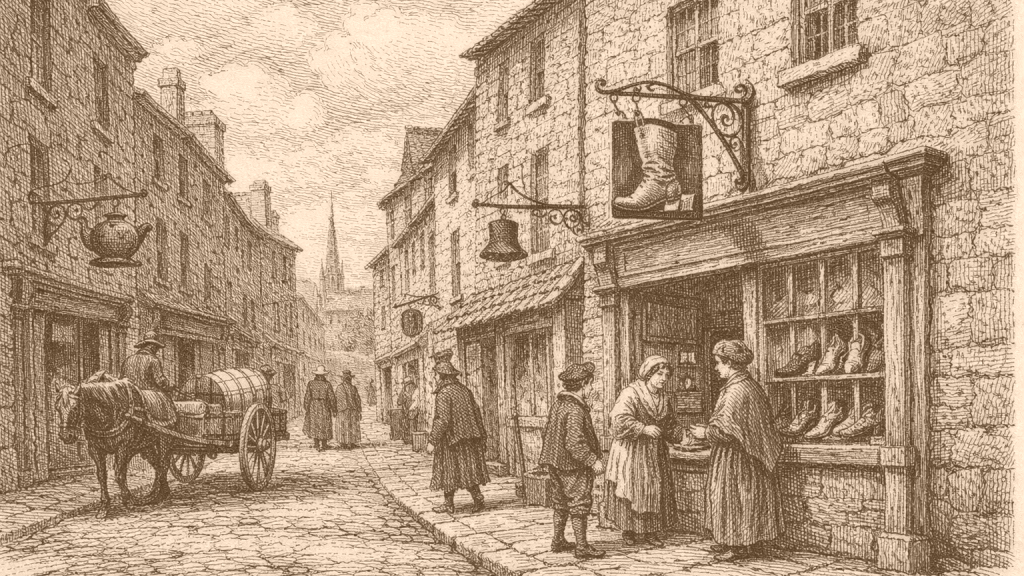
At a Glance
Source Basis
The surviving directory entries show Nicholas Street as part of urban trade listings, but they do not identify a Healy shoe shop there. One excerpt lists Dublin merchants and traders by street, including Nicholas Street; another gives the Limerick directory street by street and includes several Nicholas-street businesses. The Limerick entry also records shoe-related work elsewhere in the city, such as a shoe-maker and leather cutter on Mary-street. On that basis, Nicholas Street can be linked to trade listings, not to a specific Healy premises. [2] [1]
The Limerick directory excerpt includes Nicholas Street among many other streets and records several householders and traders there, including a hardware house, a toy shop, and other occupations. It also records other streets with shoe-related trades, but those entries are attached to Mary Street rather than Nicholas Street. That distinction matters: the excerpt supports the presence of trade in the city and on Nicholas Street, yet it does not support transferring footwear businesses from one street to another without a direct naming link. [1]
Nicholas Listings
The 1783 Nicholas Street directory list is broad and commercial. It names haberdasher, weaver, silk manufacturer, linen draper, currier, grocer, tallow chandler, brazier, and riband weaver among the recorded occupations. These are all street-level retail or craft activities, and the excerpt shows Nicholas Street as a working urban address with varied trades. It does not, however, identify a Healy entry or a shoe shop in the portion preserved here, so any claim about such a business would need a different record. [2]
The same directory also demonstrates how business identities are tied to exact streets in the compiled list. The excerpt gives numbered entries on Nicholas Street, but the footwear-related examples visible in the later Limerick directory are on Mary Street, not Nicholas Street. That creates a clear boundary between evidence and inference. The record supports the idea that shoe-related retail existed in Limerick, yet it does not, in these excerpts, connect that trade to Nicholas Street or to the Healy name. [2] [1]
City Trade
Read together, the two directory excerpts show an urban commercial environment in which many different trades clustered in named streets. In Limerick, the excerpted entries place shoe-making and leather-cutting on Mary Street, while Nicholas Street contains other retail and craft addresses. This makes it plausible that a shoe shop could have operated somewhere in the city’s street economy, but plausibility is not proof. The evidence here remains street-specific, and the preserved Nicholas Street entries do not identify a shoe shop or a Healy proprietor. [1] [2]
The most careful reading therefore treats the directories as a map of trade presence rather than a proof of ownership. A line of evidence may tell us that Nicholas Street hosted multiple commercial activities, but it does not automatically tell us which businesses lasted, changed hands, or belonged to the same family name. For the present materials, the Healy element remains unverified. The evidence supports a search strategy, not a conclusion about a documented Healy shoe shop. [1] [2]
Regulatory Context
Later legal texts show that Limerick authorities continued to regulate traffic and street trading in the county borough. The 1939 bye-laws define parking, waiting, and street as a public road, and they apply to the county borough of Limerick together with specified townlands. The 1961 regulations likewise govern street trading in the county borough and provide forms, certificates, and procedures. These texts establish administrative oversight of street use, but they do not name Nicholas Street or identify a Healy shop there. [3] [4]
Because those regulations are general in scope, they should not be used to reconstruct a particular shopfront without a street-level reference. The texts show how the city and borough regulated vehicles and traders, but they do so at a citywide level. That means they are relevant background only. They confirm that street commerce remained subject to formal rules, yet they leave the specific question of a Healy shoe shop on Nicholas Street unanswered. [3] [4]
Archival Reading
The surviving excerpts encourage a restrained historical method. One set of records names traders on particular streets; another sets out the rules under which urban movement and trading were managed. Taken together, they show how much can be learned from brief administrative and commercial notices and how much remains out of reach when the desired shop name does not appear. The evidence here is enough to describe Nicholas Street as a commercial street, but not enough to identify a Healy shoe shop with confidence. [1] [2] [3] [4]
That uncertainty is itself part of the historical result. The records show a city in which Nicholas Street and other named streets hosted a range of occupations, including several that touch on leather or clothing, but the excerpts do not bridge the final gap to a Healy business. Any stronger statement would go beyond the texts and into conjecture. The proper conclusion is therefore negative in a limited sense: these excerpts do not establish the existence of a Healy shoe shop on Nicholas Street. [1] [2]
Measured Conclusion
A final synthesis must stay within what the excerpts actually show. Nicholas Street appears as a business address in the eighteenth-century directories, while later Limerick regulations demonstrate continuing municipal attention to roads and trade. Yet the surviving passages do not supply a direct Healy reference, and the footwear entries visible in the Limerick directory belong to Mary Street rather than Nicholas Street. The record therefore supports neither a confirmed shop identification nor a precise date for such a business. [1] [3] [4]
For readers seeking the history of a private shop, the most defensible statement is also the narrowest one. The materials consulted here show trade on Nicholas Street and shoe-related trade elsewhere in Limerick, but not a documented Healy shoe shop on Nicholas Street itself. In historical terms, that is an evidential absence within these passages, not a denial that such a shop may once have existed in a fuller archive. [1] [2]
Source References
Hover over a number to see the source. Select it to open the source.



What can the surviving directory and regulatory excerpts establish about a possible Healy shoe shop on Nicholas Street in Limerick?