

Contested Passage
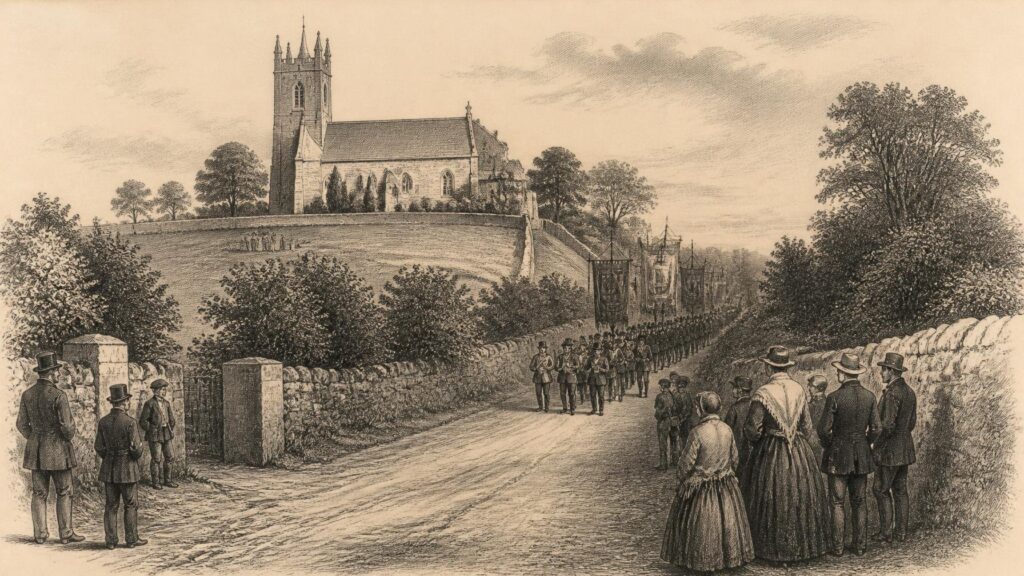
AI generated historical illustration, not a contemporary photograph.
At a Glance
For several summers in the 1990s, a short stretch of road in Portadown, County Armagh, became one of the most charged places in Ireland. The dispute at Drumcree was ostensibly about the return route of an Orange Order church parade. In reality, it exposed older arguments about territory, historical memory, public authority, equality and the right of neighbours to live without intimidation. Its effects travelled far beyond the Garvaghy Road, testing the Royal Ulster Constabulary, drawing in the British and Irish governments, and helping to produce the institutions through which Northern Ireland still regulates contentious parades.
Place Memory
Drumcree lies on the outskirts of Portadown, a town long associated with the linen industry, Protestant unionism and Orangeism. Drumcree Parish Church stands on elevated ground outside the town. Each July, in the period around the Twelfth of July commemorations, Portadown District Orange Lodge held a religious service there and paraded to and from it. The disputed element was the return journey into Portadown along the Garvaghy Road, which passed through, or beside, a largely Catholic and nationalist residential district.
It is tempting to describe this as a quarrel over a road. That phrase was often used by commentators who found the intensity of the dispute hard to comprehend. Yet roads are not merely lines on a map. They determine access, visibility and the terms on which communities encounter one another. In a divided town, a parade can be understood by participants as worship, commemoration and a declaration of communal continuity; by others, especially when imposed against local opposition, it can be experienced as a demonstration of dominance. Drumcree became important because both readings were sincerely held, and because neither was easily detached from the history of Northern Ireland.
The Orange Institution emerged in the late eighteenth century and developed as a Protestant fraternal organisation devoted to the defence of the constitutional link with Britain, the Protestant succession and the memory of William III’s victory at the Boyne. Its annual ritual calendar includes church services, lodge parades and the large Twelfth demonstrations. The exact antiquity attached to particular Drumcree routes has been contested. What is secure is that the church parade possessed nineteenth-century antecedents and that, by the later twentieth century, Portadown Orangemen regarded the return from Drumcree as an established tradition. Tradition, however, is not an unchanging record of the past. Routes, populations, policing practices and expectations of public consent all changed.
By the later twentieth century the Garvaghy Road area had become predominantly nationalist. This demographic and political fact was central to residents’ objections. The local dispute also cannot be separated from Portadown’s difficult history. Nationalists recalled exclusion from civic life, unequal power and earlier confrontations over Orange parades through the Tunnel and Obins Street districts. Unionists recalled the rerouting of parades away from Obins Street during the 1980s as a concession already made under pressure. Each side therefore saw the Garvaghy Road not as an isolated case but as part of a longer pattern of advance, loss and perceived disrespect.
Parading Traditions
Orange parades contain several meanings at once. They are religious in the sense that church services, hymns, lodge banners and Protestant devotional language are prominent. They are cultural, involving bands, uniforms, banners, social networks and annual local custom. They are also political, because the Orange Order developed within the history of unionism and because parading has often made claims about Britishness, Protestant identity and public space. To reduce every marcher to an aggressor, or every parade to an act of sectarian menace, would be historically inadequate.
Equally inadequate would be the suggestion that participants’ peaceful intentions settled the issue. Processions acquire meaning from their setting, history and reception as well as from the motives of those marching. For residents of the Garvaghy Road, the arrival of a large loyalist procession in a nationalist neighbourhood could evoke a political order in which Catholic objections counted for little. Banners, music, supporters and the presence of hostile crowds could add to that sense of vulnerability. The historical question was therefore not simply whether a parade could be orderly at the moment it passed, but whether it should proceed along a route rejected by the community through which it travelled.
Before 1995, opposition had already been organised. The Rosemary Nelson Inquiry later recorded that the Drumcree Faith and Justice Group had protested against the return route from the mid-1980s through 1994. Such protests were generally smaller than those which followed, and the parade continued to use the Garvaghy Road. The group sought to articulate the concerns of nationalist residents and attempted engagement with parade organisers. This prehistory matters because the crisis did not suddenly arise from the 1994 IRA ceasefire or from a newly invented grievance. The ceasefire altered the political context, but resentment at the route predated it.
The dispute also illustrates the limits of the word “traditional”. A route may be traditional in the sense of repeated usage, but repetition cannot alone decide whether it remains appropriate. In a society emerging from conflict, the continued use of inherited public rituals must be assessed alongside changing patterns of residence, equality law, human rights expectations and the experience of those who live along the route. The strength of the Orange claim lay in custom and identity. The strength of the residents’ claim lay in their demand that custom should not override consent, dignity and safety.
Changing Portadown
Portadown’s local geography sharpened the conflict. Orange parades that had formerly used the Tunnel and Obins Street route met determined opposition during the mid-1980s. When the authorities diverted such parades, the Garvaghy Road became the principal alternative return route. In effect, one unresolved controversy was displaced to another neighbourhood. Residents on the Garvaghy Road believed they had inherited a problem created elsewhere, without being consulted about the consequence.
The change was not merely spatial. The political climate of the early 1990s was changing rapidly. The Downing Street Declaration of 1993, the Provisional IRA ceasefire of August 1994 and the subsequent negotiations raised hopes that old forms of domination and exclusion might be reconsidered. Within nationalist districts, civic organisation became more confident. People who had previously regarded protest as futile, risky or likely to be dismissed could imagine that their objections might receive a hearing.
This did not make Portadown harmonious. Rather, it brought latent divisions into sharper public view. In the language of many unionists, nationalist residents were seeking to deny a lawful and long-established expression of Protestant culture. In the language of residents, the Orange Order was asserting a right to march where it was not welcome while refusing meaningful dialogue. The failure lay not only in disagreement but in the absence of a trusted method for resolving it. Until 1998, decisions were essentially matters for policing and government, leaving the police to determine both public order and the practical balance of competing rights.
That arrangement was particularly fraught because the RUC was not viewed equally by both communities. Many unionists saw it as a force trying to uphold law amid disorder. Many nationalists regarded it as historically partial and feared that it would protect Orange claims while treating residents’ protest as a security problem. Each successive Drumcree confrontation deepened these perceptions. Policing was never a neutral background to the dispute; it became one of its central subjects.
Residents Organise
In 1995 the Garvaghy Road Residents Group, later known as the Garvaghy Road Residents Coalition, gave the opposition a more coordinated local form. Its membership and support drew from a variety of community organisations and political backgrounds. The coalition’s public argument was not that Orange culture should disappear, nor that all parades should be prohibited. It sought rerouting away from a residential nationalist area and argued that a parade should not pass without local accommodation.
Its critics frequently questioned its political affiliations, particularly because republican activists were associated with the wider nationalist community in Portadown. That issue was politically potent during the peace process. Nevertheless, it should not erase the wider constituency of objection. The official Rosemary Nelson Inquiry noted that the post-ceasefire context enabled nationalist elements described as moderate and militant to participate in a coalition that did not advocate violence. The residents’ campaign was therefore both rooted in a local experience and entangled with the larger political conflicts of the period.
The group’s approach placed emphasis on protest, media attention, mediation and legal representation. Rosemary Nelson, a Lurgan solicitor, represented the residents during crucial years. Her subsequent murder by a loyalist car bomb in March 1999 and the later public inquiry into the circumstances of her death gave the Drumcree story an even darker dimension. The inquiry did not find that state agencies directly facilitated her murder, but it found serious failures that increased her vulnerability, including abusive conduct and threats by some RUC officers. Those findings underline the personal risks borne by figures associated with the Garvaghy Road campaign.
Residents’ protests were not always free from disorder, nor did all people present necessarily share the coalition’s discipline. That qualification is important. But it is equally important not to conflate a neighbourhood with every act committed around it. The central demand remained consistent: the Orange Order should return by another route or reach an agreed arrangement with those who lived along the road.
First Confrontation
On Sunday 9 July 1995 the RUC prevented the Portadown Orange parade from returning from Drumcree Church along the Garvaghy Road. The decision produced an immediate stand-off. Orangemen refused to disperse or accept rerouting, while supporters assembled at Drumcree. The confrontation continued for more than two days and drew national attention. It also brought senior unionist figures, including David Trimble and Ian Paisley, to the scene.
Mediation eventually produced an arrangement. The parade was permitted to proceed along the Garvaghy Road without bands, while residents staged a silent protest. The procession passed, and the immediate crisis ended without the scale of violence that later surrounded Drumcree. Yet the settlement was unstable because the parties understood it differently. Residents believed they had made a constrained concession in an exceptional situation and expected that further marches would not simply be imposed. Many Orangemen and their supporters treated the successful return as vindication of their claimed route.
The images which followed proved politically powerful. Trimble and Paisley walking together at Drumcree were widely seen as a moment of unionist solidarity. For some Protestants, the scene represented resistance to the erosion of their culture. For many nationalists, it appeared as public celebration after a nationalist community had been pressured into allowing a march it opposed. The symbolic consequences were far larger than the number of men who had walked the road.
Drumcree I demonstrated that informal mediation could avert immediate violence, but it did not resolve the underlying disagreement. Crucially, neither side accepted that the other possessed a legitimate veto or an equal claim. The Orange Order rejected the idea that local residents could prevent a traditional march on a public highway. Residents rejected the proposition that longstanding use entitled an organisation to pass through their area regardless of opposition. That impasse made a renewed crisis almost inevitable.
Second Crisis
The crisis of July 1996 was markedly more serious. Chief Constable Sir Hugh Annesley decided that the Drumcree return parade would not use the Garvaghy Road. Once again Orangemen and supporters remained at Drumcree rather than dispersing. This time the stand-off lasted for several days, and large numbers of supporters gathered around the church. The confrontation was accompanied by loyalist protests, road blockades, attacks and disorder in other parts of Northern Ireland.
The scale of pressure on the security forces was immense. The Rosemary Nelson Inquiry later recorded that between 10,000 and 15,000 Orange Order protesters gathered on Drumcree Hill, while additional troops were flown into Northern Ireland. The RUC and British Army faced sustained disorder and feared that their resources could be overwhelmed. The authorities’ predicament was real; no responsible account should pretend that public-order decisions were easy.
But the events also revealed a damaging principle: violence, or the credible threat of it, appeared capable of changing the outcome. On 8 July, Catholic taxi driver Michael McGoldrick was found shot dead near Craigavon. His murder was associated with the Drumcree crisis and was later linked to a member of the breakaway loyalist organisation that became the Loyalist Volunteer Force. The murder showed the human cost behind the language of protest and public order.
After five days, the RUC reversed its earlier decision. Police cleared protesters from the Garvaghy Road and allowed the Orange parade to pass. The reversal was defended by senior police on the grounds that the alternative might have brought still graver disorder. It was understood very differently by residents and nationalists. They believed that the state had yielded to loyalist mobilisation and had then used force against the community which had sought protection from the march. The inquiry into Rosemary Nelson later observed that the 1996 events raised profound questions about the RUC’s impartiality and professionalism.
The passage of the parade did not restore calm. Violence spread into nationalist districts, and the sense of grievance became more deeply embedded. Drumcree II therefore was not simply a victory or defeat for either party. It was a failure of authority in the larger sense: the state had maintained immediate order only by making its neutrality less credible to a substantial part of the population.
Wider Consequences
The consequences of 1996 reached well beyond Portadown. Drumcree became a rallying point for loyalist mobilisation across Northern Ireland and a symbol of vulnerability in nationalist communities. The dispute intensified public debates about whether the police could fairly decide parade routes, whether parading was primarily a matter of civil liberty or local consent, and whether the state had a duty to resist the threat of disorder rather than accommodate it.
It also influenced party politics. David Trimble’s association with Drumcree was widely believed to have enhanced his standing among unionists shortly before he became leader of the Ulster Unionist Party. Yet the same association damaged his standing with nationalists, who saw in the Drumcree scenes confirmation that unionist leadership would not recognise their concerns. The controversy therefore complicated the already difficult work of the peace negotiations.
There was no simple communal division on every question. Some Protestants were uneasy about the disorder, the paramilitary presence and the cost to Northern Ireland’s reputation. Some Catholics supported practical compromise. Clergy, mediators, journalists and local activists made repeated efforts to find language acceptable to both sides. Still, voluntary accommodation proved elusive. The dispute was made harder by a shortage of direct trust: meetings were often indirect or conducted through intermediaries, while public statements were aimed as much at each community’s supporters as at the other side.
Historically, Drumcree belongs with other disputes over parading, including those at the Lower Ormeau Road in Belfast, the Bogside in Derry and Ardoyne. It was distinctive because of its repeated national significance, its proximity to the central peace-process years and the intensity of the confrontations at Drumcree Church. It provided the clearest demonstration that ritual, territory and political power could not be separated in Northern Ireland.
State Authority
The events of 1996 encouraged demands for a new regulatory system. The existing approach placed an impossible burden upon policing: officers were expected to determine whether a parade should proceed, manage its consequences and retain the confidence of communities whose understanding of legitimacy differed fundamentally. An independent review chaired by Sir Peter North considered the broader problem of parades and marches. Its work contributed to the creation of a new institutional framework.
The Public Processions (Northern Ireland) Act 1998 established the Parades Commission for Northern Ireland. The Commission was given functions that went beyond simply prohibiting processions. It was intended to promote public understanding, facilitate mediation, keep the conduct of processions under review and make determinations imposing conditions where necessary. In principle, this separated the decision about a contested parade from the operational role of the police.
That change did not make decisions uncontroversial. Indeed, the Commission itself became the target of severe criticism from unionists who believed unelected appointees were curtailing inherited rights. Nationalists, meanwhile, often regarded it as a limited but necessary correction to a system in which police assessments of disorder had repeatedly overridden local objections. The Commission’s importance lay not in ending argument but in changing its terms: a parade was no longer to be decided solely by whoever could create the greatest security crisis.
The legislative reform formed part of the wider reworking of Northern Ireland in 1998. The Belfast or Good Friday Agreement addressed constitutional status, power-sharing, rights and policing reform. Drumcree was not created by the Agreement, but the dispute showed why the agreement’s language of parity of esteem and mutual respect could not remain abstract. Public space had to be governed in ways that allowed conflicting identities to exist without one routinely imposing itself on the other.
Third Confrontation
In July 1997, before the Parades Commission’s first Drumcree determination, the dispute erupted again. The new Labour government had taken office in May, with Mo Mowlam as Secretary of State for Northern Ireland. In the days before the parade, the authorities deployed substantial numbers of RUC officers and British soldiers around Portadown. Residents established a protest camp and sought to resist the march’s passage.
In the early hours of 6 July, security forces sealed the Garvaghy Road area and removed residents from the route. The Orange parade was subsequently allowed to proceed. The operation, undertaken under an overwhelming security presence, became one of the defining visual records of the 1990s: armoured vehicles, barriers, police lines and local people cut off from their own road. Catholic worshippers were unable to reach their chapel as normal, and priests celebrated Mass outdoors near military vehicles.
The decision was defended as necessary to avoid a recurrence of the previous year’s widespread loyalist violence. Mowlam publicly stressed fairness and her wish to avoid a further breakdown. Yet the sequence again convinced many nationalists that threats from loyalist groups carried political weight. The state appeared prepared to restrict residents’ movement and use coercion against them in order to permit a march they opposed. Subsequent disorder in nationalist areas ensured that the decision did not bring peace.
It is important to distinguish documented events from later symbolism. Documented evidence establishes that the road was sealed, protesters were removed and the march passed. Interpretation concerns what these actions meant. For supporters of the parade, the operation upheld lawful procession against obstruction. For residents, it was a demonstration that the coercive power of the state remained available to impose a unionist ritual on a nationalist district. Both interpretations rested upon lived political experience, but the latter gained added force from the long history of distrust in policing.
New Institutions
The Parades Commission’s 1998 decision was a decisive turning point. On 29 June it determined that the Drumcree Church parade should not proceed down the Garvaghy Road. Under the new statutory regime, the return procession was prohibited from proceeding beyond Drumcree Parish Church or entering the notified route along the Garvaghy Road. This was not an informal police compromise; it was a formal decision by the body created to assess contentious processions.
Orange Order members and supporters nevertheless maintained a protest at Drumcree. Tension remained high, and Portadown was heavily policed. The refusal to permit the return route became a powerful grievance within loyalism. Yet, in historical terms, the 1998 ruling established a principle absent from the previous crises: the asserted tradition of a procession did not automatically outweigh the rights, fears and welfare of residents affected by it.
The ruling was tested under terrible circumstances. In July 1998, three young brothers, Richard, Mark and Jason Quinn, died in a loyalist petrol-bomb attack on their home in Ballymoney. The killings occurred amid the wider tension surrounding the marching season and prompted revulsion across Ireland and Britain. They were not an event on the Garvaghy Road itself, and it would be inaccurate to treat them as a simple consequence of the Drumcree stand-off. Nonetheless, the murders revealed the lethal atmosphere in which sectarian mobilisation had been occurring.
Drumcree remained unresolved in the sense that no mutually agreed settlement was reached. The Commission continued to impose restrictions in subsequent years, including in 1999. Portadown Orangemen maintained that they were being denied completion of a church parade; residents maintained that no parade had any entitlement to enter their area without consent. But the absence of a return march after 1998 meant that the recurrent crises of 1995–97 did not resume in the same form.
Fatal Summer
The story of Drumcree cannot be told solely through institutions and public speeches. It is also a story of individual danger. Michael McGoldrick’s murder during the 1996 stand-off and Rosemary Nelson’s murder in 1999 placed human lives at the centre of what could otherwise seem a debate about procedure. Both deaths exposed the ways in which threats, paramilitarism and public rhetoric surrounded the parades dispute.
Nelson’s role was particularly significant. As solicitor to the Garvaghy Road Residents Coalition, she was a visible advocate for people seeking to challenge the route through legal and political means. The public inquiry into her death later found no evidence that any state agency directly facilitated her murder. It also found that omissions by the RUC and Northern Ireland Office left her more at risk and vulnerable, and that misconduct by some officers had the effect of legitimising her as a target. These findings must be stated carefully: they do not establish a state conspiracy to murder her, but they do establish grave institutional failures.
The inquiry also provides valuable retrospective evidence about Drumcree itself. It preserves accounts from police officers, residents, politicians and others who participated in the confrontations. Such evidence does not remove disagreement, but it makes it harder to sustain simple myths. The record shows that police commanders confronted genuine fears of extensive disorder. It also shows that nationalist residents had reason to see the policing of 1996 and 1997 as partial and injurious. A historical account must retain both truths rather than make one disappear into the other.
Legal Legacy
The most lasting institutional legacy of Drumcree was the Parades Commission. Its existence represented an attempt to move contentious parades from emergency policing into a framework of advance notice, mediation, codes of conduct and reasoned determination. That was an imperfect achievement. Critics could still dispute appointments, procedures and outcomes. Yet the alternative had been annual brinkmanship in which the possibility of disorder dominated every decision.
Drumcree also influenced wider thinking about rights. Neither freedom of peaceful assembly nor residents’ right to private and family life is absolute in practice. Rights must be exercised with attention to the rights of others and to the specific circumstances in which expression occurs. In a place marked by segregation and violence, the question was not whether Orange people had culture, history or civil rights. They plainly did. The question was whether cultural rights included the power to insist upon a route through a community that repeatedly objected.
Residents, too, did not acquire a general legal power to prevent all unwanted events in public space. Their case gained force because it concerned a distinctive history, the character of the route, the recurrent disorder and the failure of dialogue. This is why Drumcree should not be reduced to a universal formula. It was a particular conflict whose resolution required judgement about a particular place.
In later decades, the formal regulation of parades and the transformation of policing reduced the likelihood that a route dispute would again produce the province-wide confrontations of the mid-1990s. That does not mean the underlying memories disappeared. The continuation of claims, applications, protests and public argument demonstrates that institutional decisions can contain a dispute without reconciling the narratives through which communities understand it.
Competing Memories
Drumcree remains subject to competing historical memories. In one unionist memory, the dispute concerns a traditional religious parade prevented from returning by its customary route because nationalist protest was granted disproportionate authority. The police reversals of 1996 and 1997 are remembered as reluctant acts to preserve public order, while the post-1998 restrictions are seen as evidence that Protestant culture was treated less generously than nationalist expression.
In one nationalist memory, Drumcree concerns a community required to endure an unwanted loyalist march because the state privileged the claims of an Orange institution. The confrontations of 1996 and 1997 are remembered as proof that loyalist pressure and threats could influence official decisions. The Parades Commission ruling of 1998 is remembered not as a denial of culture but as a modest recognition that residents had rights which previous policing arrangements had neglected.
Neither memory is mere folklore; each grows from real events and genuine emotion. But each can become selective. A unionist account that ignores nationalist insecurity, historical inequality and the effects of loyalist mobilisation is incomplete. A nationalist account that ignores the religious and communal importance of the Orange tradition to many participants is also incomplete. Historical understanding does not demand that the two sides agree. It demands that neither side’s account be treated as the whole record.
Historical Meaning
Drumcree’s importance lies partly in timing. The confrontations occurred as the Northern Irish peace process was attempting to replace violence with negotiation. They revealed that peace could not be achieved simply by securing paramilitary ceasefires or signing constitutional agreements. The ordinary use of roads, the conduct of rituals and the relationship between police and neighbourhoods all required renegotiation.
The dispute also demonstrates that political symbolism can be concentrated in a small space. The Garvaghy Road became an arena in which ideas of sovereignty, citizenship and respect were enacted physically. Who walked where, who stood behind police lines, who was removed from the road and who was protected by the state: these were not minor operational details. They were visible statements about whose claims mattered.
For historians, the most useful conclusion is not that one community won and the other lost. It is that Drumcree exposed the inadequacy of old assumptions. The assumption that inherited practice alone could settle a disputed route failed. The assumption that policing could be detached from politics failed. The assumption that a public-order crisis could be solved by force without long-term consequences failed. From these failures came an imperfect institutional response, but also a clearer recognition that public space in Northern Ireland must be shared rather than claimed by one tradition alone.
Evidence Interpretation
The documentary record of Drumcree is extensive: official inquiries, legislation, parliamentary evidence, contemporary statements, television archives and academic studies preserve different aspects of the story. The basic chronology is well established. Protests predated 1995; the RUC stopped the return parade in 1995 and 1996; the parade was permitted after a negotiated arrangement in 1995, after a police reversal in 1996, and after a major security operation in 1997; the Parades Commission prohibited the Garvaghy Road return route in 1998.
Interpretation remains necessarily contested. It is reasonable to conclude that the disputes helped accelerate the move towards independent parade regulation. It is also reasonable to conclude that the policing of 1996 and 1997 damaged nationalist confidence in the RUC. Those are interpretations grounded in evidence, not neutral facts in themselves. Claims that one side alone created the crisis, or that every participant shared the motives of the most extreme people present, belong more to polemic than to history.
Drumcree and the Garvaghy Road endure as a warning against easy explanations. They show how inherited ceremonies can carry incompatible meanings, how local grievances can become national crises, and how the legitimacy of public authority depends not only on maintaining order but on being seen to act fairly. In that sense, the contested passage from Drumcree Church was never only a route home. It was a passage through the unresolved history of Northern Ireland.
Drumcree shows how a procession can carry meanings that extend far beyond its route: for some, continuity, worship and cultural expression; for others, unequal power, insecurity and exclusion. The article’s implication is that policing decisions themselves shaped the dispute, especially when reversals appeared to reward the threat of disorder and weakened confidence in neutrality. The creation of a regulatory framework therefore seems not administrative, but connected to peace process’s search for legitimate authority. How should societies emerging from conflict fairly balance traditions with residents’ consent, safety and demographic realities while ensuring negotiation does not privilege whichever side can exert pressure?