

Island Exchanges
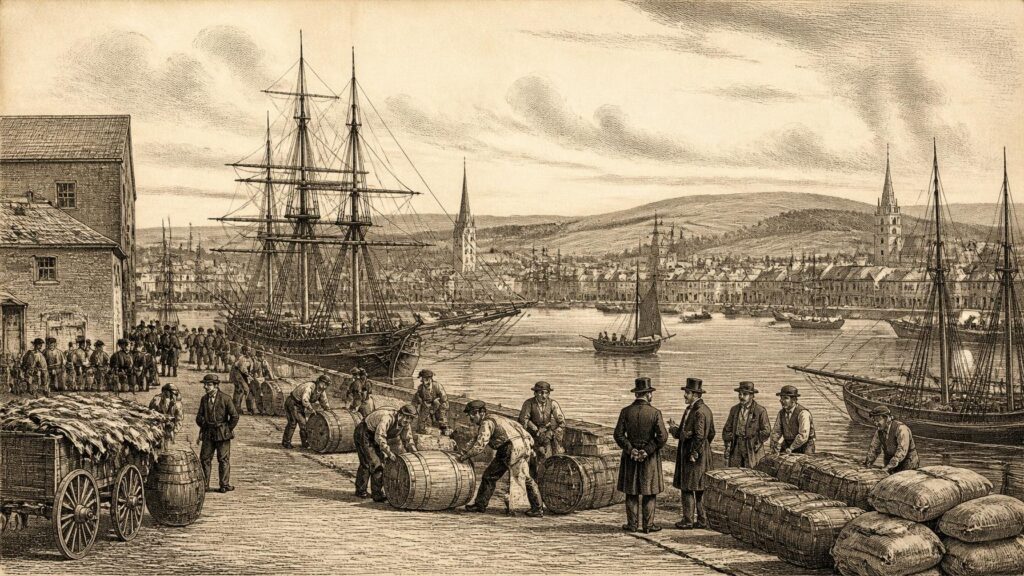
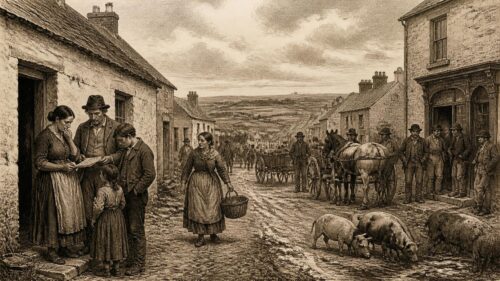
AI generated historical illustration, not a contemporary photograph.
At a Glance
Commerce has never been a merely economic matter in Ireland. It has determined where towns grew, which crops were raised, how labour was organised, which overseas powers mattered, and who bore the risk when markets failed. The historical record shows Ireland as neither isolated island nor passive periphery: its people traded, manufactured, borrowed, smuggled, provisioned, migrated and negotiated across the Irish Sea, the Atlantic and Europe. Yet access to markets was repeatedly shaped by unequal political power, and commercial growth did not reliably produce security or shared prosperity.
Early Exchanges
Long before there was an Irish state, communities on the island exchanged livestock, foodstuffs, metalwork and other valued goods through local and regional networks. Archaeology can demonstrate movement, production and contact, but it cannot always identify the precise terms of an early transaction or date the beginning of a commercial system. It is therefore wiser to speak of exchange than to project later ideas of national trade or capitalism back into prehistory. Objects found far from their geological sources, distinctive styles in metalwork, and imported materials all suggest that Ireland participated in wider networks, while local craft traditions remained fundamental to daily life.
The arrival and settlement of Scandinavian groups between the late eighth and eleventh centuries altered the scale and form of that exchange. Raiding was real and destructive, particularly for ecclesiastical settlements rich in movable wealth. It is, however, a distortion to treat the Viking presence as only predatory. The National Museum of Ireland’s archaeological account of Viking Dublin records scales, weights, silver, craft debris, workshops and imported goods. Such evidence points to a settlement where maritime connections, manufacture and exchange were inseparable. Traders required ships and crews, but also coopers, smiths, leatherworkers, weavers, food suppliers and people able to repair quays, buildings and tools.
Dublin became the most important trading town in the western Viking world. That designation should not imply that every inhabitant was prosperous or that the town displaced rural Ireland. The urban settlement depended on a productive hinterland, while rural communities retained their own patterns of cultivation, craft and exchange. Nevertheless, the town concentrated skills, people and goods in an unprecedented way. Fishamble Street, High Street and the wider Wood Quay excavations supplied unusually rich evidence for workshops and domestic life. They show commerce as physical labour: handling hides, spinning thread, making wooden containers, working antler, weighing silver and moving cargoes through a crowded waterfront settlement.
Money Matters
Silver was an important medium of exchange in Viking Age Ireland, although barter, credit, obligation and gift giving also remained significant. Hoards of coins, bullion and hacked silver demonstrate both wealth and the practical need to assess value by weight. The circulation of coins from Anglo Saxon England, Carolingian Europe and the Islamic world reveals how far the island’s connections could reach through chains of exchange. These objects do not prove that ordinary people handled foreign coin every day; they do show that Ireland lay within commercial routes extending well beyond its shores.
Coinage gave urban commerce a further institutional form. According to the National Museum’s numismatic history, silver pennies were struck at Dublin under King Sitric in about 997 or 998. Exact dating at that distance must be treated with the caution appropriate to medieval evidence, but the broader significance is secure. A local mint was a statement of political authority as well as an aid to exchange. Coinage connected a ruler, a town and a trading population to common measures of value, taxation and payment.
Following the Anglo Norman invasion, mints operated not only in Dublin but at Waterford, Limerick and Kilkenny, with further issues associated with Downpatrick and Carrickfergus. These places were ports, administrative centres or strategically valuable towns. Their money does not describe the whole island, since lordship, language, law and commercial custom varied greatly between regions. It does, however, make plain that medieval Ireland contained several commercially active urban centres rather than one isolated capital. The later weakening of colonial authority and the irregularity of minting are reminders that commercial institutions depended on political stability and enforceable power.
Medieval Ports
Medieval commerce was maritime as well as local. Dublin, Waterford, Limerick, Cork, Galway, Drogheda and smaller harbours served as points at which agricultural produce, hides, wool, fish, wine, salt, cloth and imported manufactures entered or left the island. The surviving evidence is uneven. Port customs, civic records, legal documents, archaeological finds and later descriptions offer glimpses rather than a complete ledger of every cargo. Yet they reveal that Irish merchants and overseas traders operated within a busy Irish Sea and European world.
Cork’s early commerce illustrates both the possibilities and limitations of port history. Later antiquarian accounts describe imports of wine from France and Spain and exports including hides, fish, skins, staves and wool. Such descriptions should be read critically, especially when they generalise about distant centuries, but they accord with the broader character of Atlantic facing Irish trade. Harbours linked rural producers to foreign consumers, and merchants converted bulky, perishable or seasonal produce into money, credit and imported goods. That role gave port towns influence disproportionate to their population.
Commerce also created social distinctions. A merchant elite could accumulate property, gain municipal office and sponsor religious or civic buildings. Artisans relied on demand for their work but could face regulation through guilds, town authorities and market rules. Sailors, labourers, servants and women engaged in retail or household production commonly appear less clearly in formal records, despite being indispensable to the movement and preparation of goods. A history concerned only with prominent merchants would therefore mistake surviving documentation for the whole commercial population.
Conquest Markets
From the sixteenth century, English expansion of authority in Ireland increasingly affected commercial life. Military conquest, plantation, confiscation and new systems of landholding did not simply add external markets to an otherwise unchanged society. They reshaped the ownership of land, the direction of exports and the balance of power between towns, landlords, tenants and communities. Cattle, hides, wool, butter and other pastoral products became especially important, partly because they could be produced for markets beyond the island.
The relationship with England was never a straightforward story of total prohibition or total dependence. Policies changed, exemptions existed, enforcement varied and merchants found ways around regulations. Yet the larger framework was unequal. English governments regarded Ireland as a kingdom whose production and trade should serve imperial and metropolitan interests. The famous restrictions on cattle and woollen goods became central to later Irish political memory because they offered compelling examples of commerce being governed from elsewhere.
That memory has sometimes hardened into a simple account in which all Irish industry was deliberately destroyed. The documented evidence supports a more qualified conclusion. Restrictions could constrain Irish producers, change incentives and benefit rival interests in England, but Irish manufacture did not vanish. Domestic consumption, regional markets, linen, yarn production, illicit trade and adaptation all continued. The important point is not that commercial life ceased, but that its development took place under rules that Irish producers and legislators did not fully control.
Woollen Restrictions
The woollen trade became the best known case. Ireland possessed extensive sheep pasture, produced wool and supported makers of frieze, stockings, yarn and other cloth. During the late seventeenth century, English manufacturing interests feared Irish competition, especially where lower costs might enable Irish goods to undercut English wares. Legislative restraints followed. The Woollen Act of 1699 barred the export of Irish woollen manufactures to most foreign markets and restricted the export of wool, leaving England as the permitted principal destination.
Alice Effie Murray’s early twentieth century study, made available by University College Cork’s CELT project, remains valuable because it assembles a wide range of contemporary material on these commercial relations. Its language reflects its own period and some estimates cannot be accepted without reservation, but the central documentary pattern is clear: restrictions redirected production, encouraged linen, and made smuggling an enduring feature of coastal commerce. The policy did not stop people from seeking better returns across the sea. It made the pursuit of those returns illegal, risky and dependent on local knowledge, informal credit and maritime connections.
Smuggling is easily romanticised. Folklore has often made it a tale of daring captains, concealed coves and heroic defiance. The historical reality was more complicated. It could involve organised merchants and well connected landowners, but also violence, confiscation, debt and danger for crews. It also reflected the practical difficulty of imposing uniform customs control along a long and indented coastline. The prevalence of illicit exchange shows the limits of law; it does not prove that all regulation was meaningless or that every commercial actor opposed the state.
Linen Expansion
While woollen manufacture faced restriction, linen received varying forms of official encouragement. Linen suited a policy that sought to channel Irish industry into a line believed less threatening to English manufacturers. The outcome was particularly consequential in Ulster, where flax growing, spinning, bleaching, weaving, marketing and export developed into an extensive commercial system. The story was not confined to large mills. Much linen was made through dispersed household labour, with women’s spinning central to the supply of yarn and with merchants and factors organising credit, raw material and sale.
That arrangement brought cash income into many households, but it did not make producers independent. Those who spun or wove could be exposed to fluctuating prices, irregular demand and dependence upon dealers. Commercialisation increased the importance of time discipline and quality standards within domestic life. A piece of cloth was no longer only household provision; it could become a commodity assessed by width, whiteness, strength and marketability. The division between domestic work and commercial work was therefore often blurred.
Linen also deepened the regional contrast between an increasingly industrialised north east and many other parts of Ireland where agricultural exports predominated. This did not create two entirely separate economies. Food, labour, capital and people moved across regional boundaries. But it contributed to later patterns in which Belfast became a major industrial and commercial city while Dublin retained administrative and mercantile predominance and southern ports remained closely connected with agricultural provisioning.
Atlantic Provisioning
The eighteenth century brought a marked expansion of Ireland’s Atlantic connections. Cork grew into a major provisioning port, supplying beef, butter, pork and other foodstuffs to Britain’s naval, military and colonial systems. Demand generated by war could be especially lucrative. Merchants developed links with the Caribbean, Iberia, North America and Britain, while the surrounding countryside was drawn more deeply into market production. Ports were not merely gateways through which goods passed. They were places where meat was salted, butter packed, barrels made, credit arranged, insurance sought and labour hired.
This growth cannot be detached from the Atlantic slave economy. Irish merchants, shippers and suppliers participated in commercial networks that provisioned slave societies and consumed commodities produced by enslaved labour, including sugar, tobacco and rum. The degree and form of involvement varied among places and individuals, and Ireland was not itself a plantation colony. Nonetheless, it would be historically false to present Atlantic commerce as an innocent source of prosperity. The profits and purchases of Irish consumers were connected, directly or indirectly, to systems of coercion, racial violence and dispossession across the Atlantic world.
The gains from provisioning were also uneven within Ireland. Commercial farms and merchants might benefit from rising prices, while labourers and smallholders could confront more expensive food, insecure employment and diminishing access to common resources. The expansion of trade altered landscapes as well as account books. It encouraged specialised production and commercial farming, sometimes intensifying the dependence of poorer households on wages, conacre arrangements or a limited range of subsistence crops.
Patriot Demands
Commerce became a language of politics during the later eighteenth century. Irish Protestant political figures, merchants and volunteer organisations demanded greater freedom to trade, particularly during the disruption created by the American Revolutionary War. Their campaign for what was called free trade should not be confused automatically with the modern ideal of universal economic openness. It was a demand shaped by the interests of a kingdom within an empire, by fears of metropolitan restriction and by hopes that Irish producers might gain wider access to colonial and foreign markets.
Legislative concessions in 1779 and 1780 were celebrated as victories, but their scope and practical consequences require careful assessment. The removal or relaxation of some restrictions did not erase the power of Britain, transform social inequality or give the Catholic majority equal political standing. The phrase ‘free trade’ could unite people with very different objectives. Some wanted commercial opportunity, others constitutional leverage, and others hoped for a stronger Irish Parliament. It was a powerful slogan precisely because it joined material interest to political dignity.
William Pitt’s Commercial Propositions of 1785 exposed the tension. They offered a closer commercial arrangement with Britain and an extension of certain imperial opportunities, while also seeking to bind Irish trade more firmly into a wider British structure. James Stafford’s study of the episode stresses that the proposals became entangled in competing ideas of empire, economic freedom and legislative independence. Their failure demonstrates that commerce was not a technical matter to be settled by tariffs alone. It involved sovereignty, constitutional authority and the fear that advantage granted on one condition might become dependence by another name.
Union Consequences
The Act of Union, effective from 1 January 1801, abolished the Irish Parliament and joined Ireland and Great Britain within the United Kingdom. Commercial integration followed a phased course rather than an instant creation of a frictionless market. Duties changed, institutional arrangements were altered and producers had to compete more directly within a larger economy. Supporters expected wider markets and security; critics feared that Dublin’s political and commercial standing would decline and that Irish industry would struggle against better capitalised British competitors.
There was no single Irish commercial outcome. Belfast’s linen and shipbuilding economy expanded dramatically during the nineteenth century, building on earlier industrial foundations and access to British imperial markets. Dublin remained important in brewing, food processing, retail, finance and administration, but did not become an industrial counterpart to the great manufacturing cities of Britain. Cork, Limerick, Waterford and other ports retained major roles in food exports and regional trade. The unevenness was itself historic: commerce concentrated opportunity in particular places while leaving other regions reliant on small scale agriculture and seasonal employment.
Union also made the movement of people part of commercial history. Irish labourers travelled to Britain for harvest work, building, industry and domestic service. Emigrants carried skills, remittances, contacts and purchasing power across the Atlantic. Migration could be a strategy, a necessity or a calamity, depending on circumstance. It was not an export commodity, yet commercial systems repeatedly depended upon mobile Irish labour while many households depended upon money sent home by relatives abroad.
Famine Commerce
The Great Famine of the 1840s makes any simple equation of exports with national prosperity impossible. Potato blight devastated the crop on which millions of poorer people depended, while Ireland continued to produce and export other foodstuffs. That fact has often been condensed into the assertion that Ireland exported food while its people starved. The statement captures a grave moral reality but needs explanation rather than repetition alone. Food was grown under systems of ownership, tenancy, contracts, prices and purchasing power that did not ensure those most in need could obtain it.
Exports during famine years were neither proof that there was enough suitable food in every locality nor an excuse for the failure of relief. They reveal the structure of an export orientated agrarian economy. Grain, livestock and other products belonged to producers, landlords or merchants who operated through market channels. Poor households without income, land security or credit could starve in a country that continued to produce saleable food. Relief policy, public works, soup kitchens, poor law administration and private charity all mattered, but they operated within a society already marked by profound inequality.
The famine also destroyed commercial capacity. Death, eviction, emigration and the loss of livestock or tools weakened households for years afterwards. Local fairs, small shops, craft work and informal credit networks could not survive unchanged when customers disappeared. To call the famine an agricultural crisis is accurate but incomplete. It was also a catastrophe of market dependence, property relations, state policy and human entitlement. Commerce did not cause the blight, but commercial and legal arrangements shaped who could endure its consequences.
Industrial Contrasts
Nineteenth century Ireland was commercially connected but unevenly industrialised. Belfast became the most conspicuous exception to the island’s generally limited factory development. Linen spinning and weaving, engineering, rope making, tobacco processing and shipbuilding created a city closely linked to British and global markets. Its growth rested on capital investment, skilled labour, transport, commercial institutions and a substantial surrounding population. It also rested on harsh working conditions, cyclical unemployment and sectarian divisions that could enter workplaces as well as streets.
Elsewhere, commerce was often rooted in agriculture and processing. The cattle trade, butter trade, brewing, distilling, milling and food provisioning tied rural districts to towns and ports. The development of railways altered the geography of exchange by reducing travel times, extending markets and enabling livestock and goods to reach ports more predictably. Yet railways did not dissolve regional inequality. Lines were built where capital, anticipated traffic and political influence made them viable, and they could direct trade towards some towns while bypassing others.
Markets and fairs retained importance, particularly for livestock. They were social occasions, information exchanges and sites of bargaining as much as simple sales points. The language of fair dealing should not obscure unequal knowledge or power between buyer and seller. Nor should it obscure women’s work in dairying, market gardening, petty retail and household production. Formal commercial records privilege companies, banks and male proprietors, but the ordinary operation of commerce depended upon many forms of labour that left faint archival traces.
National Protection
After independence in 1922, the Irish Free State inherited a commercial economy heavily oriented towards Britain. Agricultural exports, especially live animals and food, remained central, and British markets dominated both sales and imports. The new state faced difficult choices: whether to preserve open trading relations, encourage domestic manufacturing, protect agriculture, conserve scarce public funds or seek greater autonomy through tariffs and quotas. No option was costless for a small country whose producers, consumers and emigrants remained tied to its nearest neighbour.
The 1930s marked a decisive turn towards protection. The government elected in 1932 introduced tariffs and encouraged import substitution, while the dispute with Britain over land annuities produced the Economic War. The Economic and Social Research Institute’s historical account records the severity of the disruption: exports suffered sharply, while imports fell less dramatically because the state still depended on goods it did not produce. Protection fostered some domestic industry and symbolised national self assertion, but it could also raise prices, limit competition and leave firms sheltered from pressures to improve productivity.
Judgments about protectionism must distinguish its political meaning from its measurable economic results. For many supporters, tariffs represented the right of a sovereign state to make its own economic choices after centuries of external constraint. For critics, they prolonged stagnation in a country suffering unemployment and emigration. Both positions arose from real experience. The historical evidence does not support treating the policy as either complete failure or uncomplicated liberation. It was an experiment in national development undertaken in adverse international conditions.
Opening Markets
By the late 1950s, the limits of a highly protected economy were increasingly evident. Emigration remained severe, domestic demand was restricted and industrial policy needed new direction. The shift associated with Economic Development, published in 1958, encouraged export led industrialisation, foreign investment and a more outward looking approach. This was not a return to the commercial world of the eighteenth century. It was a modern strategy based on attracting internationally mobile firms, improving education and infrastructure, and seeking access to larger markets.
Trade agreements with Britain and membership of the European Economic Community in 1973 transformed the institutional setting. Entry into the EEC offered Ireland access to a wider European market and connected agriculture to the Common Agricultural Policy. It also reduced the overwhelming exclusivity of the British connection, even though Britain remained economically important. Commerce once again became a question of political alignment: Irish economic policy was increasingly made through European frameworks as well as national institutions.
The longer history gives this transition a particular meaning. Ireland did not move in a straight line from isolation to openness. Rather, it experienced different forms of integration: Viking maritime networks, medieval port exchange, imperial regulation, British market dependence, Atlantic provisioning, post independence protection and European membership. Each arrangement distributed opportunities and risks differently. The recurring historical question was not whether Ireland traded, but on what terms, through whose institutions, and with what consequences for those who produced the goods.
Historical Balance
The evidence supports a view of Irish commerce as a force that made towns, connected households to distant consumers and supplied livelihoods across centuries. It also supports a less comfortable conclusion: commercial success often rested on unequal property relations, imperial power, environmental vulnerability and labour that was poorly paid or insufficiently recorded. Ports could be engines of opportunity and conduits of coercion. Free trade could mean emancipation from one restriction while leaving other inequalities untouched. Protection could express sovereignty while imposing burdens on consumers and exporters.
Folklore often preserves the human texture of commerce: stories of smugglers, market bargains, seafaring families and fortunes made at the quayside. These traditions are valuable as cultural memory, but they should not be treated as documentary proof without corroboration. By contrast, archaeological finds, statutes, customs material, coinage, contemporary accounts and scholarly analysis allow firmer claims, though each source has its own silences. The historian’s task is not to replace a heroic commercial legend with a bleak one. It is to recover the complexity in which enterprise, constraint, adaptation and exploitation existed together.
Commerce remains one of the clearest routes into Ireland’s past because it joins the intimate and the international. A spinner’s work, a farmer’s cattle, a dock labourer’s strength, a merchant’s credit, a mint’s silver and a government’s tariff could all be part of the same chain. Ireland’s commercial history is therefore not a side story about prices and cargoes. It is a history of power, place and survival, written in ports and markets, workshops and fields, ships’ holds and household accounts.
The article’s treatment of Cork’s Atlantic provisioning complicates any simple picture of commercial success. Trade generated employment, credit and urban growth, yet it also linked Irish merchants and consumers to slave societies while exposing poorer households to higher food prices and insecure work. This raises an important interpretative question: should Ireland’s eighteenth-century Atlantic commerce be understood chiefly as regional enterprise within empire, or as a form of participation in a wider system of coercion whose benefits and burdens were unevenly shared? What further evidence about labourers, smallholders and consumers might help us assess how these connections shaped life across Ireland?