Fragmented Ireland
At a Glance
Annalistic Worlds
Irish political fragmentation is most securely approached through the survival of several annalistic traditions rather than through any single narrative of state formation. The Annals of Ulster extend from AD 431 to 1540 in printed form, while the Annals of Inisfallen preserve a distinct Munster-linked tradition. Their separate manuscript histories show that the keeping of records was not concentrated in one archive. That fact does not prove political division on its own, but it does support a dispersed pattern of memory.
The wider CELT list strengthens that modest conclusion by naming several annalistic compilations, including Ulster, Inisfallen, Loch Cé, Connacht, the Four Masters, and fragmentary or short annals. This is bibliographic evidence rather than direct political proof. Even so, the list shows that Irish historical writing survived in multiple textual families, each with its own editorial history. The safest inference is that memory was widely dispersed, and that such dispersion fits a regionally varied political landscape.
Regional Records
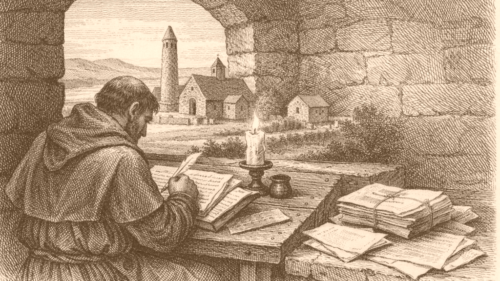
The Annals of Inisfallen are important because their manuscript history links them to Emly, Tomgraney, Killaloe, Lismore, and later Inisfallen, according to the editorial note. That movement suggests changing custodianship across Munster rather than a single stable centre. It is reasonable to read the text as preserved through ecclesiastical and regional elites, but the evidence does not justify a stronger claim about their politics. The manuscript trail shows continuity and displacement at once.
The Annals of Ulster present a different kind of complexity. The edition notes lacunae, more than one manuscript witness, and the use of later copies to fill gaps in the text. These features show textual layering and loss, not a direct map of power. They do, however, show that the text survived through copying, correction, and supplementation rather than through one uninterrupted line of transmission. That pattern is enough for caution, not for a fuller political reconstruction.
Lost Compilations
The Fragmentary Annals make the instability of preservation especially visible. The Brussels manuscript is the only known copy, and its immediate source was a transcription made by Dubhaltach Mac Fir Bhisigh from a now-lost vellum manuscript. The editor also suggests a possible connection with the Book of Cluain Eidnech. This is careful reconstruction, not certainty. Even so, the chain of copying shows that important historical writing could survive only through small learned networks and precarious manuscript transmission.
The same source history suggests that the Fragmentary Annals were once part of a broader compilation containing secular and ecclesiastical materials. The editor says the book probably gathered several kinds of texts, and that related material belonged to different sources. This does not identify a single political centre. It does show that learned communities assembled the past from varied interests, including religious and dynastic ones, which is compatible with a politically divided island, though the degree of division cannot be measured from this text alone.
Political Meaning
Fragmentation here should be understood as a historical condition, not as a single event. The surviving texts do not provide a direct political map, and the editorial histories show that preservation depended on copying, lacunae, and later reconstruction. They do, however, show records produced and preserved in different regional settings. That pattern is consistent with dispersed institutions and local authority, but the broader political realities must remain interpretive rather than directly read from the annals.
A cautious reading is necessary because the digital editions themselves depend on editorial reconstruction, supplied text, and manuscript comparison. That makes any large political synthesis partly interpretive. The overall pattern is persuasive, but it remains a pattern of evidence rather than a finished political map. Ireland appears here as a landscape of many centres of preservation, not one centre alone, and that distinction should be kept as an inference, not as an absolute claim.
Regional Memory
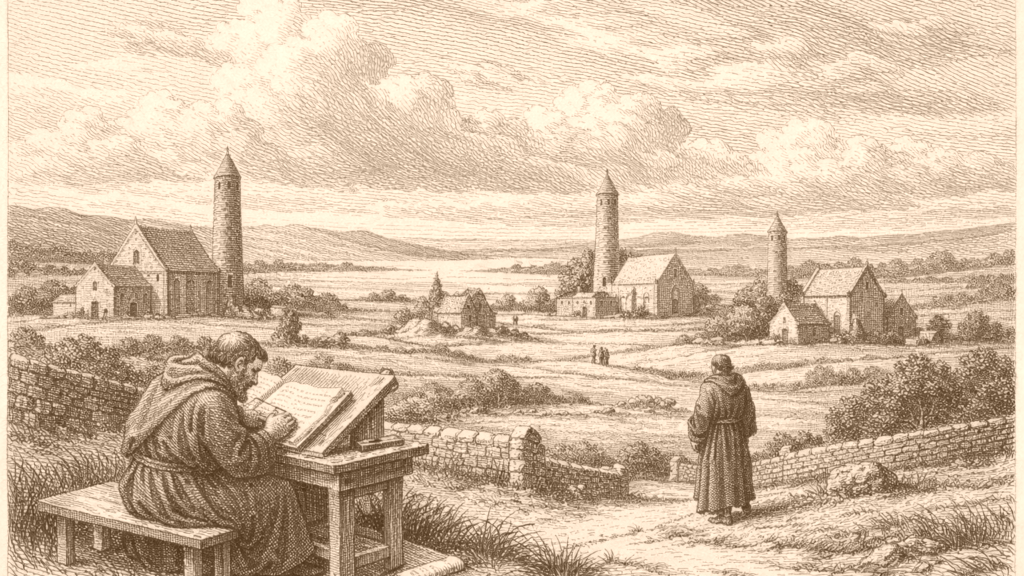
Regional memory helped sustain fragmentation by preserving distinct pasts in distinct manuscript traditions. Inisfallen is linked to Munster houses, Ulster survives through multiple manuscript witnesses, and the Fragmentary Annals passed through another chain of ownership entirely. These are not interchangeable archives. Taken together, they show that communities remembered the past through their own ecclesiastical and learned settings, while the surviving books themselves remained partial, uneven, and dependent on later recovery.
The bibliographic record confirms that these were not isolated survivals. CELT lists many Irish annalistic and historic texts, from Ulster to fragmentary annals, short annals, and other compilations. That dispersion is a clue rather than a conclusion. It suggests that political memory was local, partial, and repeatedly reassembled from surviving copies, but it does not prove that every political community in Ireland shared the same priorities or institutions.
Historical Judgement
A cautious conclusion is warranted. The evidence does not permit a direct measurement of political fragmentation, nor does it allow every lordship or kingdom to be mapped from the annals alone. What it does reveal is a world of multiple recording centres, overlapping institutional loyalties, and layered textual transmission. On that basis, fragmentation can be treated as a durable feature of Irish political life, but only as an interpretation grounded in manuscript history rather than as a simple statement made by the texts themselves.
The surviving annals are uneven sources shaped by editors, copyists, lacunae, and replacement readings. Their value lies in what they reveal about preservation as much as about events. The overall pattern is persuasive, but it remains a pattern of evidence rather than a finished political map. Ireland appears here as a landscape of many centres, not one centre, and that distinction should remain interpretive rather than absolute.