Humanitarian Diplomacy
At a Glance
Opening Context
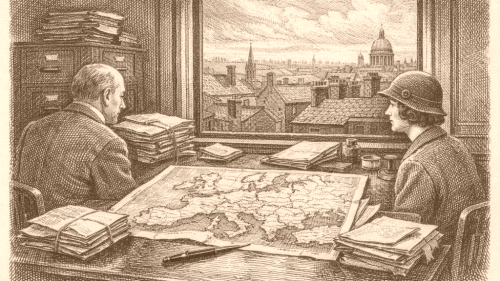
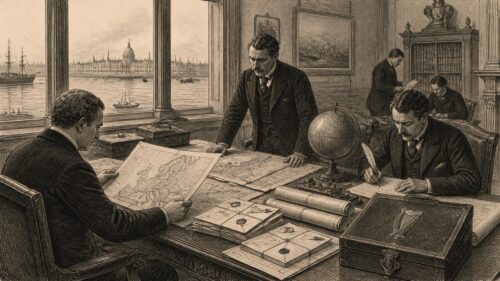
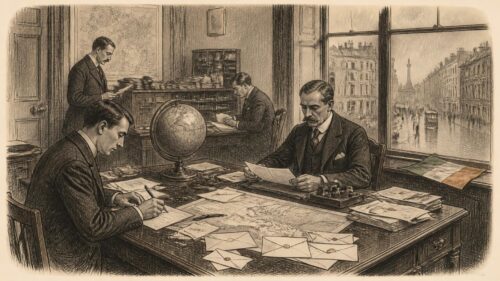
The surviving material places humanitarian diplomacy inside formal Irish foreign relations rather than outside them. One source describes an illustrated history of Irish foreign policy and notes that it was intended to combine text with images, ephemera, and documents. Another explains that CELT is a digital repository of Irish historical and literary texts. Taken together, these records show a modern scholarly and archival frame for studying Irish diplomacy through written traces rather than through broad summary alone.
Within that frame, the word diplomacy covers different kinds of action. Some passages concern official correspondence in 1921, others postwar foreign policy after 1945, and others the hunger strikes of 1981. The record is therefore not a single continuous story of humanitarian policy. It is instead a set of distinct moments in which appeals to peace, relief, or humane treatment appear in diplomatic writing, often alongside political calculation or institutional formality.
Peace Appeal
The 1921 correspondence presents peace as a practical diplomatic aim stated in moral language. The British prime minister says the government is anxious that the king's appeal for reconciliation in Ireland not be in vain, and that a conference should be held in the spirit of conciliation. He also invokes a desire to end a conflict that had divided Ireland and the relations of the two islands, and says cooperation would matter to humanity as well as to the empire.
De Valera's reply also uses the language of peace, but it sets conditions around national unity and self-determination. He says his side most earnestly desires a lasting peace between the peoples of the two islands, yet sees no route if Ireland's essential unity is denied and the principle of self-determination set aside. He then turns to consultation with representatives of the political minority, linking peace talk to domestic representation rather than to a simple bilateral bargain.
Minority Voices
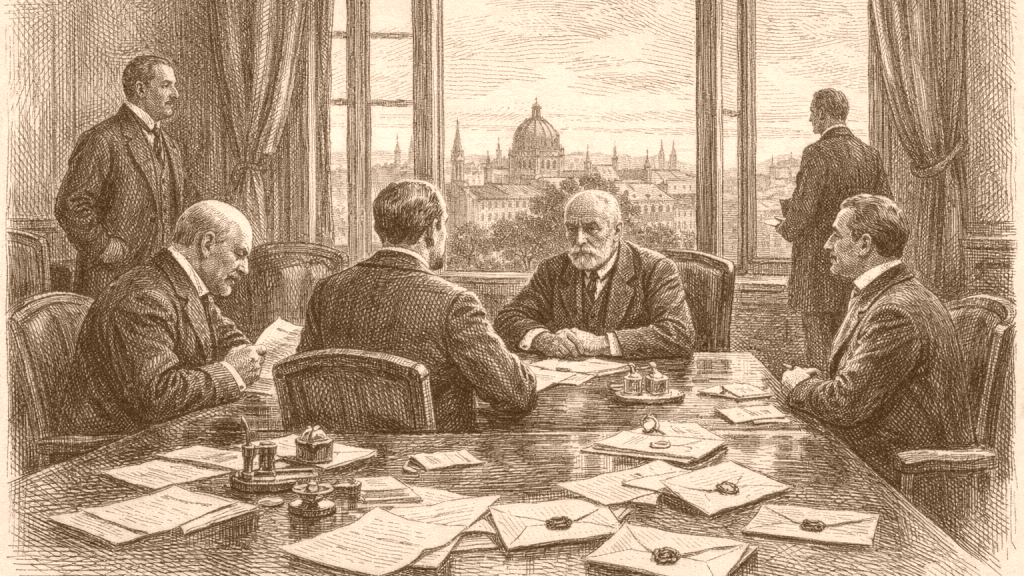
The same correspondence expands the negotiating frame beyond the main protagonists. De Valera writes to representatives of the political minority in Ireland before sending his reply, saying that his answer would affect their lives and fortunes as well as those of the majority. He invites them to confer at the Mansion House, and the letter was accepted by several named figures. The surviving text therefore shows a deliberate attempt to bring minority representation into the diplomatic exchange.
The record also shows that not every invitation was accepted. De Valera sent a telegram to Sir James Craig asking him to come to Dublin, but Craig declined, saying he had already accepted the British prime minister's invitation to the London conference. De Valera replied that the proposal in its present form was impossible of acceptance and that Irish political differences ought to be adjusted in a different way. The documentary sequence preserves disagreement as well as conciliation.
Postwar Relief
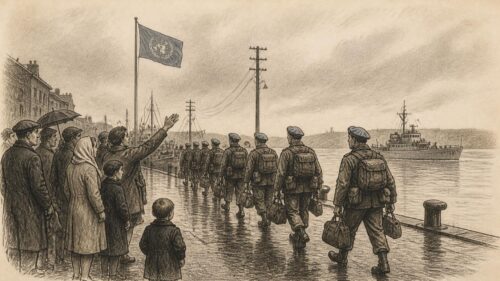
Later diplomatic writing places Ireland in a wider postwar setting that includes relief and recovery. One Irish Times account of post-1945 foreign policy says the period involved rebuilding Europe, the Marshall Plan, and food aid, including a photograph of Irish sugar given to Milan. It also states that Irish diplomats sought to repair relations with states that had suffered during the war. In this material, relief is not abstract; it appears as a named part of foreign policy practice.
The same account emphasizes that Irish foreign policy after the Emergency extended to a wide set of issues. It says the archives cover German assets, bombing compensation, German internees, British minefields, and the position of Defence Forces deserters. The passage does not present these matters as a single humanitarian programme. Instead, it shows a state addressing the aftermath of war through administrative and diplomatic channels, alongside the broader return to the international system and multilateral organisations.
Global Reach
The broader foreign-policy narrative also links Ireland's diplomacy to wider world institutions. One account says Ireland engaged with new multilateral organisations, opened new diplomatic missions, and repaired relations with the United States and Britain. Another says the state sought a place in international affairs from the first Dáil onward, and that early diplomacy included missions to Paris and the United States. These passages describe a long movement from seeking recognition to working within an established diplomatic system.
Yet the wording of these passages keeps humanitarian language close to practical statecraft rather than to idealism alone. The same source on postwar diplomacy says the foreign service had to cover a wide range of bases because a small European country could not remain aloof from world upheaval. The description is organizational, but it sits beside references to relief, missions, and repair. The result is a picture of diplomacy that must handle human consequences and state interests together.
Humanitarian Strain
A later example shows humanitarian language entering a domestic political crisis. An account of the 1981 hunger strikes says Dublin, fearful of the emotions the strikes aroused but opposed to political status, sought a humanitarian solution that would limit support for Sinn Féin. The same account says the governments wanted to undercut support for the movement while avoiding concessions that would amount to political recognition. Humanitarian phrasing was thus present, but it was tightly bounded by electoral and constitutional concerns.
The same source shows how this approach continued under Garret FitzGerald. It says he and John Kelly criticized the British lack of urgency, but still held that the key problem was the IRA's refusal to end violence. FitzGerald would not meet one hunger striker, and he told families that solutions would be easier if the IRA and INLA gave up violence. The text makes clear that humanitarian concern did not remove the surrounding political conditions.