
Irish Journalism
At a Glance
Collection Scope
The National Library of Ireland describes its newspaper holdings as the largest in the country, with coverage extending from the late seventeenth century to the present day. It also states that it collects national, regional, Northern Irish, and selected international newspapers of Irish interest, while aiming to be as comprehensive as possible. That description presents Irish journalism as something preserved through a broad and continuing collecting policy rather than through a single title or period. [6]
The same institution explains that titles may be searched in its online catalogue and consulted in microfilm or digital form in reading rooms, with hard copy used only when those formats are unavailable. It also notes that many national and regional titles have been digitised. This shows a layered research environment in which newspaper history is preserved through catalogues, microfilm, digitisation, and controlled access, rather than through one medium alone. [6]
Historic Papers
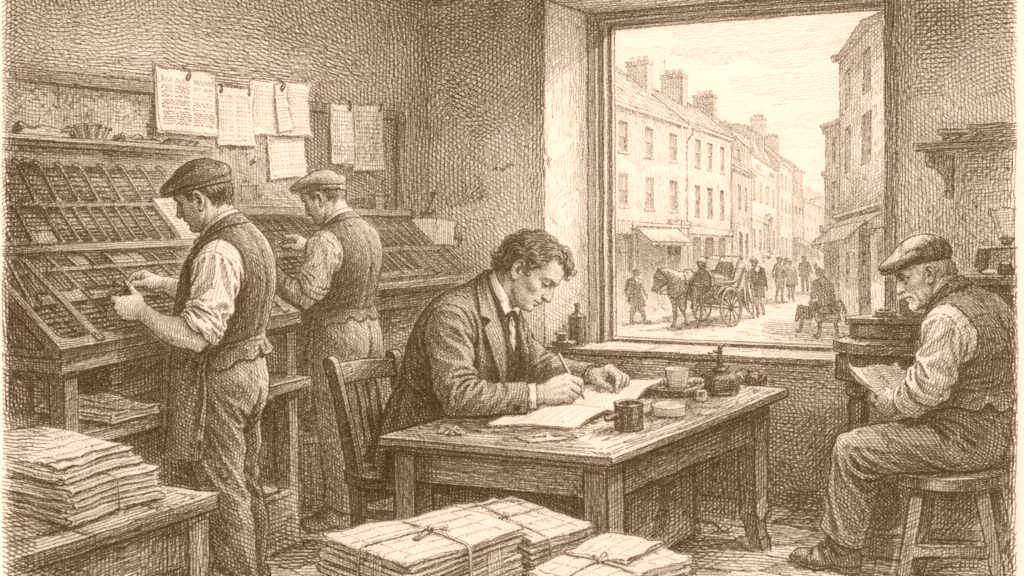
University College Cork’s project on Cork’s historic newspapers presents Irish newspaper enterprises as important in disseminating news and opinion, and says they sometimes became part of the news themselves. The project links that activity with the years around the Easter Rising and states that proprietors, editors, reporters, journalists, and printers in Cork were all men. It also describes them as middle-class figures who connected political leaders with ordinary citizens. [7]
That same project is framed as a collection focused on the politics of Cork’s newspapers and their employees before the Rising, their reaction to the rebellion, and any transformative effect on reportage. The wording is limited to that local setting, but it makes clear that newspapers can be studied not only as records of events but also as workplaces and public actors. In this case, the record is explicitly tied to one city and one political moment. [7]
Digital Access
Irish Historical Newspapers presents itself as a searchable archive with numerous titles, including the Irish Press, Belfast Newsletter, Freeman’s Journal, The Nation, and others. Its listing gives publication places and year spans, showing that Irish journalism is approached through an inventory of individual newspapers rather than through a single national sequence. The archive therefore appears as a practical research gateway, organised by title, place, and date range. [2]
The National Library of Ireland’s eResources page adds that it provides access to hundreds of Irish newspaper titles and serials, along with digitised books, manuscripts, maps, and other reference tools. It names several newspaper databases, including an Irish newspaper archive, a radical newspaper archive, the British Newspaper Archive, and the Irish Times Archive. The emphasis is on research access, not on narrative history, but it shows the range of digital routes into newspaper material. [5]
Magazine Framework
History Ireland describes itself as a dedicated history magazine first launched in 1993, published six times a year, and illustrated in every issue with photographs, maps, or paintings. It says the magazine covers topics from the earliest times to the present day and offers subscribers access to a full archive of articles, features, and reviews. Within these excerpts, it appears as a current venue for historical writing rather than as a newspaper source itself. [1]
The magazine’s description also names an editorial structure, including an editor, consulting editor, digital editor, editorial board, and publishing staff. That detail indicates a contemporary publication infrastructure, but the excerpt does not identify specific journalism topics or individual articles. What it does establish is that Irish historical publishing now includes a specialist magazine with a broad subject range and an accessible archive for readers and subscribers. [1]
Bibliographic Context
Irish History Online describes itself as a searchable electronic bibliography of publications on Irish history, based at NUI Maynooth and developed in cooperation with the Royal Historical Society bibliography. It states that almost 60,000 titles are accessible, covering publications from 1936 to 2002, and that the database includes monographs, essays in collective volumes, and journal articles. For the study of Irish journalism, that means the field can be searched within a wider historical bibliography, not only in newspaper archives. [3]
The same resource notes that records are indexed with keywords, time periods, subjects, places, and personal names, and that users can search by year or range of years. It also says that more recent titles are being added in phases. Those details indicate a bibliographic tool designed for topical investigation, while also showing an explicit limitation: the online record described here stops at 2002, with later material only partially available. [3]
Reporter Method
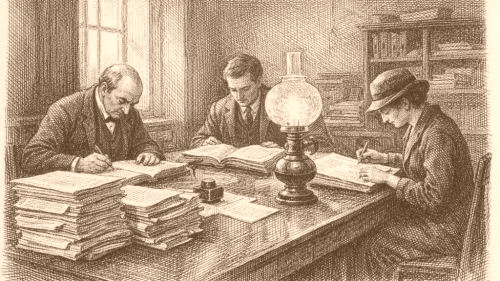
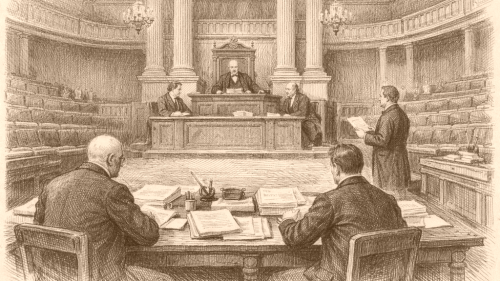
A UCC article on Dublin City coroner’s court reporting states that reporters routinely occupied court galleries at the beginning of the twentieth century and that newsworthy cases were self-selecting. It says headlines could be built quickly from verdicts and riders, and that verbatim replication of proceedings gave editors material safe from libel. The passage therefore presents newspaper reporting as a process shaped by courtroom access, selection, and editorial reuse. [4]
The same study warns that historians should use digitised newspapers with great caution when reconstructing partial archival pasts. It also points to limitations in search engines and to embedded gender and class biases that affected editorial decisions. Within the excerpt, those cautions apply specifically to coronial records and suicide coverage, so the evidence supports a methodological warning rather than a general claim about all Irish journalism. [4]
Source References
Hover over a number to see the source. Select it to open the source.

- [1] About History Ireland - History Ireland
- [2] Irish Historical Newspapers
- [3] Irish History online
- [4] Newspapers as Surrogate Archives: A Case Study of the Early Twentieth-Century Dublin City Coroner's Court - Discover Research at University College Cork
- [5] eResources | National Library of Ireland
- [6] Newspapers | National Library of Ireland
- [7] Cork's Historic Newspapers | University College Cork
How do the available catalogues, archives, and descriptive studies present the collection and study of Irish journalism across manuscript, print, and digital formats?