
Migration Opinion
At a Glance
Press Framing
A study of Irish newspaper discourse on immigration says the Irish Times was used as the source base for opinion and editorial writing between 1996 and 2004. The abstract states that the analysis examined how Irish national identity was constructed against demographic, social, and economic change brought by immigration. It also identifies two recurring cultural resources, a historical duty argument and the myth of Saint Patrick, as part of the newspaper’s treatment of immigration. [1]
The same abstract says one might have expected an exclusive ethnic response because of Ireland’s emigration experience, imperial involvement, and treatment of indigenous minorities. Instead, it says the local narratives were used to make sense of immigration and to encourage inclusive political and social action. In this limited material, the notable comparison is not between equal competing camps, but between an expected exclusionary response and the inclusive framing actually described. [1]
Famine Judgement
Trevelyan’s Irish Crisis frames the famine as a moment from which posterity will trace a salutary revolution in national habits. The opening pages present the event as something to be reviewed with calm and as a basis for future historical judgment. The passage also places this discussion beside references to absenteeism, Protestant bigotry, Roman Catholic bigotry, Orangeism, Ribbandism, and the Repeal cry, listing them as troubles an enlightened observer might name. [3]
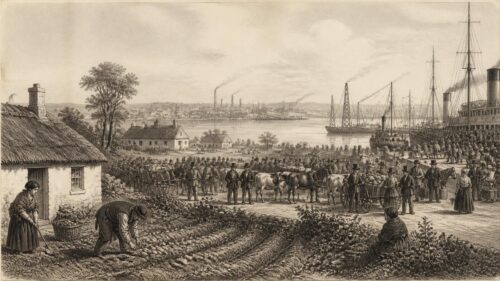
A later economic survey describes the nineteenth century as divided by the famine of 1846 and 1847. It says the potato failure led to thousands of deaths by starvation and the commencement of emigration that was still continuing. The same passage states that the population declined from eight million to under four and a half, and that the repeal of the Corn Laws first checked Irish grain growth and export trade. [4]
Returned Men
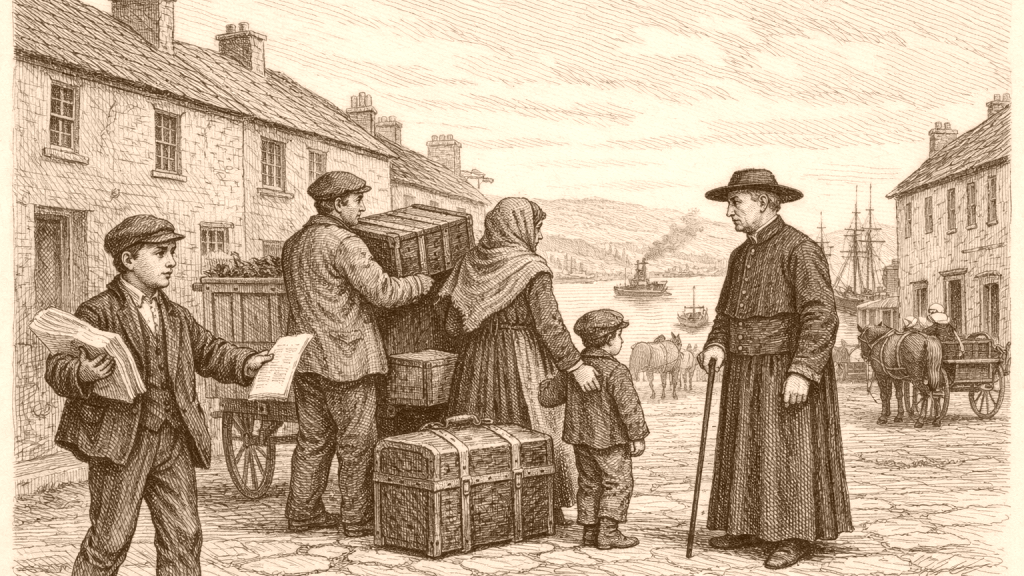
Connolly’s Returned Emigrants responds directly to press reporting about refused passages and forced returns. He says the daily papers reported that Irish emigrants, or would-be emigrants, were refused permission to board Atlantic liners at Liverpool and Londonderry, and that the men were of military age and suspected of trying to avoid conscription. He also notes the newspaper image of the men standing outside a steamship office while a jeering crowd looked on. [2]
The same text says British steamship companies issued notices declining to book passages to men of military age. Connolly turns that fact into a political argument by contrasting the blocked movement of men with the export of food from Ireland to England. His passage asks whether Irish people should allow cattle and harvests to leave if the men who sowed and reaped them cannot go as well. [2]
Church Loss
Sheehan presents emigration as a continuing drain on the country. He describes the people as banned, persecuted, and exiled, and says three million left in thirty years. He also notes that a bill had passed through Parliament for State aid to assist emigration and that private speculators, leader writers, pamphleteers, philanthropists, doctrinaires, and landed gentry were all involved in the discussion or financing of the scheme. [5]
He then asks how this exodus affects the Irish Church and says he wants to discuss the matter without reference to existing controversies except where facts support his statements. The passage says the Church had been shorn of half its strength during the last thirty years. The evidence here is institutional and numerical, focusing on loss rather than on the motives of emigrants or the broader politics of departure. [5]
Money Flow
A modern discussion of remittances says that after the Great Famine emigrants sent money home and that the British government began gathering statistics on Irish remittances in 1848. It also states that demand for transfer services led to the Emigrant Industrial Savings Bank in New York and that the bank opened an office in Dublin. These passages make migration visible as a monitored and organized financial practice. [6]
The same account says remittances were often used for rent and that for tenant farmers they could mean keeping the land or losing it. It adds that Irish patriots decried the reliance on American money because it went to landlords, while priests sometimes collected emigrants’ names and addresses to seek funds for church building. The passage therefore shows money from abroad entering both household and parish life. [6]
Public Voices
Taken together, these excerpts show migration appearing in several public voices: newspaper editorial analysis, polemical pamphlet argument, clerical reflection, economic survey, and discussion of remittances. The newspaper study identifies inclusive framing in late twentieth-century opinion writing, while Connolly, Sheehan, Trevelyan, and Murray present migration through different kinds of judgment or description. The shared feature is public visibility, not a single consistent interpretation. [1] [2] [3] [4] [5] [6]
The chronology across the excerpts also matters. The nineteenth-century texts speak from famine, church, and economic crisis, while the newspaper study addresses 1996 to 2004. The language ranges from judgment and grievance to administrative description and inclusion. What remains absent is a single continuous account of all public opinion; these passages instead preserve separate moments in which migration becomes discussable in public language. [1] [3] [4] [5] [6] [2]
Source References
Hover over a number to see the source. Select it to open the source.

- [1] Who Do We Think We Are? Immigration and the Discursive Construction of National Identity in an Irish Daily Mainstream Newspaper, 1996-2004 - MURAL - Maynooth University Research Archive Library
- [2] Part 1 of The Returned Emigrants
- [3] The Irish Crisis
- [4] Part 17 of History of the Commercial and Financial Relations between England and Ireland from the Period of the Restoration
- [5] The Effect of Emigration on the Irish Church
- [6] We have relied on our diaspora’s generosity for centuries
How do the selected Irish texts represent migration in relation to public opinion, and what kinds of public language do they show?