Whiskey Origins
At a Glance
Early Record
The earliest dated reference in these excerpts belongs to 1405 and appears in a note on the drinking of usquebagh or whisky. That note identifies the passage as the earliest extant reference to the national beverage and summarizes the episode as a death after drinking uisce-betha. The wording is brief, but it is enough to show that the drink was already named in a form recognizably connected to later whisky terminology.
The same note also places the 1405 reference alongside later sixteenth- and seventeenth-century mentions of the drink in Irish social habits. It does not provide those later passages in full, but it does explicitly say that notices of the drinking of usquebagh or whisky were frequent in that later period. The evidence therefore shows continuity of reference across centuries, while the specific contexts remain only partly described here.
Named Drink
The terminology in the excerpts is varied but closely related. One passage uses usquebagh, another explains uisce-betha, and a later travel narrative gives the English form Usquebaugh and Whiskey. These forms appear in explanatory prose rather than in a glossary, which makes the relationship between them visible without any formal definition beyond the text itself. The evidence shows naming in motion, not a single fixed spelling.
The descriptive note on Moryson's text also states that Stanihurst referred to the excellence of Waterford whisky and that Campion wrote in 1571 about the consumption of the same drink. Those are the only named writers in this set of excerpts, and they are introduced as earlier references. The paragraph does not explain their wider arguments; it only records that they are used as evidence for early modern whiskey.
Production Methods
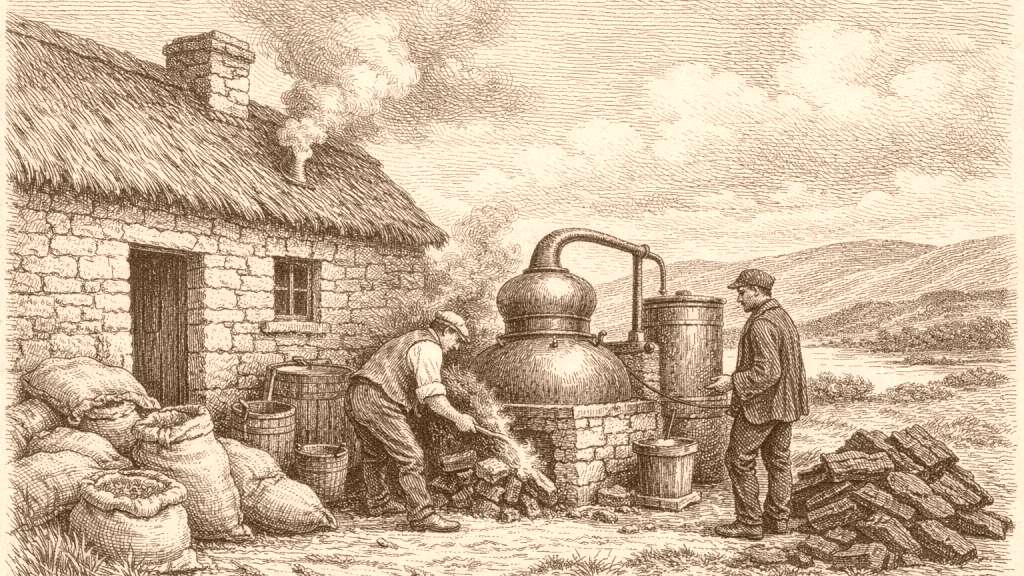
Pococke's eighteenth-century account is the clearest passage on how whiskey was made in the excerpt set. He says that whiskey is made of barley and that it was also distilled from water pressed from potatoes after boiling, mashing, and fermentation with barme. That is a direct description of ingredients and process, not a general theory, and it gives two forms of raw material in one observation.
The same passage frames those methods as local practice in the parts he was travelling through. He notes that the drinking of whisky very much prevails there and that the people regarded it as the wholesomest of spirits. His own judgment differs from theirs, but the contrast is part of the account itself and should be treated as his opinion rather than a verified fact about the drink's effects.
Social Observation
The historical note linked to Moryson presents whiskey as part of social habit. It says that notices of drinking usquebagh or whisky were frequent in sixteenth- and seventeenth-century references to Irish social habits. The statement is broad but bounded: it does not identify every setting or custom, only the repeated appearance of the drink in references to social behaviour.
Pococke adds a different kind of social observation. He remarks that the drinking of whisky very much prevails in the region he is describing and claims it tended to debauch and corrupt the common people. That moral judgement belongs to the traveller, not to an impartial register, yet it remains an important part of how the drink was observed in the eighteenth century within this excerpt.
Manuscript Context
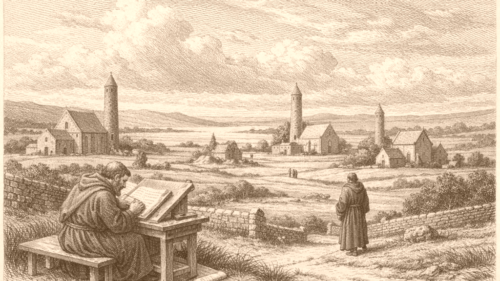
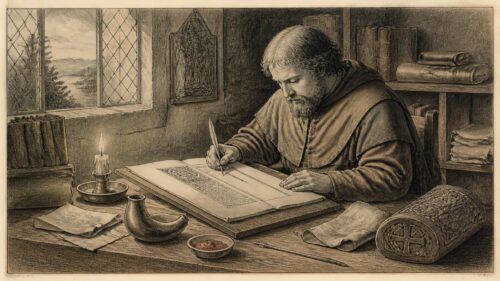
The whiskey references are embedded in texts preserved and described by UCC's Corpus of Electronic Texts. The Annals of Inisfallen are presented as one of Ireland's most important medieval manuscripts, handwritten in Irish and Latin, with 57 vellum leaves and a continuous year-by-year narrative. This contextual material does not concern whiskey directly, but it identifies the manuscript environment in which annalistic references such as the 1405 notice are being read.
CELT's listings also show that annalistic material is grouped among historical, legal, and genealogical Irish texts, with the Annals of Inisfallen named among other annals and chronicle traditions. The page gives editorial information rather than narrative content, but it demonstrates that the whiskey-related reference belongs to a wider archive of medieval and early modern Irish writings now presented in edited digital form.
Historical Range
Across these excerpts, whiskey appears over a long span: an annalistic notice from 1405, later sixteenth- and seventeenth-century references, and an eighteenth-century travel account. The evidence does not allow a continuous history of production or regulation, but it does show that the drink was named, observed, and discussed in different kinds of writing over several centuries. That range is visible without any need to stretch beyond the texts.
The available passages also show limits. They do not explain who first made whiskey in Ireland, how widespread it was outside the places mentioned, or how representative the quoted judgments were. What they do show is a layered record: an annal note, a historical annotation, and a traveller's observation. Taken together, those layers document how whiskey entered Irish textual history in distinct registers.