
Omagh Justice
At a Glance
Town Bombing
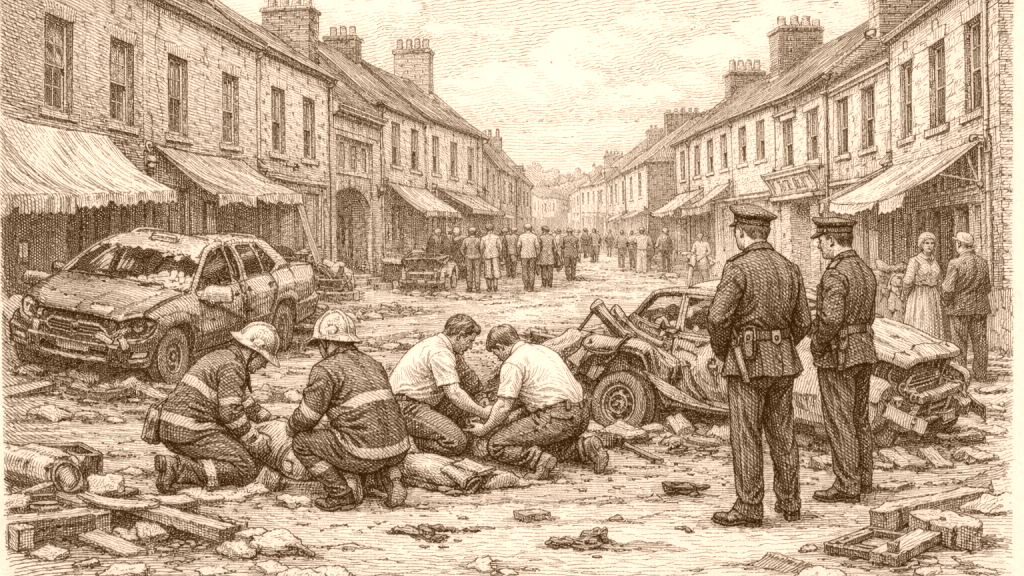
The records place the bombing in Omagh on 15 August 1998 and describe it as a car bomb that killed 29 people and injured more than 200. One account gives the time as 3.04 pm, while another notes that local health and social care services mobilised a comprehensive response. The same set of passages presents the event as occurring seven weeks after the Good Friday Agreement was endorsed, fixing it within that immediate post-agreement moment. [2] [7]
A museum account adds details of the victims by name and age and notes that a Spanish exchange group had visited the Ulster American Folk Park before going into Omagh town centre. It identifies Fernando Blasco Baselga, Rocio Abad Ramos, James Barker, Oran Doherty, and Sean McLaughlin among the dead. The archive record, by contrast, first reports 21 dead at the scene and later records the total death toll reaching 29 after Sean McGrath died in hospital. [3] [4]
Immediate Response
The archive shows the first aftermath in practical terms. It records hundreds injured, 11 described as critical, and 113 detained in hospital in early reports. It also notes political leaders returning to the United Kingdom, volunteers arriving from throughout the province and from the South, Spanish doctors flying in with relatives, and a repeated call for blood donors after more than 600 units were used in the first two days. These details present a rapid, multi-layered emergency response. [4]
The same archive also registers public grief in material form. It says floral tributes arrived in their thousands from around the world, and that the messages came from throughout Ireland, the UK mainland, and further afield. A cited phrase on one tribute reads that people came because they cared. This is evidence of breadth of response, but only within this archive excerpt; it does not by itself measure the scale of public feeling beyond those recorded messages. [4]
Memory Archive
The Libraries NI Omagh Bomb Archive presents the afterlife of the event as an archival project. It says library staff collected and collated information about the tragedy and its aftermath, and that the Omagh Support and Self Help Group also gathered material. In 2001 the two bodies agreed to work in partnership and seek funding for a searchable database. The archive describes the project as significant and challenging, involving many people across the community. [4]
The same archive explains who it was meant to serve. It says the information was made accessible for victims and their families, as well as for researchers and academics from the local community and across the world. That purpose is visible in the archive description itself, which frames remembrance and research together. The passage does not explain how users have since employed the material, only that access was intended for those groups. [4]
Public Discourse
An academic article argues that the bombing became a defining moment in the new public discourse of the peace process. It states that the attack did not fundamentally change public discourse about peace, justice, and reconciliation, but that it exposed the depth of public hopes for peace and reconciliation. The same abstract also identifies the Real Irish Republican Army as the perpetrators and places the bombing in opposition to the Belfast or Good Friday Agreement. [2]
The article also makes a limited claim about justice. It says the bombing indicated that, despite hopes surrounding the Agreement, justice would remain extremely difficult for victims to achieve legally even after it. That statement is specific to the article's framing and should be read as interpretation rather than as a general conclusion about every victim or every legal process. The passage itself gives no detailed account of particular court outcomes. [2]
Inquiry Work
The Omagh Bombing Inquiry is described as an independent statutory public inquiry established by the Secretary of State for Northern Ireland to investigate whether the bombing could reasonably have been prevented by UK state authorities. The inquiry says it began formally in February 2024 when the Government issued its Terms of Reference. A documents page shows the inquiry continuing into 2026, with hearings, rulings, restriction orders, and other material listed among its records. [1] [5]
The inquiry pages also show its work in motion rather than complete. The documents list includes a Chapter Three financial report, governance protocols, restriction orders, and witness evidence. The evidence library names many witnesses and lists items such as extracts from an Omagh SIO policy book, an opening statement for Sir Ronnie Flanagan, and a PSNI review of the PONI report. These listings show the structure of the record, though not the contents of every item. [5] [6]
Legacy Justice
A 2003 Policing Board press release shows the investigation still active years after the bombing. It records the board receiving a final report from Deputy Chief Constable Mike Tonge, who had been appointed in 2002 to oversee and progress recommendations. The terms of reference included examining resources, monitoring progress, and enhancing working practices with An Garda Siochana. The same release says the board wanted all opportunities for prosecutions maximised and all lessons learned. [8]
The same release says the board considered the investigation live and viable, with further action still required on some issues and quarterly reporting to continue. Another academic chapter, dealing with mental health, says the response led to a regionalised psychological trauma managed care network and informed a recognition scheme for victims and survivors. Read together, these passages show a legacy of continuing administration, support, and review rather than a closed event. [7] [8]
Source References
Hover over a number to see the source. Select it to open the source.

- [1] Omagh Bombing Inquiry – Independent statutory public inquiry into the Omagh Bombing in 1998
- [2] 'ACROSS THE BRIDGE OF HOPE': THE OMAGH BOMBING AND PUBLIC DISCOURSE IN NORTHERN IRELAND. | EBSCOhost
- [3] https://www.ulstermuseum.org/digital-exhibitions/omagh-bombing
- [4] Libraries NI Omagh Bomb Archive
- [5] Documents – Omagh Bombing Inquiry
- [6] Evidence Library – Page 2 – Omagh Bombing Inquiry
- [7] Case study 1: the Omagh Bomb, the mental health response, and the lessons learned - Queen's University Belfast
- [8] CAIN: Issues: Policing Board: DCC Tonge Presents Final Omagh Report, 4 April 2003
How do the retrieved records frame the pursuit of justice after the Omagh bombing and its later inquiry?