
Tuam Excavation
At a Glance
Site Opening
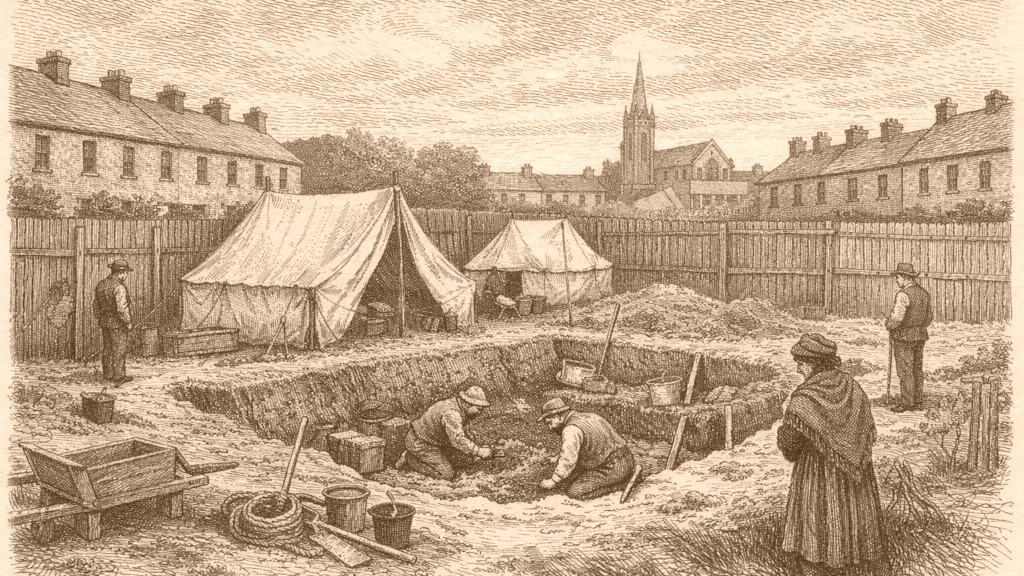
The full forensic excavation at the former Mother and Baby Institution in Tuam began on 14 July 2025, after the site had been closed off to the public and screened from view. Security measures included 24-hour guarding and perimeter hoarding, and the work was described as a process expected to take about 24 months. A visit for families and survivors had already been organised before work started, showing that the excavation was managed alongside controlled access for those most closely affected. [1] [4]
ODAIT’s own overview places the excavation within a broader programme of preparation that included preliminary surveys, recruitment of specialist staff, and family and survivor events in Tuam before the work began. The organisation says it was set up to deliver a process meeting international forensic standards and best practice, and it describes a multidisciplinary team made up of Irish specialists and international experts. In this record, historical justice appears as an administrative and forensic procedure rather than as a single event, and as one that was prepared over many months before the first ground was broken. [4] [1]
Forensic Work
By July 2026, the excavation team was working across a 0.48-hectare site in the middle of a housing estate in Tuam. The reports describe areas marked for excavation, completed areas, and temporary structures that were dismantled and replaced as the work progressed. One update notes that a subterranean vaulted structure was built in the 1840s, though that date refers to the structure itself, not to the modern excavation. The later update also says the excavation had identified the foundation cut for the chamber, helping to situate the buried remains within the site’s earlier construction history. [2] [3]
The technical updates distinguish several excavation zones. Hand excavation continued under Tent 2, work around the exterior of the subterranean chamber progressed, and a well reached four metres before being paused for health and safety reasons. The reports also say that the area now being examined had once been covered with bitumen and gravel for vehicular access, and that there were no surface markers to show burials below. In the account of the subterranean chamber, the sediment was carefully sieved and sorted after excavation, showing the measured, step-by-step character of the work. [2] [3]
Human Remains
The reports record human remains from several locations. One update says that 77 infants were recovered from Tent 1, while another says that excavation in Tent 2 had produced 22 coffined infants by mid-2026. The later report brings the total institutional human remains recovered on site to 109 individuals, showing that the scale of recovery was still increasing as the excavation advanced. A subsequent update confirms that further recovery in Tent 2 brought the total from that area to 32 infants before excavation there was paused for tent removal. [2] [3]
The same updates also report disarticulated infant remains in the subterranean chamber, where the material lay above deposits containing evidence of pre-institutional date. The chamber yielded three adult teeth and artefacts, including glass bottles with maker names and a registered trade mark that indicates post-1875 production. These details matter because they show the excavation reading the site through layered physical evidence, not through single remains alone. The evidence from the chamber was therefore treated as part of a broader archaeological sequence, rather than as an isolated find. [2] [3]
Identification Effort
The identification programme runs alongside the excavation. ODAIT reports collecting DNA reference samples from family members, delivering them to Forensic Science Ireland, and extending contact beyond immediate kin to first cousins. One update says the total DNA references had reached 62, and another later says 74. The updates also note that the Government intended to amend the Institutional Burials Act 2022 so that first cousins could be eligible family members, and that officials were working on the necessary legislative changes. Identification is therefore presented as a continuing administrative and scientific task, not as a separate stage completed after excavation ends. [2] [3] [4]
This material presents identification as part of the same process as excavation and recovery. ODAIT says the team continued to engage with families, that an identification programme was planned to open, and that a public information campaign was due to launch in November. The sequence suggests a formal effort to connect recovered remains with living relatives while the forensic work was still under way, with outreach extending nationally and internationally. The office also continued to invite anyone who believed they might have a family member buried at the site to come forward. [3] [4]
Justice Process
The language of justice in these updates is procedural and careful. ODAIT emphasises forensic integrity, respect for survivors and family members, and adherence to international standards. Public access for media and photographers was prohibited during the works, and the excavation was concealed from view. These steps are presented as protections for the examination and for the people connected to the site, rather than as interpretive claims about the past. The record also shows a deliberate effort to manage information so that technical work, family engagement, and privacy could proceed together. [1]
The record also shows a change in institutional setting. ODAIT reports that the new forensic facility and mortuary at Toghermore opened in July 2026, and that forensic analysis began there in August. A Scientific Working Group had already visited both the excavation site and the facility as part of its review. In the available updates, historical justice is therefore tied to a wider network of expert review, laboratory work, and managed public communication, with excavation and analysis linked across different locations and phases of the same programme. [4]
Source References
Hover over a number to see the source. Select it to open the source.


How have the forensic excavation and identification programme at Tuam been framed as a pursuit of historical justice in the available institutional updates?