
Traveller Recognition
At a Glance
Archive Context
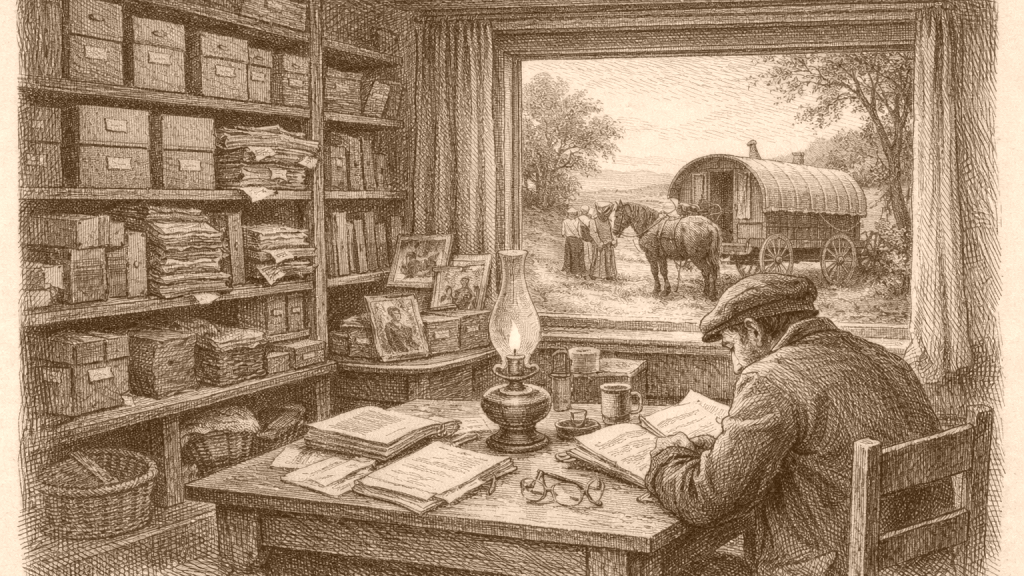
The evidence places Traveller recognition inside institutional description rather than a single legal moment. One university collection is presented as a resource on Irish Travelling People and says it covers the community’s way of life, values, and customs. Another archive describes itself as a growing collection focused on Irish Travellers and on the social changes from the 1960s onward. These records show recognition through cataloguing, subject selection, and naming practices rather than through one uniform definition. [1] [3]
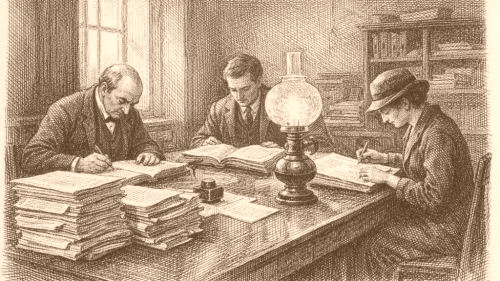
The same institutional pages also show that Traveller-related holdings are mixed in date and form. Ulster University says its collection includes books, pamphlets, newspaper cuttings, journal articles, photographs, and postcards, with some earlier documents from 1890 onward. The University of Galway archive similarly lists books, papers, notes, photographs, videos, and audio recordings. Taken together, these descriptions show a broad documentary range rather than a single archival genre devoted to Travellers. [1] [3]
Policy Language
A later policy-related description identifies a strong contrast with the archive material. The Irish Traveller Movement states that the first state policy on Travellers was the Commission on Itinerancy report of 1963, and it says the report framed nomadism as a problem and aimed to reduce and end it. A separate Jesuit Centre text reproduces the report’s terms of reference as seeking a better way of life, absorption into the general community, and reduction of itinerant disadvantages. These passages preserve the policy language itself. [4] [5]
The same policy sources also show that Traveller representation was absent from that committee, at least as described in the movement’s account. It says no Traveller representatives were included, while the Jesuit Centre passage presents the report as a state document still shaping later experience. The evidence does not provide further detail here about how the committee worked; it only shows the wording of the report and the stated absence of Traveller membership. [4] [5]
Collection Scope
Special collections pages show recognition through curation of named holdings. Ulster University’s Irish Travelling People collection says it covers all aspects of Travellers’ way of life, values, and customs, and lists subjects such as early history, Shelta, folktales and folk music, health and welfare, education, and site provision. The University of Galway archive likewise lists human rights, education, employment, accommodation, music, folklore, and photographs. The overlap is visible in the subject lists, though each archive organizes them differently. [1] [3]
These collection descriptions also show different time frames. Ulster University says most of its material was collected between 1975 and 1998, with occasional later additions, while the University of Galway archive says its project began in November 2021. That difference matters for reading the records: one is a long-assembled special collection, the other a newer archival project. Both, however, present Traveller material as a legitimate object of archival care and research access. [1] [3]
Research Access
Access conditions themselves are part of the evidence for recognition. Ulster University says its collection may be consulted by arrangement with the Social Sciences Librarian, while the University of Galway says its archive is open to Irish Travellers, the university community, and the public. These statements present different access frameworks, but both place Traveller material within formal institutional spaces rather than informal storage. Recognition here appears as permission, arrangement, and public listing. [1] [3]
The University of Galway page also states that the archive was one of six projects sponsored by the Office of the University President through a special fund. That detail shows institutional support for the project, but it does not by itself explain larger historical consequences. What can be said from the page is narrower: Traveller-related archiving was treated as a supported university initiative and linked to historical record-making at the institution. [3] [6]
Community Records
Later community records show Traveller recognition through advocacy and service provision. London Metropolitan University’s description says its material on Irish Travellers includes reports and information sheets on supporting Traveller pupils, safe childbirth, prison experiences, and accommodation in housing and sites. It also notes audio recordings in which Travellers based in London explain their traditions and the discrimination they have faced. The emphasis is on contemporary lived experience and practical concerns rather than on a single historical archive type. [2]
The same collection page adds that the Irish Traveller Movement in Britain was founded in 1999 to research and advocate for Irish Travellers, later changing its name to the Traveller Movement. That detail shows a named organization dedicated to research and advocacy, but the page does not explain every phase of its work. It does, however, connect Traveller recognition to public-facing materials, services, and advocacy networks in the late twentieth and early twenty-first centuries. [2]
Comparative Threads
Across the passages, recognition appears in several forms: naming a community, defining subjects for collection, and preserving institutional access. The policy texts use terms such as itinerants and absorption, while the archive pages use Irish Travellers, Irish Travelling People, and Mincéirs Archives. These are not identical labels, and the sources do not claim that one replaced another. What is directly visible is that different institutions chose different descriptive language for related material. [1] [3] [4] [5]
The documentary record also shifts from policy framing to collection description. The 1963 report, as summarized in later pages, is concerned with problems, absorption, and disadvantages; the newer archives list culture, rights, accommodation, and community life. That comparison is limited to the wording preserved in these pages, but it still marks a clear change in emphasis within the retrieved material itself, from administrative problem-setting to archival preservation and community documentation. [3] [4] [5]
Source References
Hover over a number to see the source. Select it to open the source.

- [1] Ulster University Library - Library Services - Special Collections
- [2] https://collections.londonmet.ac.uk/pages/travellers
- [3] Mincéirs Archives - University of Galway
- [4] accommodation - Irish Traveller Movement
- [5] Where Is My Mind: Traveller Accommodation and Mental Health - Jesuit Centre for Faith and Justice in Ireland
- [6] September - University of Galway
How do archival and institutional descriptions document the recognition of Irish Travellers across policy, collection-making, and research access?