

Remembered Ireland
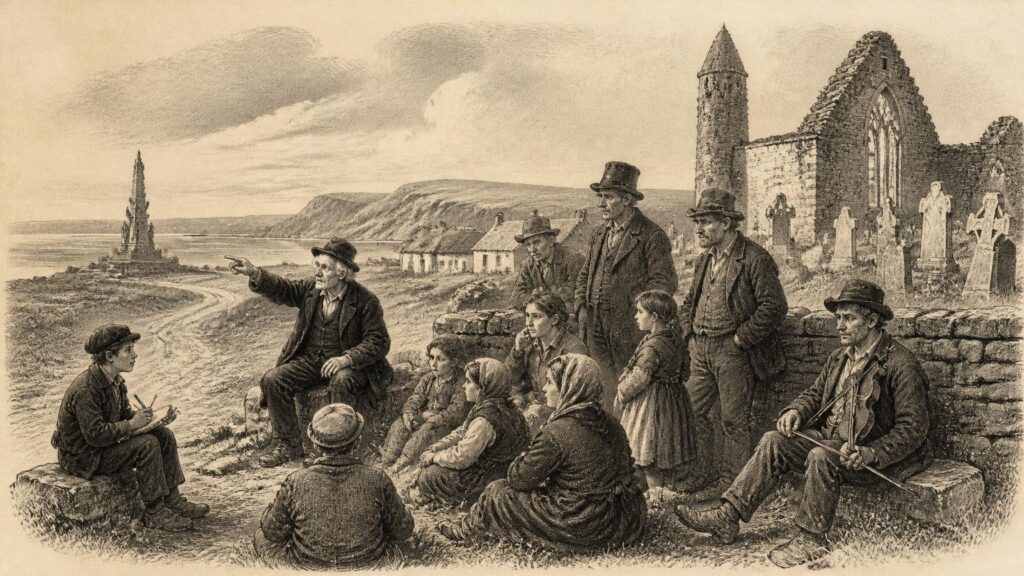
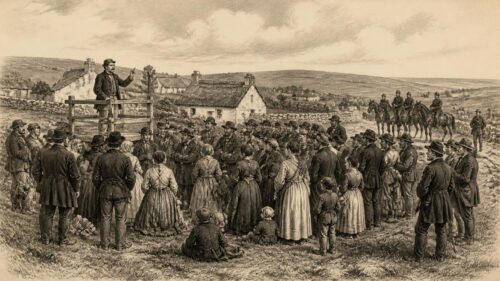
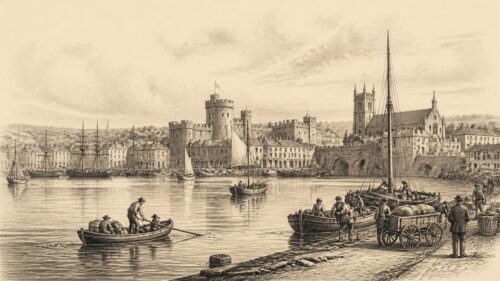
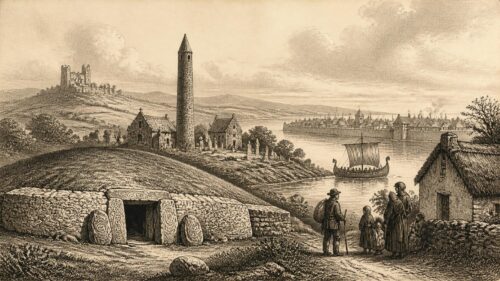
AI generated historical illustration, not a contemporary photograph.
At a Glance
Memory Matters
National memory in Ireland has never been a single inheritance, calmly agreed and simply passed down. It has been made and remade in family kitchens, schoolrooms, graveyards, parish halls, libraries, theatres, political speeches and public streets. It lives in Irish and English, in prayer and ballad, in monuments and silences, and in arguments over whose losses deserve recognition. Culture has supplied many of the forms through which the past becomes emotionally present; memory, in turn, has helped decide which cultural forms are preserved, elevated, neglected or challenged.
To speak of national memory is not to suggest that a nation possesses one mind. Memory is a practice undertaken by people and institutions. It selects, arranges and gives meaning to surviving traces of earlier lives. A state may commission a ceremony; a family may repeat a story; a local historian may rescue a name from an inscription; an artist may make absence visible. Each action can influence public understanding, but none abolishes disagreement. In Ireland, where questions of sovereignty, religion, language, land and belonging have long overlapped, historical memory has often carried unusual political weight.
History and memory are related but not identical. Historical enquiry tests claims against evidence, compares accounts, considers context and remains open to revision. Memory may use evidence, but it is also shaped by mourning, loyalty, resentment, hope and habit. A remembered event can be true in broad outline while the inherited meaning attached to it changes over time. Conversely, a story may be cherished because it expresses a community’s values even where its details cannot be verified. The distinction is essential when considering folklore, patriotic tradition and the stories told after violence.
The modern Irish state has increasingly acknowledged this complexity in its official commemorative practice. The Decade of Centenaries programme, which addressed events between 1912 and 1923, sought to include social conditions, ordinary lives, the Irish abroad and differing traditions on the island. Such an approach did not erase conflict. Rather, it recognised that the past is more intelligible when it is not reduced to an uncomplicated procession of national heroes. This marked an important change from forms of remembrance that had sometimes treated historical complexity as a threat to unity.
Inherited Landscapes
Long before modern nationalism, Irish communities located memory in the physical world. Ringforts, ruined churches, holy wells, standing stones, old roads and burial grounds became points where landscape and story met. Their meanings could be religious, practical, familial or imaginative. People remembered the settlement of a townland, the route of an eviction march, a famine grave or a local battle through places encountered in daily life. Such knowledge did not require formal archives, although archives can now help test and enrich it.
Place-names offer a particularly durable form of cultural memory. They preserve references to topography, work, saints, animals, families and events, often in Irish-language forms that survived even where English became dominant. Yet place-names are not transparent capsules of antiquity. Meanings may be disputed, corrupted in spelling, translated imperfectly or explained by attractive later stories. A local derivation repeated for generations can be culturally valuable without constituting proof of origin. Careful scholarship must distinguish linguistic evidence from retrospective legend.
Christian observance also organised remembrance. The dead were recalled through prayer, anniversaries, funeral customs and visits to graves. Holy wells and patron days connected local communities with saints and particular landscapes, while graveyards condensed many histories into one visible space. Protestant, Catholic and dissenting traditions created distinctive memorial worlds, sometimes alongside one another and sometimes in sharp separation. The island’s religious history means that remembrance cannot be understood solely through the categories of nation and state.
Folklore attached supernatural narratives to particular sites: fairy forts, haunted houses, wandering lights, hidden treasure and encounters with the dead. These accounts should not be read as literal documentary records of remote events. They are evidence of storytelling, belief, warning, humour and local attachment. A tale about a fort may reveal how a community understood an ancient earthwork, protected a landscape feature, or dramatised the risks of trespass. Folklore is therefore historical evidence of cultural practice, though not automatically evidence for the factual occurrence of the marvel it describes.
Revivalist Culture
The cultural movements of the nineteenth and early twentieth centuries gave memory a central place in the making of modern Irish identities. Antiquarian research, Irish-language scholarship, collecting, publishing, theatre, music and sport all contributed to arguments about what Ireland had been and what it might become. The Gaelic Revival did not create Irish culture from nothing. It selected and re-presented materials from living communities, manuscripts, oral traditions and European intellectual currents. In doing so, it made the past a resource for political and cultural renewal.
The Irish language assumed a special symbolic importance because it linked questions of cultural continuity with the consequences of conquest, migration, schooling and economic change. Advocates of revival saw language not merely as a medium of speech but as a store of worldview, literature and collective dignity. Their work brought Irish into new institutions and public performances. It also exposed a recurring difficulty: the difference between reverence for a language and the conditions required for its everyday transmission. Cultural memory could inspire revival, but it could not by itself reverse the social pressures that had transformed language use.
Theatre made the relationship between history and identity especially vivid. The Irish Literary Theatre and the Abbey Theatre placed Irish lives, legends and conflicts before audiences in forms that could be modern, experimental and contentious. Plays did not simply mirror a pre-existing national consciousness. They helped create occasions in which competing visions of Ireland could be rehearsed. Rural life, heroic sacrifice, class conflict, women’s experience and the authority of religion all appeared in cultural debates that were also debates about national character.
Sport performed a comparable task in a different register. The Gaelic Athletic Association linked games to local association, discipline, sociability and cultural distinction. Its importance should not be exaggerated into a claim that all participants shared one politics, for sporting bodies contain varied loyalties. Nevertheless, organised games, clubs and county competitions created powerful networks through which locality and national sentiment could be connected. The colours, grounds and rituals of sport became part of a public culture in which belonging could be felt as well as declared.
Unionist memory was equally active, though it drew upon different historical landmarks and political anxieties. The Williamite tradition, the defence of Protestant civil and religious liberty, imperial connection and the experience of Ulster industrial society shaped identities that could not be absorbed easily into revivalist nationalism. To treat Irish cultural memory as exclusively nationalist would reproduce one of the very exclusions that historical study should correct. The island contained overlapping communities that remembered the past differently, and those differences were consequential.
Famine Afterlives
The Great Famine occupies a singular place in Irish historical memory because of its demographic scale, its trauma and its enduring association with emigration. The catastrophe of the 1840s was documented in official reports, workhouse records, newspapers, correspondence, parish material and later testimony. These sources establish devastation, death, displacement and a vast movement overseas. They also reveal the diversity of local experience. There was no single famine story: conditions differed by region, class, access to land, family circumstance and the policies of landlords, officials and relief agencies.
Yet the Famine did not immediately become the central public commemoration that it later became. For many survivors and descendants, memories were carried privately through emigration stories, household caution, inherited attitudes to land and accounts of eviction, hunger or departure. Silence itself can be historically meaningful, but it should not be romanticised. People may be silent because experience is painful, because words are inadequate, because listeners are unreceptive, or because the story has simply lost its social setting. Silence is not proof that an event was forgotten; nor is a later recovery proof that it was wholly suppressed.
The diaspora gave famine memory a transnational life. Irish communities in Britain, North America, Australia and elsewhere commemorated ancestors who had crossed oceans under pressure or in hope. Memorials at ports, cemeteries and quarantine stations connected Irish history with the histories of receiving societies. Such commemoration can be moving and morally serious, but it may also simplify. The emigrant’s journey was neither uniformly forced nor uniformly successful, and the descendants of famine migrants did not inherit one political outlook. The diaspora is a network of varied memories rather than a single overseas constituency.
Late twentieth-century commemorations placed the Famine more clearly in national public culture. Scholars challenged sentimental and monocausal accounts, while presidents, museums, local groups and artists explored its ethical and global meanings. Comparisons with contemporary hunger were sometimes used to widen sympathy and responsibility. That move was interpretative rather than automatic: historical analogy can illuminate, but it can also flatten difference. The Famine’s value as public memory lies not in supplying a permanent script of victimhood, but in demanding attention to power, poverty, migration and the unequal distribution of suffering.
Famine monuments illustrate the productive tension between history and memory. A sculpture, grave marker or ship replica cannot encompass the entire event. It makes a selection, often concentrating grief into a recognisable image. Its historical value may rest less in factual completeness than in showing when a community felt an obligation to remember. The best interpretation asks both what happened in the nineteenth century and why particular forms of commemoration appeared when they did. Memory has a history of its own.
Revolutionary Scripts
The revolutionary years from 1912 to 1923 supplied some of the most influential narratives of modern Irish nationhood. They included the Home Rule crisis, the Ulster Covenant, the Dublin Lockout, the First World War, the Easter Rising, the War of Independence, the Treaty, Civil War, partition and the establishment of new political institutions. They cannot responsibly be compressed into a single tale of inevitable liberation. Contemporaries made choices within uncertain circumstances, and people experienced the period differently according to gender, class, locality, religion, politics and personal loss.
1916 acquired an exceptional symbolic force. The Rising’s military failure, the execution of leaders, the Proclamation, later electoral change and the subsequent conflict all contributed to its retrospective importance. But the Rising was neither universally supported in Dublin nor the sole origin of independence. Its meaning evolved in response to later events. Public memory often turned the leaders into emblematic figures, emphasising sacrifice and aspiration. Historical research has complicated that image by recovering civilian experience, regional activity, women’s participation, labour politics, constitutional nationalism and the international context.
The Proclamation itself has become a widely recognised civic text, partly because it contains ideas that later generations have found expansive: popular sovereignty, equal rights and the inclusion of women in political address. Its status should not obscure the gap between aspiration and practice. New states are not made by documents alone, and the Ireland that developed after revolution did not consistently realise every promise later readers discerned in its language. To recognise the Proclamation’s symbolic power while examining its historical limitations is not to diminish it; it is to take its legacy seriously.
Women’s history has altered the memory of revolution. For many decades, commemoration concentrated on male leaders and armed action. Research into Cumann na mBan, labour activism, relief work, intelligence, imprisonment, political organisation and family life demonstrates that women were participants in events, not merely witnesses or mourners. At the same time, women’s experiences were not identical. Some supported nationalist causes, some identified with unionism, some opposed violence, and many negotiated immediate pressures of work, care and survival. Recovery must avoid replacing one simplified cast of heroes with another.
The Civil War proved particularly difficult to absorb into national story. It fractured revolutionary alliances and left intimate local divisions. Families and communities could inherit political identification without retaining detailed knowledge of the original issues. Commemoration sometimes softened the conflict into an unfortunate but necessary stage on the road to statehood; at other times it renewed partisan loyalties. Documentary evidence can establish killings, imprisonments, executions and political decisions, but it cannot prescribe a single emotional response. The task of public history is to make the record available without pretending that pain can be made neutral.
Partitioned Pasts
Partition made memory a central element of political life in both jurisdictions created in the early 1920s. In Northern Ireland, unionist political culture drew strength from memories of the Union, the Williamite settlement, the Ulster Covenant and resistance to Irish Home Rule. Nationalists and republicans remembered exclusion, discrimination, lost unity and an unfinished national project. These were not simply rival historical opinions. They were identities embedded in institutions, neighbourhoods, parades, schools, symbols and family narratives.
The annual ritual calendar conveyed these inherited frameworks. Parades, bonfires, memorial services, marches, commemorative lectures and flag displays created public performances of continuity. Such practices could offer fellowship and a sense of stewardship. They could also mark territory, amplify fears and make neighbours feel excluded. Their meaning depends on place and circumstance. It is inaccurate to describe every cultural expression as sectarian, but equally inaccurate to ignore the ways that culture has sometimes been used to assert dominance or to signal threat.
The First World War further reveals the limits of a narrow national narrative. Hundreds of thousands of Irishmen served in British forces, while families throughout the island experienced bereavement, injury and return. For much of the twentieth century, their place in southern public memory could be uneasy, particularly where service seemed difficult to reconcile with a dominant account of national independence. In Northern Ireland, the Somme assumed a powerful place in unionist remembrance. Later scholarship and commemoration have made space for these histories without requiring that they be detached from the politics in which they were originally understood.
Partition also affected cultural institutions. Different education systems, public commemorations, broadcasting environments and political priorities encouraged different historical emphases. Yet cultural traffic did not stop at the border. Families, sport, churches, literature, music and migration connected people across it. The line between separate memories was therefore never complete. A person could be shaped by local unionist tradition, Irish-language culture, British popular media, Catholic devotional life and family connections overseas at the same time. Identities are often more layered than public rhetoric allows.
The conflict commonly known as the Troubles intensified the moral difficulty of remembrance. Victims’ relatives, former combatants, security-force veterans, survivors and communities have reason to remember differently. A mature historical culture cannot make those perspectives identical. Nor should it accept evasion, euphemism or the denial of harm. Evidence about violence, responsibility and institutional conduct remains indispensable. But evidence operates within a landscape of grief in which language itself can be contested. Acknowledging complexity is not the same as declaring all actions morally equivalent.
State Rituals
Independent Ireland used ceremony, education and public symbols to develop a civic narrative. National days, military parades, monuments, stamps, schoolbooks and the Irish language all played their part. State ritual offered continuity in a society emerging from revolutionary conflict and facing economic uncertainty, emigration and the practical demands of administration. It could create shared reference points, but it also prioritised some pasts over others. Commemoration is an exercise of power because public recognition is never distributed evenly.
The fiftieth anniversary of the Easter Rising in 1966 stands as a conspicuous example of a state-centred commemorative moment. It presented 1916 through ceremonies, pageantry, broadcasting and cultural activity at a time when the Republic was seeking confidence and coherence. The anniversary helped renew popular awareness, but it also illustrated the limits of heroic presentation. Later generations, living through conflict in Northern Ireland and exposed to new scholarship, viewed the relationship between armed rebellion, statehood and violence with greater unease. A commemoration may seem definitive in its own moment and dated in the next.
Official memory was never the only memory. Labour organisations remembered workers and activists; local communities tended graves; families carried stories of service in different armed forces; religious bodies preserved their own martyrs and anniversaries; emigrant communities developed distinct attachments. The relationship between state and society was reciprocal. Institutions could encourage a narrative, but they depended on participants, teachers, writers, performers and voluntary groups to make it durable. Where communities did not recognise themselves in the official story, alternative memory cultures endured.
Museums and archives have become increasingly important mediators. Their task is not merely to display treasured objects. A uniform, letter, witness statement, photograph or school copybook gains historical value when it is placed in context and made available for questioning. Archives can complicate cherished accounts by preserving awkward evidence. They can also correct the false impression that only famous people made history. Collections relating to ordinary households, local associations and personal testimony enlarge the range of lives visible in the record.
Digitisation has transformed access while creating new responsibilities. A document made searchable online may reach descendants, schools and researchers far from the archive that holds it. It may also circulate detached from context, cropped into a partisan argument or mistaken for a complete account. Digital access is therefore not a substitute for historical literacy. The abundance of material makes questions of provenance, authorship, date and purpose more necessary, not less.
Domestic Silences
Some of the most consequential changes in Irish public memory have concerned experiences once marginal to official national narratives. The history of industrial schools, mother and baby institutions, Magdalene Laundries, adoption, emigration under constraint and other forms of institutional confinement has forced renewed examination of the relationship between family, church, state and social respectability. These histories demonstrate that the nation remembered in public ceremony could coexist with profound private suffering and official neglect.
Testimony has been crucial to this process, but testimony requires careful handling. Personal recollection is not inferior to archival evidence merely because it is subjective; it records how events were experienced and understood. Yet it should be considered alongside institutional files, legal records, correspondence, medical evidence and the limits of what survives. Survivors may remember differently, and documents may be incomplete, misleading or created by powerful institutions for their own purposes. Responsible history neither subjects testimony to casual disbelief nor treats every memory as exempt from contextual enquiry.
Public acknowledgement can offer recognition, but it cannot undo harm. Apologies, inquiries, memorials, exhibitions and artistic works have different functions and should not be confused. An apology is a moral and political act. An inquiry seeks findings within a defined remit. A memorial creates a durable public sign. Art may make emotional realities perceptible without claiming to settle factual disputes. Each can be important, but none replaces the others. The danger lies in treating commemoration as a final resolution rather than part of a longer process of truth-telling and care.
These histories also complicate easy claims about cultural continuity. A society may celebrate family, faith and community while enforcing harsh norms on those who do not conform to them. National memory becomes more credible when it can accommodate contradiction: pride in cultural achievement alongside scrutiny of coercion; affection for inherited traditions alongside recognition that traditions can be used to exclude. This is not an attack on the past from outside. It is a demand that the past be faced in its full human range.
Folklore Archives
The National Folklore Collection demonstrates the extraordinary value and ambiguity of popular memory. Its holdings preserve stories, songs, customs, sayings, local history and material culture gathered from communities across Ireland. The Schools’ Collection of 1937 to 1939 is especially striking. Schoolchildren, working through their teachers and guided by the Irish Folklore Commission, recorded material from parents, grandparents, neighbours and local figures. Tens of thousands of children participated, producing a vast manuscript record of remembered life.
The collection is invaluable because it captures voices and subjects often absent from formal political archives. It includes local cures, weather lore, customs, games, crafts, place-names, stories, prayers, tales of landlords, famine recollections and accounts of local happenings. It shows young collectors encountering older people’s knowledge at a moment when rural life, language use and patterns of authority were changing. It is not a neutral window onto an unchanged folk past. The topics supplied, the school setting, the authority of teachers and the ambitions of collectors all shaped what was written down.
That mediation does not lessen the collection’s importance; it defines the questions historians should ask. Who was the informant? What age were they? In what language was the material first told? Did a pupil copy a familiar printed story, or record a conversation? Was an account of the Famine remembered directly, inherited from a parent, or adapted from local tradition? These questions help distinguish the age of the narrated event from the age of the testimony. They also remind us that folklore collections record encounters between collectors and communities as well as the content collected.
Folklore often preserves local heroes and local wrongs that never entered national textbooks. A community may remember a hedge-schoolmaster, a woman healer, an eviction, a shipwreck, a musician or a person said to possess unusual gifts. Sometimes independent documentary evidence confirms the basic event. Sometimes it does not. The historian’s responsibility is not to ridicule the story or to certify it uncritically. It is to explain what can be corroborated, identify what remains uncertain and consider why the narrative mattered enough to endure.
Digitising folklore enlarges the public archive, allowing descendants and local researchers to reconnect with material gathered in earlier generations. It can encourage a democratic historical culture in which people recognise their families and places as worthy of study. It can also tempt users to extract colourful anecdotes without context. The fullest value of the archive lies in patient reading: seeing the individual tale, the notebook, the collecting scheme and the broader cultural project together.
Changing Commemorations
The Decade of Centenaries represented an attempt to practise commemoration with greater historical breadth. Its focus extended beyond spectacular revolutionary events to social change, women’s suffrage, the First World War, labour, local experiences, partition, policing, state formation and the Civil War. It involved state ceremonies, archival initiatives, community projects, academic discussion and creative work. The programme’s stated aim was not to manufacture agreement but to encourage respectful engagement with a difficult period.
This approach reflected developments in Irish historiography. Earlier public accounts frequently concentrated on constitutional leaders, republican martyrs and military campaigns. Those subjects remain important, but historians have widened the frame to include women, children, civilians, Protestant minorities, unionists, police, British soldiers, migrants, workers, prisoners and people whose political choices were ambiguous or changing. The result is not a weaker national history. It is a more accurate account of how societies experience upheaval.
Commemoration nevertheless remains vulnerable to political pressure. Decisions about dates, participants, language, flags, music and venue can carry meanings beyond those intended by organisers. A ceremony that feels inclusive to one audience may feel evasive to another. Disagreement is not necessarily a failure. It can show that people understand the ethical stakes. The problem arises when disagreement becomes a reason to avoid evidence, or when claims of sensitivity are used to suppress difficult history.
The distinction between celebration and commemoration is useful here. Celebration implies approval or triumph. Commemoration can include grief, criticism, uncertainty and reconciliation. A state can acknowledge the importance of an event without asking all citizens to inherit one emotion about it. This is particularly necessary for episodes involving political violence. Public ritual should neither glamorise death nor demand that descendants relinquish their own memories. It should create conditions in which the dead are not reduced to instruments of present argument.
Creative work has an important role because it can approach questions that official language struggles to express. Novels, films, songs, visual art and performance can explore atmosphere, grief, contradiction and the moral costs of allegiance. Art is not archival proof, and artists are not obliged to reproduce a textbook. Yet strong creative work can prompt historical curiosity, especially when accompanied by opportunities to encounter sources and scholarship. The relationship between art and history is most fruitful when neither claims to replace the other.
Plural Futures
Ireland’s national memory will continue to change because the society remembering is changing. Migration, new religious communities, changing family forms, renewed interest in Irish and Ulster-Scots, constitutional debate, digital media and the evolving relationships among Ireland, Northern Ireland and Britain all affect the questions people bring to the past. New citizens do not arrive without history; they encounter Irish memory while also contributing their own perspectives on colonialism, diaspora, conflict, language and belonging.
A plural memory does not require the abandonment of inherited loyalties. It requires recognition that loyalty is not a substitute for evidence and that no group owns the whole past. People may retain deep attachment to 1916, the Somme, the Covenant, the Famine, civil-rights activism, religious tradition or local family history. The civic challenge is to make room for those attachments without allowing any one of them to become an exclusive test of belonging. Shared history does not mean shared memory in identical form.
Education is vital in this work. Young people need access to primary sources, but they also need help in reading them. A witness statement may be moving and partial; a government document may be authoritative and self-protective; a photograph may appear direct while concealing its framing; a ballad may preserve emotion while rearranging chronology. Historical literacy teaches not cynicism but disciplined sympathy: the ability to understand why people acted as they did without surrendering judgement about consequences.
Local history remains one of the strongest routes into this larger understanding. A townland study can reveal the effects of famine, land reform, war, migration, sport, religious change or state policy with a concreteness that broad narrative lacks. It can also expose connections across boundaries. A name on a memorial, an entry in a school manuscript, a grave inscription or an old letter may lead outward to national and international history. The local is not parochial when it is investigated carefully; it is where large forces become human.
Culture and national memory in Ireland are therefore best understood as a continuing conversation rather than a finished inheritance. Documentary records establish much, though never everything. Interpretation connects evidence to changing questions. Folklore records the meanings communities have made, even when its literal claims remain uncertain. Public commemoration can honour, simplify, exclude or invite dialogue. The most durable historical culture will be one that does not fear complexity: willing to remember achievement and suffering, to identify injustice, to test cherished stories, and to recognise that the past belongs to more than one tradition.
Archive Encounters
Public memory is strengthened when people can meet the surviving record for themselves. The archive does not dissolve disagreement, but it can alter its terms. A court-martial file, a compensation claim, a police report, a letter or a recorded reminiscence places a particular person in a particular administrative or social setting. Such material can reveal details omitted by later legend: uncertainty, damage to property, competing loyalties, the language of officials and the ordinary pressures surrounding dramatic events. It also reminds readers that documents were made for purposes. A police report was not a neutral account; a claim for compensation had to persuade a committee; an interview reflects both speaker and interviewer. Access must therefore be accompanied by questions about authorship, audience and silence.
The growing availability of digitised collections has widened the circle of people able to ask those questions. The National Archives’ Decade of Centenaries material makes records relating to 1912–1923 available beyond the reading room, including reports on suspected activists, files concerning property losses during the 1916 Rising and court-martial records. This changes the scale of possible engagement. A pupil can investigate a street or surname; a family historian can find an ancestor in an unexpected context; a local group can compare a cherished account with contemporary paperwork. Accessibility, however, is not the same as comprehensiveness. What appears online is a selection from a much larger surviving record, while much that once existed was never preserved or has been lost.
Digitisation can also bring oral memory into new relationships with written evidence. The online exhibition devoted to inherited recollections of 1916 presents material gathered across several decades, from handwritten interview transcripts made in the 1930s and 1940s to later audio recordings. Its Irish- and English-language resources show that remembrance has travelled through both speech and writing, and that the Rising remained meaningful within households long after those who experienced it directly had died. An inherited story is not made less valuable because it cannot settle every factual question. It can show which incidents a family retained, which emotions attached to them and how political events entered domestic life.
Yet digital memory has its own risks. Search results can encourage readers to treat a name, a phrase or an image as self-explanatory, detached from the file, notebook or interview from which it came. A fragment may be compelling precisely because it seems to confirm a present conviction. Responsible use requires the opposite habit: reading before and after the striking passage, noting dates, identifying gaps and comparing different kinds of evidence. The convenience of a scanned page should not obscure its physical history either. Handwriting, arrangement, crossings-out and the sequence of documents can all matter. A digital surrogate permits wider access, but it does not eliminate the need for interpretation.
The Schools’ Manuscript Collection offers a model of this double perspective. Initiated in 1937 through cooperation between the Department of Education, the Irish Folklore Commission and the Irish National Teachers’ Organisation, it asked children in national schools to collect material from older people in their communities. More than 50,000 children in 5,000 schools took part, producing about 740,000 manuscript pages. The collection’s magnitude is remarkable, but so is its method. Teachers supervised the work, suggested themes and recorded material in notebooks. The manuscripts preserve encounters between generations, not an unmediated voice from a timeless past. Their value lies partly in allowing readers to see the conditions in which local knowledge was selected, translated, copied and passed on.
This is a hopeful form of remembrance because it makes national history answerable to particular lives without reducing those lives to illustrations of a settled story. Archives can correct false certainty, restore neglected experience and make room for questions that earlier commemorations did not ask. They cannot provide a final version of Ireland’s past. Nor should they. Their deeper contribution is to cultivate a public willing to distinguish evidence from assertion, sympathy from appropriation and commemoration from possession. Remembering Ireland responsibly means keeping the record open: preserving it, sharing it and allowing each generation to examine both what has been remembered and what still remains difficult to say.
One compelling issue is the article’s distinction between historical enquiry and memory: monuments, parades and family stories can preserve real losses while assigning them meanings that change with political circumstances. This seems especially significant in relation to partition and the Troubles, where public rituals may provide fellowship for one community yet convey exclusion or threat to another. The article suggests that inclusive commemoration need not erase disagreement, but can create conditions for dialogue and fuller evidence-based understanding. How might organisers of Irish commemorations acknowledge incompatible memories, including victims’ experiences, without reducing complex histories to either neutral ceremony or competing claims?