

January Threshold
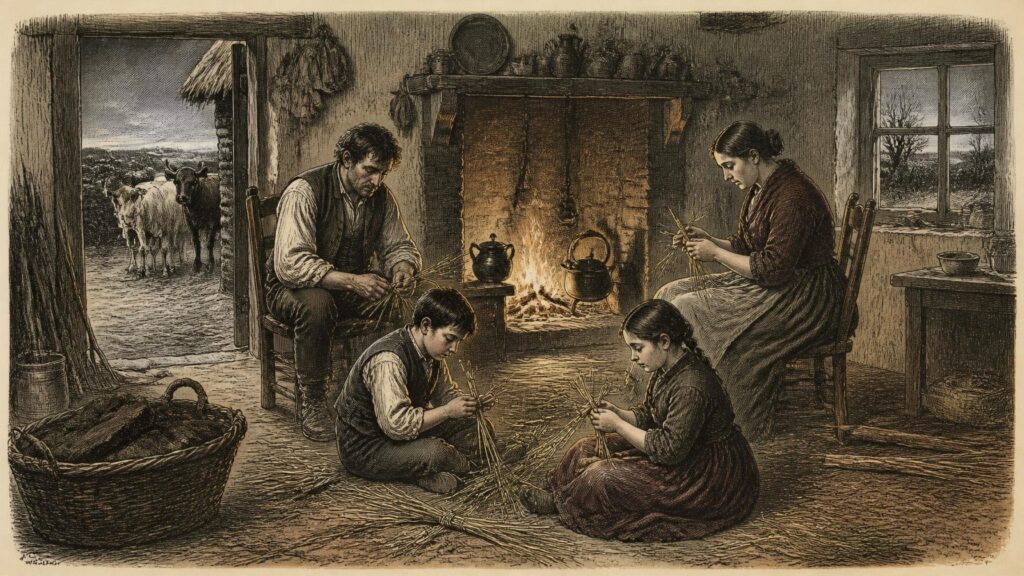
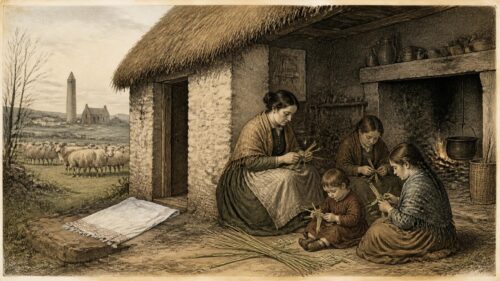
AI generated historical illustration, not a contemporary photograph.
At a Glance
January in Irish history is less a simple beginning than a threshold: a month in which imported systems of dating met older seasonal habits, when households endured winter work while looking towards spring, and when written records, religious observance and popular custom all gave special meaning to the opening days of the year.
Roman Inheritance
The name January did not originate in Ireland. It came through the Roman calendar, and ultimately from the Latin Ianuarius, conventionally associated with Janus, the deity of gateways, passages and beginnings. Yet the name’s foreign origin should not suggest that it was merely superficial in Ireland. Over many centuries, Roman and Christian systems of timekeeping became embedded in Irish religious life, learned writing, administration and, eventually, everyday printed calendars. January acquired an Irish history precisely because calendars are never neutral lists of days. They order rents, markets, legal documents, feast days, memory, labour and expectation.
For much of pre-modern Ireland, people experienced the year in several overlapping ways. The changing needs of animals and crops mattered; the liturgical cycle mattered; local fair days mattered; and, for clerics, administrators and chroniclers, the written calendar mattered. A month named January might therefore hold different weight in a monastery, a landlord’s estate office, a market town and a small farm. The modern habit of treating the first day of January as the unambiguous start of the year was not always shared in law, record keeping or custom.
It is important not to invent a neat ancient Irish equivalent to the later January. Irish seasonal reckoning is strongly associated with the quarter days of Samhain, Imbolc or St Brigid’s Day, Bealtaine and Lughnasa. These points divided the agricultural and ritual year in ways that do not map exactly onto the twelve Roman months. The National Museum of Ireland’s interpretation of calendar customs places winter at Samhain and spring at St Brigid’s Day, 1 February. January, in that framework, belongs to winter’s latter stretch rather than to a self-contained indigenous season.
The distinction matters. There is good evidence that medieval and later Irish people used the inherited Christian calendar in writing. There is also abundant evidence that rural communities gave ritual importance to the turn of the year and to the eve of 1 February. It is an interpretation, rather than a demonstrated fact, to say that every January practice preserved an unchanged pre-Christian past. The historical record instead shows adaptation: Roman month names, ecclesiastical calculation, local memory and household custom working together in different proportions over time.
Irish Reckoning
Medieval Irish annals offer one of the clearest documentary routes into January. Their entries often open with references to the Kalends of January, a Roman form of reckoning that marked the first day of the month. The Annals of Inisfallen and the Annals of Ulster, preserved and published through University College Cork’s CELT project, repeatedly use such formulae. They may also note the weekday, the age of the moon or the position of a year in a cycle. These were not decorative flourishes. They helped chroniclers locate events within an ordered Christian chronology.
This practice demonstrates that learned communities in Ireland did not simply receive a calendar and copy it mechanically. Dating was a technical activity. Annalists coordinated regnal memories, ecclesiastical eras, lunar observations and inherited chronological tables. A year heading could establish the framework in which deaths, raids, church burnings, storms, successions and political expeditions were placed. January, in the annals, is consequently a point of calculation before it becomes a description of weather or a scene of domestic celebration.
The annals also caution against treating every date as if it had the precision of a modern civil register. Manuscripts were copied, revised and sometimes compiled long after events. Different annalistic traditions can assign a year differently, and scholars must compare texts, manuscript transmission and chronological systems. Nonetheless, the repeated use of the Kalends shows that the first of January had a recognised formal role in medieval Irish historical writing. The date was part of a shared Latin Christian language of time, even where the people and places described were distinctly Irish.
There is a further significance in this. Annalistic Ireland was connected to wider ecclesiastical learning while remaining politically fragmented. The same calendar vocabulary could be used to record the affairs of Uí Néill rulers, Munster dynasties, Norse settlements, monasteries and churches across the island. January therefore serves as a small but revealing example of cultural connection: an international chronological framework was made serviceable for recording local conflicts and local communities.
Yet annals do not tell us how every household regarded 1 January. They preserve the viewpoint of literate record makers, usually working within ecclesiastical or elite settings. To recover the lived month, historians must read other evidence: later folklore, household recollection, agricultural description and the material culture of seasonal observance. None of these sources is complete on its own. Together they show that January was both a written date and a practical season.
Monastic Time
Christianity gave January a place in a densely structured sacred year. The season followed Christmas and the feast of the Circumcision in older Western calendars, moved through Epiphany, and approached the feast of St Brigid on 1 February. In Irish monasteries and churches, such observances were connected to readings, masses, saints’ commemorations and the calculation of movable feasts. The calendar was therefore an instrument of worship as well as a means of dating political events.
The calculation of Easter was especially consequential. Medieval Christian communities inherited disputes about lunar and solar reckoning, and Irish ecclesiastical history is well known for controversies surrounding the dating of Easter in earlier centuries. January itself did not determine Easter, but it opened the annual sequence in which those calculations were maintained, copied and applied. The technicality visible in annalistic January headings belongs to a wider culture in which correct timekeeping was a matter of religious order.
Church time also coexisted with local seasonal language. A farmer might speak of winter’s severity, fodder, weather and the approaching lambing or calving season; a priest might speak of feasts and fasts; a chronicler might record the Kalends. These were not necessarily rival calendars. They were different ways of making time meaningful. Their coexistence helps explain why Irish January traditions could combine prayers, holy water, livestock protection, domestic work and hopes for prosperity.
One should nevertheless resist an easy story in which Christianity simply covered an older religion with a thin new layer. Some customs certainly have been interpreted through that lens, especially those connected with Brigid and the seasonal transition around Imbolc. But the documentary evidence often reaches us through Christian collectors, schoolchildren, clergy or folklorists. What it securely proves is that Catholic devotional practice and folk observance were entwined in modern Irish memory. What it cannot always prove is the exact age or original meaning of each act.
Winter Labour
For rural households, January was a demanding interval. The National Folklore Collection’s Main Manuscript Collection includes a 1936 account from Kilmore Quay, County Wexford, describing New Year’s Day in terms of early rising, Mass, feeding cattle and horses, milking, boiling the kettle and continuing work while animals remained housed. The account is a twentieth-century record of remembered or observed practice, not a universal description of every Irish farm. Even so, it conveys a central historical truth: a new year did not suspend the needs of livestock.
Winter labour was structured by scarcity and maintenance. Animals needed fodder and shelter; fires had to be kept; water, turf and food had to be managed; and bad weather could isolate households or make roads difficult. The later folklore record frequently gives January a harsh character. One collected weather rhyme begins, “January brings the snow”, presenting cold as the month’s defining expectation. Such verse is not meteorological data, but it records a cultural understanding of winter hardship.
Agricultural work did not cease altogether. A Schools’ Collection account from County Clare describes lime being laid on ground in January and left to work through the soil before later cultivation. This evidence cannot be generalised to every district, soil type or historical period. It does show, however, that January could be a month of preparation, not only endurance. Farmers and labourers were already working towards the growing year, even when the landscape appeared dormant.
The material realities behind these recollections help explain the moral force of New Year customs. A belief that waste, debt or an unlucky visitor might affect the whole year was not merely picturesque superstition. In households whose resources could be precarious, the symbolic management of food, fuel and money spoke directly to anxieties about survival. Folklore does not offer a statistical measure of poverty, but it can illuminate the emotional economy through which people responded to uncertainty.
January also exposed differences of class and place. Urban residents, shopkeepers, servants, fishermen, labourers, clergy and substantial farmers did not meet winter in identical circumstances. Printed almanacs and commercial calendars spread increasingly widely during the nineteenth and twentieth centuries, but a common printed date did not produce a common experience. The same month could mean ledgers and rents to one household, casual employment to another, or an anxious calculation of food stores to a third.
New Year
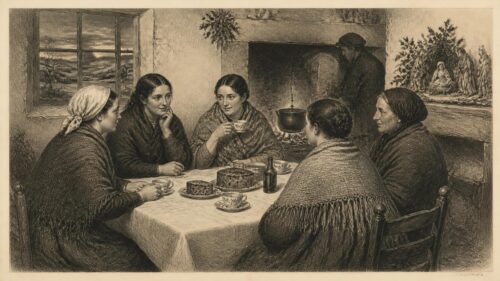
New Year’s Day was marked in Ireland by observances intended to shape the year ahead. The Schools’ Collection, assembled in the 1930s by children who recorded local testimony, preserves many examples. In one account, nothing was to be thrown from the house on New Year’s Day, because doing so was believed to send away prosperity. Another reports close examination of hearth ashes on 2 January, with tracks read as signs of death or increase within the household. These are valuable records of belief, but they are records of reported custom, not proof that all families practised them.
The recurring theme is containment. Food, money, luck and household well-being were imagined as things that could be retained or lost through apparently small actions. A person who paid money out at the opening of the year risked a year of expenditure; one who received money might expect abundance. Ashes, which were ordinarily discarded, could be treated as a medium of prognosis. Domestic space, especially the hearth and doorway, became a boundary at which the future might be guarded or interpreted.
These beliefs should not be dismissed as irrational remnants. They had social uses. They turned a calendrical transition into a shared opportunity for care, restraint and conversation. They also allowed families to frame unpredictable circumstances in comprehensible terms. The historian cannot establish whether participants literally believed every prediction, performed it playfully, or varied their practice by age and household. The evidence does establish that such ideas were sufficiently familiar to be collected across several counties.
New Year observance was also shaped by religion. The Wexford manuscript refers to attendance at Mass and resolutions for the coming year. Here, January combines devotional obligation, moral self-examination and ordinary work. The image complicates any division between a formal Church calendar and supposedly separate folk culture. In lived experience, a morning could include prayer, resolutions, animal care, food preparation and customs of good fortune without participants seeing these as contradictory categories.
Fortune Monday
The first Monday of January, often called Hansel Monday, is particularly well represented in the Schools’ Collection. The word “hansel” referred to a first gift, payment or token intended to bring luck. Accounts from different districts commonly say that receiving money on the day was fortunate, while giving it away could bring financial loss throughout the year. In some versions, a small coin or gift was deliberately given to relatives; in others, people were careful not to spend at all.
The variations are historically useful. They reveal that there was no single national rule. One community’s gift could be another community’s risky outlay. What remained consistent was the concern with the first transaction. The beginning established a pattern. That logic resembles New Year prohibitions on throwing things out, but it is applied specifically to exchange. Money was not only currency; at a threshold moment it became a sign of future flow, dependence and good fortune.
Hansel Monday also shows Ireland’s connections with neighbouring popular traditions. The term and the custom have parallels in Scotland and northern England, where a hansel could mean a good-luck gift or the first earnings of a venture. Such parallels do not erase local Irish forms. Rather, they remind us that custom travelled through language, migration, trade and shared vernacular culture around the Irish Sea. Folklore is often regional and transnational at once.
It would be misleading to claim that Hansel Monday governed commercial behaviour in a measurable way. The surviving sources are testimonies, usually written down decades after the practices they recall. They provide strong evidence that the custom was known and remembered; they do not provide account books showing its economic effect. Its significance lies chiefly in what it reveals about the symbolic importance of money at the year’s opening.
Brigid Eve
The final days of January led towards one of the most resonant dates in Ireland’s seasonal year: St Brigid’s Day on 1 February. The eve of that feast, 31 January, was widely associated with the making of crosses from rushes, straw or other materials. The National Museum of Ireland notes considerable regional variation in their form, including diamond, interlaced, wheel-shaped and multi-armed examples. Crosses might be placed in homes and animal sheds, while leftover material could be used in fields, bedding or ropes as a blessing for people, crops and stock.
In the Schools’ Collection, accounts from Donegal and Longford describe rush crosses made at the end of January and hung over doors. Some narratives identify the night as a protective “cross day”; others connect the object explicitly to St Brigid’s blessing. Such testimony offers unusually vivid evidence of domestic ritual, although its forms differed between regions and families. The cross was not merely a display object. It joined house, byre, animals, crops and the hoped-for safety of the coming season.
Brigid herself stands at the meeting point of history, hagiography and folklore. Historians accept that the cult of Brigid and the early medieval church at Kildare were deeply important. Yet the detailed miracle stories associated with her were written down long after the period in which she is traditionally placed. The National Museum explicitly notes that relatively little is known with certainty about her life and that many accounts of her miracles are later. This is a necessary caution when discussing the familiar story of a saintly woman making a rush cross to explain Christianity.
Likewise, the association sometimes made between St Brigid and an earlier goddess named Brigid is an interpretation with a long history, not a simple documentary fact. The resemblance of names and the seasonal setting have encouraged the idea of continuity. There may indeed be cultural relationships worth investigating, but the surviving evidence does not permit a straight line to be drawn from prehistoric ritual to every recorded twentieth-century household practice. What can be said securely is that, by the modern period, the eve of St Brigid’s Day formed a powerful Irish threshold between winter and spring.
January’s importance therefore culminated not on its first day but at its end. The month closed with making, blessing and protection. This gave practical expression to the hope that winter would loosen its hold, animals would prosper and the household would endure into the agricultural year.
Calendar Reform
The legal meaning of January changed decisively in 1752. Before then, official English and British civil dating commonly treated 25 March, Lady Day, as the start of the legal year, even though 1 January was already recognised in ordinary usage and in many other European systems. This creates a familiar difficulty for historians reading documents dated in January, February or early March before the reform. A date that appears to belong to one year by modern reckoning could belong to the preceding legal year in a contemporary record.
The Calendar (New Style) Act 1750 applied throughout the dominions subject to the British Crown, including Ireland. It provided that 1 January 1752 should be reckoned as the beginning of the year, and it introduced the Gregorian calendar. In September 1752, eleven nominal dates were omitted, so that 2 September was followed by 14 September. The change affected legal instruments, courts, public administration and the dating of documents.
For Irish historical research, this means that dates must be handled with care. A letter, parish record, newspaper or official paper from January 1740 may require attention to whether it follows Old Style or New Style convention. Historians sometimes use double dating, such as 1740/41, to prevent confusion. This is not pedantry. Misreading the year can distort sequences of political decisions, births, deaths, leases and correspondence.
The reform also demonstrates that January’s status was not timeless. Its modern primacy was made legally explicit by statute. The law did not erase older seasonal habits, nor did it make rural people experience winter differently overnight. But it standardised the civil year in the records through which later historians often encounter the past. January became both a familiar cultural beginning and an administrative one.
Political Beginnings
In modern Irish history, January has repeatedly served as a date of political commencement. Ireland entered the European Economic Community on 1 January 1973, a change that linked the state’s economic and political future more closely to continental Europe. On 1 January 1975, Ireland assumed the Presidency of the Council of the European Communities for the first time. These dates illustrate the bureaucratic power of the calendar: treaties, memberships and presidencies are often designed to begin with a new civil year.
January also contains dates of grave remembrance. Bloody Sunday occurred in Derry on 30 January 1972, when British soldiers shot civil-rights demonstrators. The event became a defining trauma of the Northern Ireland conflict and a subject of prolonged public inquiry, legal scrutiny and commemoration. Its place late in January is a reminder that a month associated with renewal may also carry painful historical memory.
These examples should not turn January into an artificial theme imposed upon events that happened to occur then. Their importance derives from the wider history of European integration and the Troubles, not from the month itself. Yet dates shape public memory. Anniversaries create recurrent opportunities for ceremony, reflection, journalism and political argument. A month is therefore not merely a container in which history happens; it can become part of the way history is recalled.
Historical Caution
January’s Irish history is best understood as layered rather than anciently uniform. Documentary evidence supports the use of January and the Kalends in medieval annals, the legal redefinition of the new year in 1752, and the twentieth-century recording of household customs. These are firm foundations. Interpretation begins when historians ask how far the customs may reach back, how widely they were practised, and what they meant to those who performed them.
Folklore is neither a transparent window into remote antiquity nor a collection of errors to be discarded. The National Folklore Collection preserves voices and memories that would otherwise be lost: children’s transcriptions, local narratives, proverbs and descriptions of domestic rites. But each item has a context. It was collected at a particular time, in a particular place, often from an older informant and through the language of a schoolchild or collector. It may describe a living custom, a remembered custom, an idealised past or a practice already fading.
The same caution applies to weather sayings and agricultural lore. They show what communities expected or valued; they do not substitute for climate records. A rhyme about snow tells us that cold belonged to January’s cultural character. It does not prove that every January was snowy. A story about a ritual cross tells us that protection of house and livestock mattered. It does not prove an unbroken ritual reaching back beyond the evidence.
Such restraint does not diminish the month. On the contrary, it makes its history more compelling. January in Ireland can be followed across very different records: Latin annals, legislation, museum collections, local manuscripts and remembered speech. Each source catches a different aspect of time: calculation, authority, labour, belief, devotion or commemoration.
Enduring Threshold
January’s enduring Irish significance lies in its double direction. It looked backwards to Christmas, old obligations, stored food and the depth of winter. It looked forwards to money yet to be earned, animals yet to prosper, fields yet to be worked and the coming feast of St Brigid. This made it a month of anxiety as well as hope. Its rituals tried to govern uncertainty by regulating the first gift, the first payment, the hearth, the doorway and the household’s relation to the saint approaching in the night.
The historical sources do not yield one universal January. They reveal monastic chronologists marking the Kalends; legislators redefining the civil year; rural families rising to feed animals; collectors recording prohibitions against waste; and householders making crosses at winter’s edge. The variety is the point. Ireland’s January was made through institutions and intimate acts alike.
To study the month is therefore to study how people organised time. The calendar imposed names and numbers, but communities filled them with work, prayer, fear, memory and expectation. In that sense, January remains a threshold: not simply the first month, but a place where public chronology and private life continually met.

January’s layered meanings reveal how a shared calendar could organise experiences: annalists used the Kalends for Christian chronology, rural households faced livestock care and scarcity, while New Year and Brigid Eve customs expressed hopes about prosperity and protection. The article’s caution about linking recorded folklore directly to pre-Christian practice is useful, since continuity may be less straightforward than memory suggests. Equally, the 1752 reform shows that even beginnings of the year could shift. How should we interpret the relationship between calendar change, religious observance and household custom when assessing whether January traditions represented adaptation, continuity, or both in Irish communities?