
Diplomacy, Memory And Systems Under Strain(c.2020s)
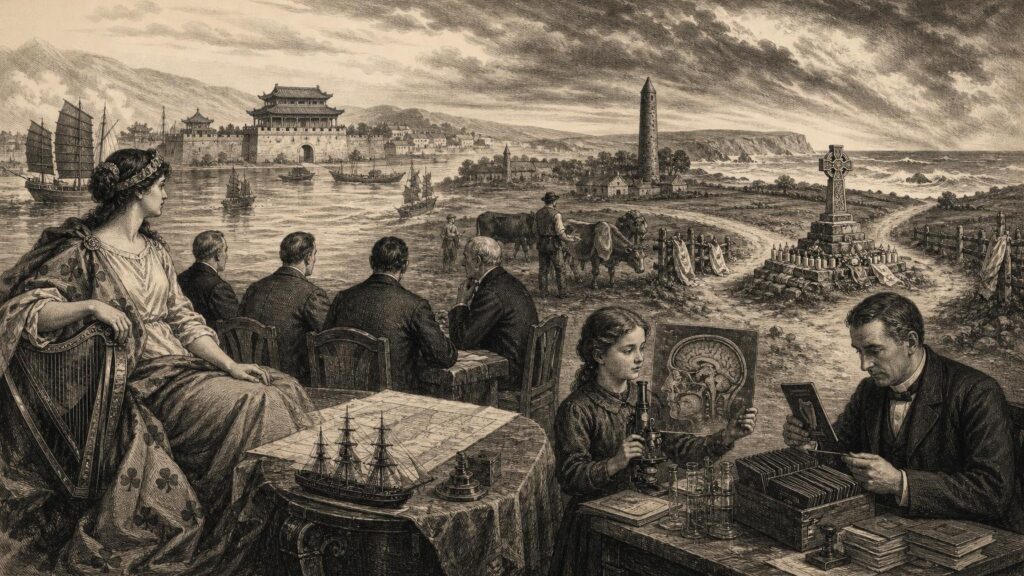
During 4–10 January 2026, Ireland’s week was shaped by diplomacy, memory and practical tests of state capacity. Micheál Martin’s first Taoiseach-level visit to China since 2012 placed trade, education and human rights inside a shifting global order, while Ireland opposed the EU–Mercosur deal at home. The fiftieth anniversaries of the Reavey and O’Dowd killings and Kingsmill massacre forced renewed reflection on sectarian violence. A passport recall, Storm Goretti, climate data, labour-market figures, a new screen-production tax credit and Aoibheann Daly’s Young Scientist victory showed a society balancing innovation, administration, weather risk and historical conscience in public life across the island.
Dateline
A week when the world pressed in
The first full week of 2026 found Ireland looking simultaneously outward and inward. Taoiseach Micheál Martin spent 4–8 January in China, the first visit by an Irish head of government since 2012, while ministers at home faced decisions on European trade, public administration, creative-industry policy and the handling of painful anniversaries from the Troubles. The week also brought a sharp weather reminder, new climate evidence, a passport-service failure affecting almost 13,000 citizens, and a high-profile student science victory. Taken together, these events made the week historically significant not because of one single rupture, but because it showed the range of pressures on a small, open state: global power politics, European obligations, domestic rural concerns, public-service competence and the unresolved moral weight of the island’s past.
Martin in China: trade, education and strategic caution
Micheál Martin’s official visit to Beijing and Shanghai was the week’s largest diplomatic event. The Government framed the trip around political, cultural and economic connections, with meetings scheduled with President Xi Jinping, Premier Li Qiang and National People’s Congress chairman Zhao Leji. Official briefings stressed that China was Ireland’s largest trading partner in Asia and fifth-largest globally, with goods and services trade worth €36 billion in 2023, excluding Hong Kong and Macau. The programme also highlighted Irish higher education, food and drink, financial services, tourism and investment, including meetings involving Irish colleges and Chinese partners.
The visit was not simply a trade mission. It took place amid a tense international environment in which Ireland, like other EU states, was attempting to maintain commercial relations with China while speaking about rules-based multilateralism, human rights and fair trade. Martin’s meeting with Xi in the Great Hall of the People on 5 January was reported as cordial, with the Taoiseach calling for more open trade and acknowledging China’s global role, while Xi spoke of increased co-operation in fields such as artificial intelligence and the digital economy. Irish diplomacy here was pragmatic rather than dramatic: it sought access, dialogue and economic opportunity, but it also placed Ireland’s position within the wider EU–China relationship.
Mercosur and the rural politics of Europe
That European context became sharper on 9–10 January when Ireland voted against the EU–Mercosur trade agreement, while a qualified majority of member states supported it. Ireland stood with France, Poland, Austria and Hungary in opposing the deal, which had long alarmed Irish beef farmers because of fears about lower-cost South American imports, environmental standards and traceability. The Government insisted its vote reflected programme-for-government commitments and concerns for sensitive agricultural sectors, although critics argued the move had more domestic than diplomatic force, given that the overall EU vote passed.
On 10 January, thousands of farmers rallied in Athlone against the agreement. The protest underlined how agricultural policy remains a central strand of Irish political identity, even in an economy increasingly shaped by services, pharmaceuticals, technology and foreign direct investment. The episode also exposed a familiar Irish tension: benefiting from open trade while fearing that particular forms of liberalisation may undermine rural livelihoods. It was a week in which Ireland sought expanded Asian markets and simultaneously resisted a major EU trade compact.
Remembering Reavey, O’Dowd and Kingsmill, fifty years on
The week’s most solemn historical moment came with the fiftieth anniversaries of killings that scarred south Armagh and the wider North. On 4 January 1976, members of the Reavey and O’Dowd families were attacked in their homes by loyalist gunmen. The following day, 10 Protestant workmen were murdered at Kingsmill after their minibus was stopped near Whitecross. In January 2026, commemorations, family testimony and official statements again placed these atrocities within public memory.
Minister for Foreign Affairs Helen McEntee marked the anniversary by naming the Reavey and O’Dowd victims and the Kingsmill dead, acknowledging grief on all sides and condemning the sectarian logic that had destroyed families. Services near Kingsmill included relatives of the men killed and Alan Black, the sole survivor. The significance of these commemorations lay in their refusal to let one atrocity erase another. The killings are often discussed together because of their proximity and retaliatory framing, but each set of families suffered its own irreparable loss. Fifty years later, the commemorations demonstrated that peace on the island depends not only on institutions, but on careful remembrance that resists hierarchy, denial and simplification.
Public systems: passports, work and screen policy
Public administration was tested on 9 January when the Passport Service announced that 12,904 passports issued between 23 December 2025 and 6 January 2026 would be replaced because a technical issue linked to a software update meant the documents might not be fully compliant with international travel standards. The problem reportedly involved the absence of the “IRL” country code on affected documents, creating a risk at eGates and border control. The Department of Foreign Affairs said affected citizens would not need to reapply and that border authorities worldwide had been notified. Even so, the incident mattered because the Irish passport is one of the state’s most trusted and symbolically important documents; a small technical omission became a reminder that modern sovereignty depends on machine-readable accuracy as well as law and diplomacy.
Economic news was steadier. On 4 January, Minister Peter Burke welcomed 2025 as a record year for the Irish labour market, pointing to employment growth, rising participation and job numbers. The CSO’s December unemployment release, published during the week, put the monthly unemployment rate at 5.0 per cent, unchanged from November on the initial estimate. These figures suggested resilience, though later debate would continue over cost of living, housing, skills shortages and the distribution of employment gains.
The week also saw the launch of a new tax credit for unscripted production, described by Government as the first dedicated incentive of its kind in Europe. The credit provided for relief at 20 per cent of certain qualifying expenditure, up to a €15 million project cap, and was intended to strengthen Ireland’s position in factual, entertainment and non-fiction television production. Though less prominent than the China visit, it was historically notable as part of Ireland’s long use of tax policy to cultivate creative and screen industries.
Weather, climate and the evidence of change
Weather added a physical edge to the week. Storm Goretti, named by Météo-France, caused major disruption in parts of Europe and prompted Irish warnings for southern counties on 8 January. Ireland avoided the storm’s worst effects, but Cork, Kerry, Waterford and Wexford faced a Status Yellow warning for snow and heavy rain, with Met Éireann warning of hazardous travel, spot flooding, poor visibility and icy patches. The N22 Macroom Bypass had already been closed temporarily after collisions in icy conditions.
The immediate storm sat beside a larger climate story. Met Éireann’s Annual Climate Statement for 2025, released on 6 January, said 2025 was Ireland’s second-warmest year on record since 1900, behind only 2023. The forecaster noted that the four years from 2022 to 2025 were the warmest in the national series, and highlighted Storm Éowyn’s record-breaking winds in January 2025, a warm and sunny spring, marine heat off the west coast, and a very wet autumn. The statement turned weather into evidence: Ireland’s changing climate was not an abstract future but an accumulating record of warmer years, heavy-rain events and more severe-weather risk.
A young scientist and a centenary-minded culture
The week ended with a forward-looking moment at the RDS, where Aoibheann Daly, a fourth-year student at Mercy Secondary School Mounthawk in Tralee, won the 2026 Stripe Young Scientist and Technology Exhibition. Her project, “GlioScope: Multi-task Deep Learning and Causal AI for Glioma and Glioblastoma Profiling”, used artificial intelligence to help profile brain cancers and potentially reduce reliance on invasive biopsies. The win mattered beyond the prize: it connected Irish education, medical need, coding, girls in STEM and the country’s long-running culture of school science competition.
Culture also carried a centenary undertone. RTÉ had begun marking 100 years since 2RN’s first public broadcast on 1 January 1926, with further commemorations planned. New programmes, including a first Late Late Show Trad Special on 9 January, placed traditional music inside mass broadcasting, while the unscripted tax credit pointed towards future media production. In the same week that Ireland remembered atrocities from 1976 and measured a warming climate, it also celebrated young research and public broadcasting. The archive of 4–10 January 2026 is therefore one of contrast: grief and ambition, trade and caution, technical error and scientific promise, all unfolding in a state still negotiating its place between island memory and global change.
Primary Sources
- Visit to China by Taoiseach Micheál Martin 4–8 January 2026
- Visit of An Taoiseach Micheál Martin to China
- Taoiseach calls for more open trade during visit to China
- President Xi Jinping Meets with Taoiseach of Ireland Micheál Martin
- Statement by Minister McEntee on the 50th anniversary of the Reavey and O'Dowd killings and the Kingsmill Massacre
- 'Time is not a healer' – 50th anniversary of Armagh, Down attacks
- Families gather to remember Kingsmill massacre victims
- Daily weather summaries for January 2026
- 2025 second warmest year on record in Ireland, says Met Éireann
- Ireland avoids worst of Storm Goretti as UK, northern Europe hit
- Minister Burke welcomes record year for the Irish labour market
- Monthly Unemployment December 2025
- Tánaiste Simon Harris and Minister Patrick O’Donovan launch new Tax credit for Unscripted Production
- Student wins Stripe Young Scientist with brain cancer diagnosis tool
- Almost 13,000 Irish passports recalled over technical error
- Thousands of farmers rally in Athlone over Mercosur deal