Membership is completely free, giving members unlimited access to all available resources, services, features, and benefits without any restrictions or fees.
Welcome back. Sign in to continue enjoying unlimited access to all available resources, services, features, and member benefits at no cost.
In 1940 the war that the Irish state had hoped to hold at arm’s length became harder to regard as a distant continental struggle. Éire, as the state was named in the 1937 Constitution, remained neutral and its government called the wartime condition simply the Emergency. Yet Germany’s victories in the Low Countries and France during May and June transformed Ireland’s strategic position. The coast of occupied France now faced Ireland across the Celtic Sea; Britain feared an Atlantic invasion route and wanted the former treaty ports back in service; Dublin feared that surrendering neutrality would compromise sovereignty, inflame old divisions and expose an inadequately equipped country to attack.
The first political drama centred on John Mitchel, the Young Ireland journalist and former transportation prisoner. Mitchel had lived for years in the United States, but a Tipperary by-election gave his supporters an opportunity to return him to parliament on a programme embracing home rule, tenant rights, free education and the release of Fenian prisoners. On 16 February he was declared elected unopposed, before he had reached Ireland; he arrived at Queenstown the following day. The symbolism was deliberate. Mitchel had been convicted after the failed rebellion of 1848 and had escaped from Van Diemen’s Land in 1853. His supporters knew that his legal position would be contested, but treated the election as a protest against the constitutional order rather than as a practical route to a Westminster seat.
On 19 May, a meeting at Bilton’s Hotel in Dublin established the Home Government Association. Its leading figure was Isaac Butt, a Donegal-born barrister, former Conservative MP and Protestant who had become prominent through his defence of Fenian prisoners and his presidency of the Amnesty Association. The setting and personnel mattered. This was not a clandestine republican organisation, nor simply a revival of Daniel O’Connell’s Repeal movement. Butt sought a constitutional, federal remedy: an Irish legislature to manage domestic affairs while Ireland remained connected to the Crown and empire.
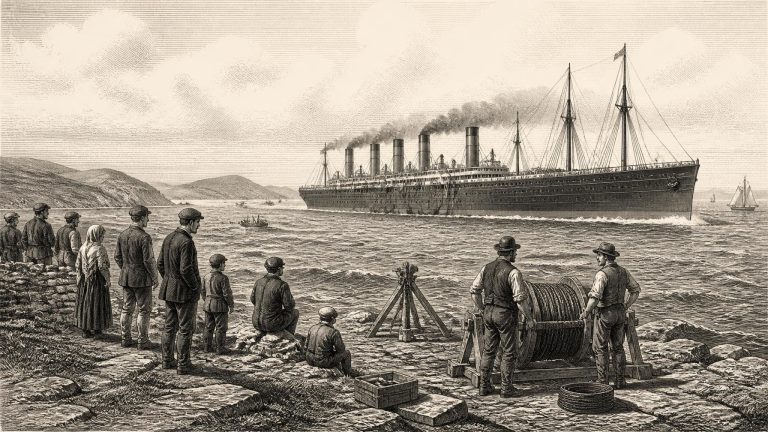
In 1866 Ireland stood at a remarkable intersection of coercion, religious confidence and modern connection. The island was still governed from Westminster through Dublin Castle, and official fears of Fenian conspiracy brought an extraordinary curtailment of civil liberty. Yet the same year supplied striking signs of institutional growth: Paul Cullen became the first Irish cardinal; Alexandra College opened a new path in women’s advanced education; a major Catholic church was dedicated in industrial Belfast; and the Atlantic cable made the remote Kerry coast a gateway for messages between Europe and North America. These were not parts of a single national programme. They belonged to communities with different loyalties, resources and hopes. Together, however, they show an Ireland whose political future was deeply contested while its religious, educational and communications worlds were being remade.