
Welcome to Emerald Archives
Emerald Archives presents Ireland’s story one reference year at a time, from the deep prehistoric past to the modern era. Each article explores the evidence, people, places and developments associated with a particular year and places them within their wider historical setting. The collection brings together archaeology, politics, society, religion, culture, conflict, everyday life and changing landscapes in one continuously expanding timeline. New articles appear here as the archive grows. You can also explore the full Irish History Timeline, search the archive directly, or use Explore to move through the collection by period and subject.
Start Exploring
Choose a route into Ireland’s past: follow the newest additions, find a particular year or subject, or browse every available period.
17th Century in Focus
Discover Ireland’s story year by year through this featured century.
New articles appear here as the collection grows.
17th Century Ireland
1601 CE–1700 CE

Wandesford’s Fractured Parliament
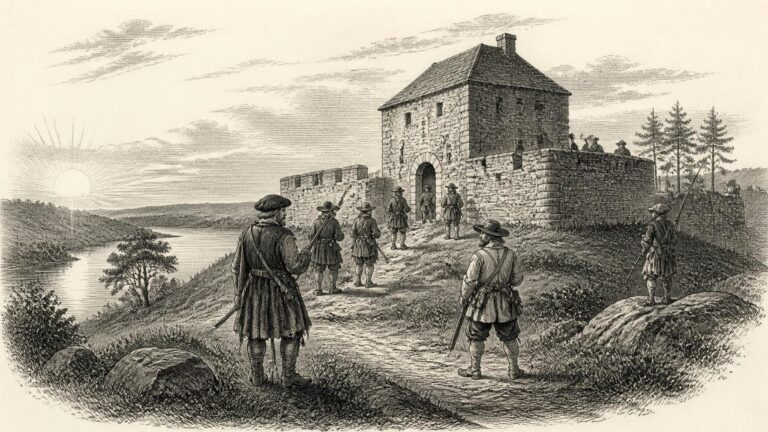
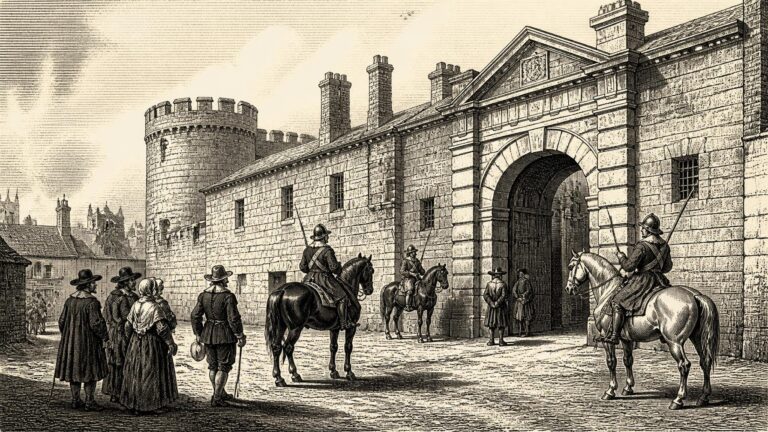
In 1640, Ireland was not yet at war within itself. The uprising usually called the Irish Rebellion would not begin until October 1641, and the Catholic Confederation belonged to the following year. Yet this was a year in which the political arrangements that had held the kingdom together began to fail visibly. Ireland’s government was drawn into Charles I’s attempt to subdue the Scottish Covenanters in the Second Bishops’ War; its parliament became an arena for arguments about taxation, law and arbitrary rule; and confidence in the administration of Thomas Wentworth, earl of Strafford, drained away. By December, the lord deputy was dead, a prominent bishop had been executed, and the authority of Dublin Castle looked markedly less secure than it had in spring.
O’Neill’s Dungannon Proclamation
The conditions behind the outbreak were older than the year, but were acutely felt in 1641. Catholic landowners, both Gaelic Irish and Old English, had experienced decades of plantation, land-title challenges, political exclusion and religious constraint. In Ulster, the Plantation had created densely settled English and Scottish Protestant communities beside dispossessed or politically diminished Catholic families. That arrangement brought commercial farming, market links and new forms of local administration, but it also made landholding, worship and allegiance inseparable from questions of power.
Kilkenny’s Confederate Model
Ireland’s emergency was inseparable from the mounting conflict across the Stuart monarchies. Charles I was king of Ireland, Scotland and England, but his authority was being disputed in each kingdom. English parliamentarians feared that the Irish rebellion might be used to strengthen royal power; Irish Catholics feared renewed dispossession, religious coercion and the punishment of all who had taken up arms. In March, the English Parliament secured royal assent to the Adventurers’ Act, which raised money for war in Ireland by promising subscribers repayment in confiscated Irish land. The measure did not determine who would eventually own those lands, but it gave a stark financial form to Catholic anxieties: military defeat might bring not only penalties but wholesale loss of estates.
Sigginstown’s Uneasy Cessation
The year opened with a notable Confederate success. On 20 January, Thomas Preston captured Birr Castle in King’s County, now County Offaly. Preston was a professional soldier with long experience in continental warfare, especially siegecraft, and his arrival had strengthened the Confederate cause in Leinster. Birr’s fall showed that the Catholic Confederation could take and hold significant positions, not merely raise local forces. Yet it also exposed a persistent problem: armies could seize places, but feeding, paying and coordinating them over long distances was much harder.
Inchiquin’s Cork Coup
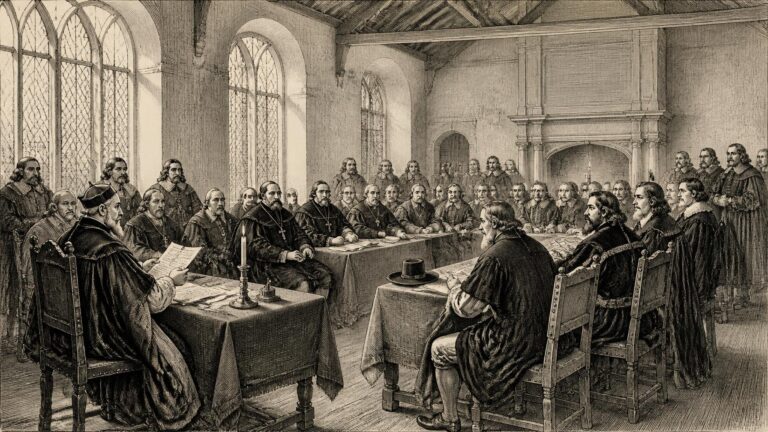
The Confederate leadership entered 1644 with a difficult calculation. The cessation agreed with Ormond in September 1643 had suspended much fighting between the Confederates and the royalist administration, but it was only a truce. It gave the Catholic leadership time to pursue a permanent settlement with Charles I, yet it also left the Covenanter army in Ulster and parliamentarian-aligned forces in Ireland outside the arrangement. The Confederacy had built a functioning wartime administration: a General Assembly, a Supreme Council, provincial armies, taxation and courts. But its political authority was uneven. The Assembly was representative by the standards of the day, bringing together peers, clergy and commoners, but the franchise was confined to male property holders; by 1644 the Supreme Council was increasingly directing policy between assemblies.
Duncannon and the Nuncio
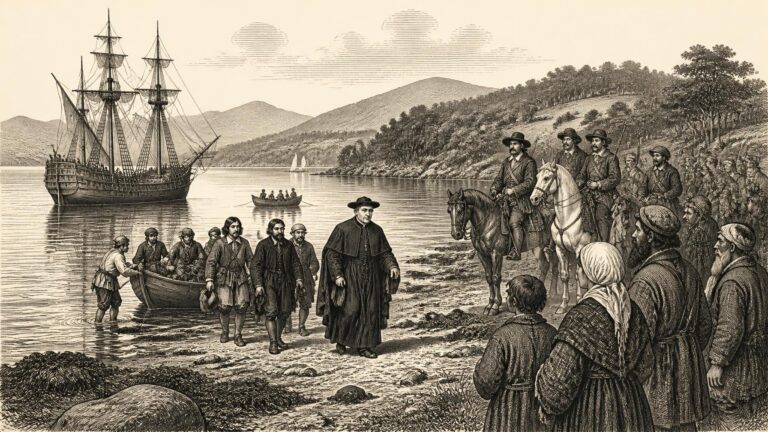
The most securely dated Irish military event of the year was the Confederate capture of Duncannon Fort, at the entrance to Waterford Harbour. Thomas Preston’s Leinster army began its siege on 20 January. The fort was a formidable strategic position: whoever held it could threaten or protect shipping moving between Waterford, the Irish Sea and continental routes. It was also an English-held outpost embedded in a region otherwise strongly influenced by the Confederation. Its governor, Lord Esmonde, had to depend upon a comparatively small garrison, sea supply and the strength of the fortifications.
Benburb and the Broken Peace
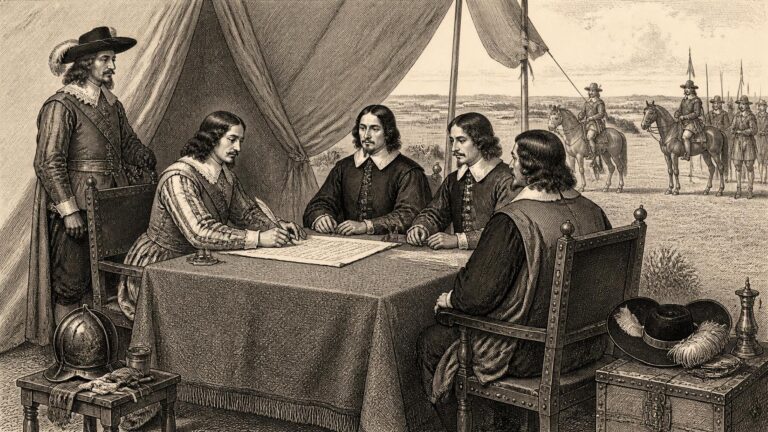
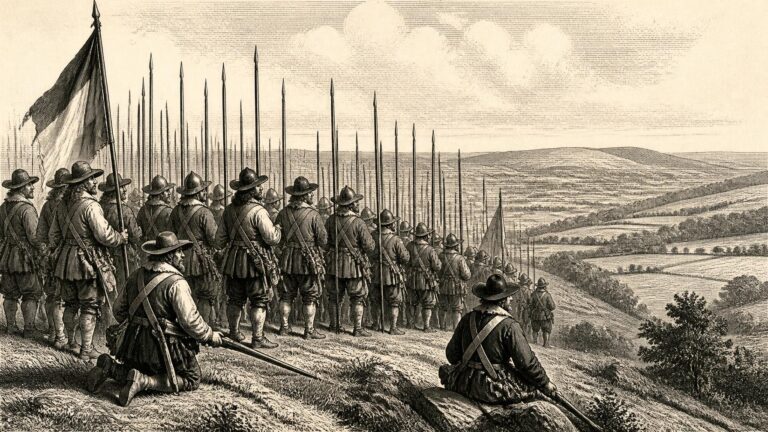
On 28 March, the Confederate Supreme Council concluded an agreement with James Butler, marquess of Ormond, Charles I’s lord lieutenant in Ireland. Ormond held Dublin for the king and was attempting to preserve royal authority in a kingdom divided among royalists, parliamentarians, Scottish Covenanters and Confederate Catholics. The proposed settlement was intended to bind the Confederates to the royal cause and permit Irish troops to assist Charles in Britain. For many members of the Supreme Council, especially those associated with Viscount Muskerry and the Old English Catholic landed interest, an agreement seemed the least dangerous option in a widening war.
Dungan’s Hill and Cashel
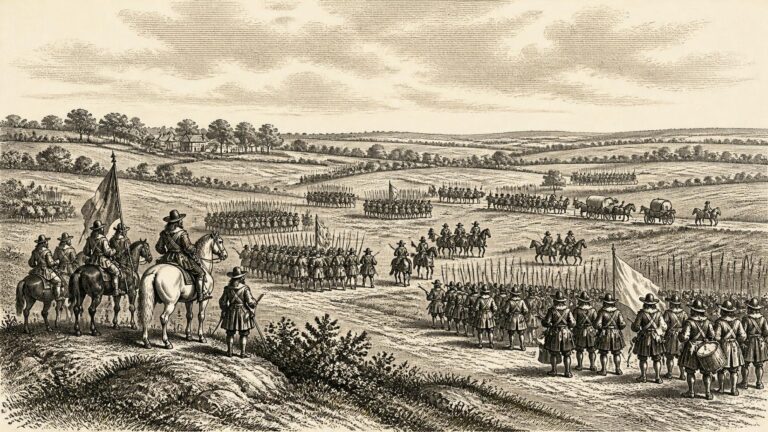
The Confederation’s leadership entered 1647 with unresolved disputes over both religion and strategy. The failed peace agreement negotiated with James Butler, marquess of Ormond, the king’s lord lieutenant, had divided Confederate opinion in 1646. Giovanni Battista Rinuccini, the papal nuncio, and many clergy had rejected a settlement that did not secure sufficiently extensive guarantees for Catholic worship and property. Others, especially among the Old English Catholic political elite, considered a negotiated arrangement with the crown essential.

Dungarvan’s Fractured Truce
The crisis belonged to a landscape already devastated by more than six years of conflict. The 1641 rising had developed into a many-sided war: Catholic Confederate armies, English royalists, English parliamentarians, Scottish covenanters in Ulster, and local Protestant forces all held territory or maintained garrisons. Their alliances had repeatedly shifted. Kilkenny was the Confederation’s political centre, but its authority depended on provincial councils, noble networks, clerical support and armies which often lacked regular pay, food, ammunition and discipline.
Rathmines, Drogheda And Wexford
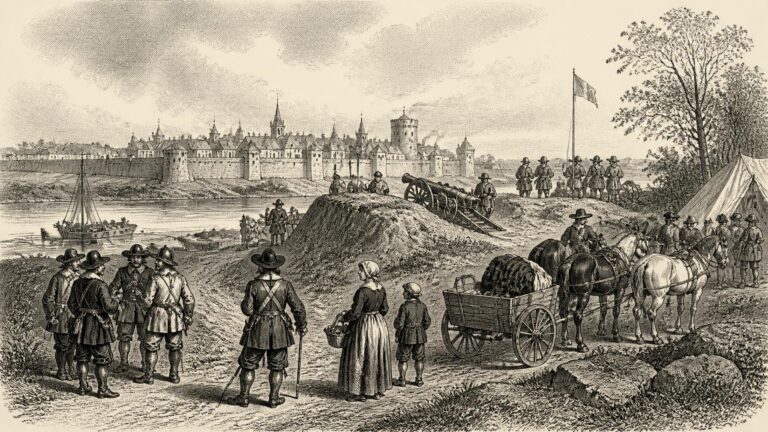
In January, the Confederate Catholics and the royalist lord lieutenant, James Butler, marquess of Ormond, concluded what is generally called the second Ormond peace. It allied the Confederacy with supporters of the Stuart monarchy against the English parliament. The agreement followed years in which Irish Catholic leaders had built a functioning wartime administration at Kilkenny: it had assemblies, councils, taxation, diplomacy and armies, but was divided by disagreements about religion, land, foreign aid and the degree of trust that could be placed in the king’s representatives.



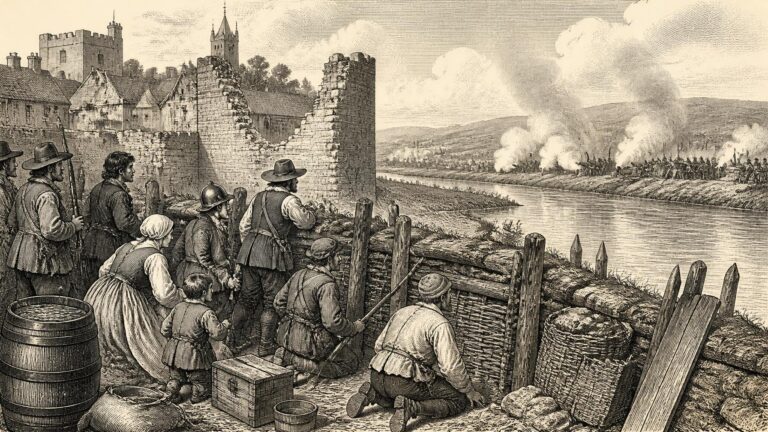
Clonmel’s Empty Breach
Ireland’s defenders were divided by religion, local interest, military rivalry and competing ideas of loyalty. The coalition associated with James Butler, marquess of Ormond, joined Irish Catholic Confederates to Protestant royalists in the name of Charles II. Yet its unity had always been precarious. In April, Cromwell secured an agreement with many Protestant royalist forces in Munster and Leinster. They undertook not to fight for the Commonwealth’s enemies; in return, Cromwell promised security for their lives and property. This mattered militarily because it removed much of the Protestant armed support on which Ormond’s alliance depended. It also sharpened the conflict’s confessional edge: those most determined to continue organised resistance were increasingly Irish Catholics.
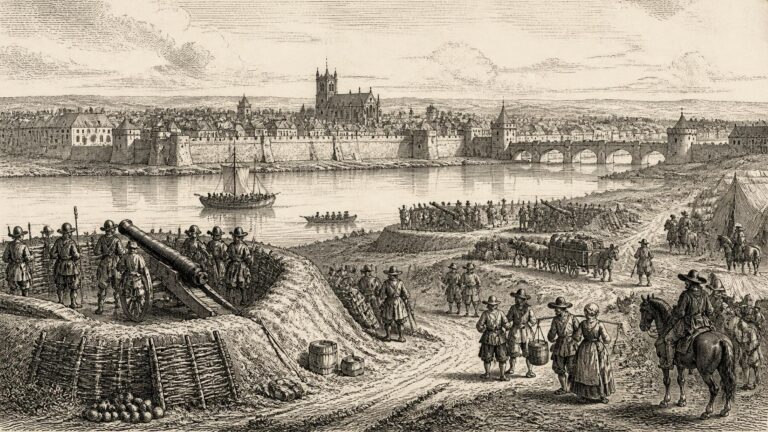
Limerick’s Starving Siege
Henry Ireton, Oliver Cromwell’s son-in-law and successor as commander of the parliamentary army in Ireland, began the campaigning season with a formidable military position but demanding tasks. Cromwell had left Ireland in 1650. Ireton now commanded the army as well as helping to shape the new Commonwealth administration. The remaining resistance was fragmented: Catholic confederates, Irish royalists, English royalists and local garrisons could still co-operate, but their political aims, religious commitments and personal rivalries did not always coincide.
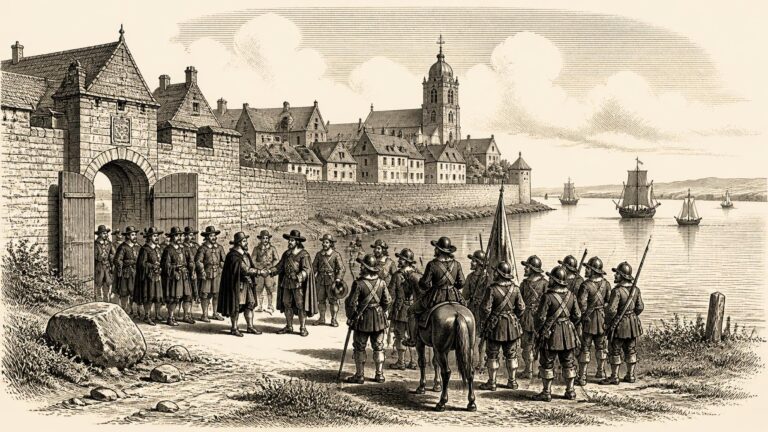
Galway’s Surrender Articles
Galway had been under severe pressure since 1651. Sir Charles Coote’s parliamentarian force enclosed it from the landward side, while Commonwealth warships helped deny relief by sea. The town was more than a local stronghold. Its merchants connected western Ireland with Iberia, France and the wider Atlantic; its walls, civic institutions and Catholic elite made it one of the last substantial centres of the Confederate cause. Thomas Preston, an experienced Catholic commander, served as its military governor. The prolonged siege compounded the shortages already experienced by inhabitants and displaced people who had reached the city during the war.

Cloughoughter’s Last Articles
The year opened with the remnants of the wars still visible in Ulster. Sir Phelim O’Neill, a leading figure in the rising of 1641, had continued resistance after the collapse of larger Catholic armies. Betrayed in Tyrone in February 1653, he was carried to Dublin before the Commonwealth’s high court of justice. The authorities offered him pardon if he would implicate the dead Charles I in the origins of the 1641 rebellion. He refused. On 10 March he was executed for his alleged part in the killings of Protestant settlers during the opening violence of the rebellion; his remains were displayed at Dublin, Drogheda and Dundalk. The execution was intended both as punishment and as a political statement: the new regime would present itself as the avenger of 1641 as well as the conqueror of Ireland.

The Connacht Deadline
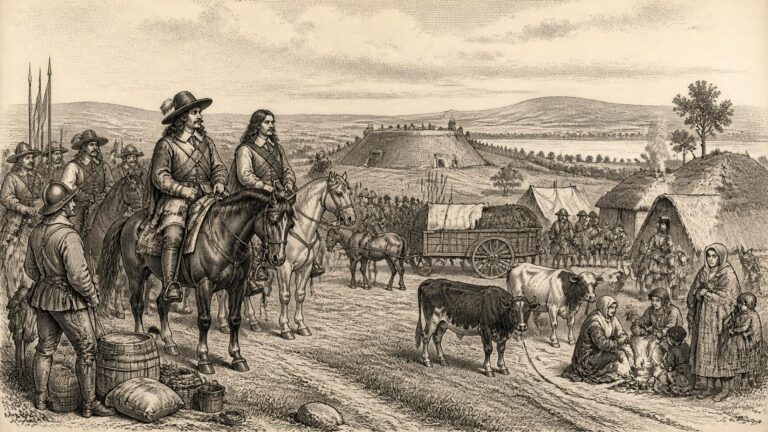
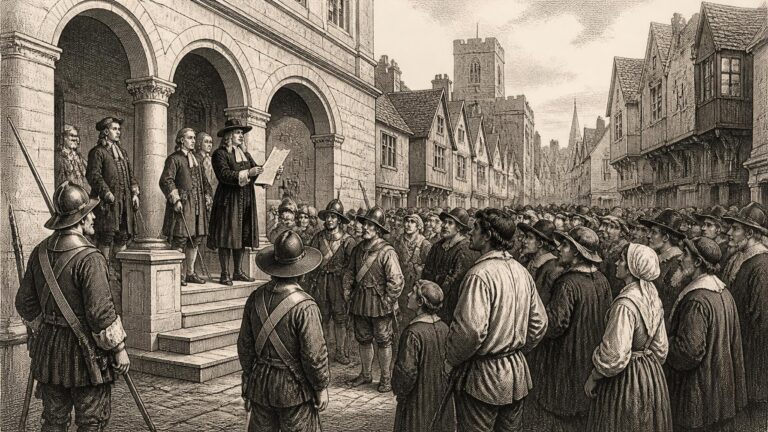
The most pressing date was 1 May 1654. Under the Commonwealth settlement, persons judged liable to transplantation were required to remove themselves, their families, dependants, livestock and movable goods to Connacht or County Clare by then. The policy was rooted in the Act for the Settlement of Ireland of August 1652 and instructions issued during 1653; it was not an order born suddenly in 1654. Yet the arrival of the deadline made its implications acute in communities across Leinster, Munster and Ulster. Catholic proprietors and others classed by the regime as transplantable faced the prospect of abandoning inherited estates east of the Shannon for allotted land in the designated western zone.

Petty’s Surveying Army
The most firmly dated business of the year concerns transplantation: the Commonwealth policy of removing many Irish Catholic proprietors and others judged liable to forfeiture from Leinster, Munster and Ulster into Connacht and County Clare. This programme had been framed in earlier legislation and orders; 1655 was not its beginning. Yet the surviving proclamations show that it was being pressed, adjusted and policed in that calendar year. On 27 February the Irish government extended the time allowed for transplantation until 20 May, expressly because heavy rains had impeded movement. The detail is revealing. Removal on paper meant travel on winter and spring roads, across rivers and through a landscape made difficult by weather, livestock, carts and the need to find somewhere to live.

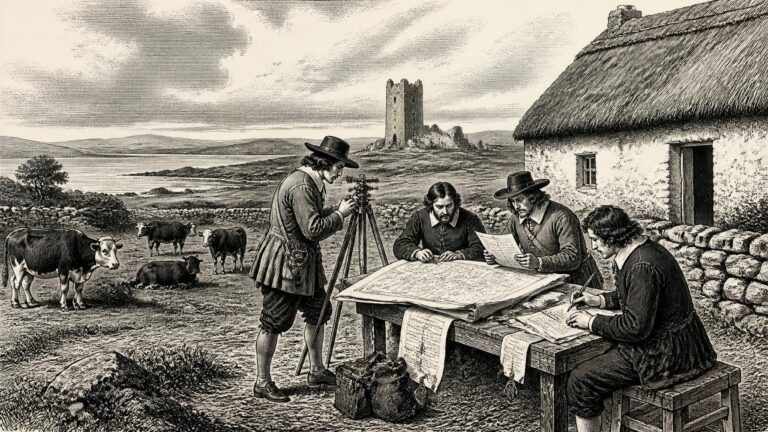
Petty’s Field Books
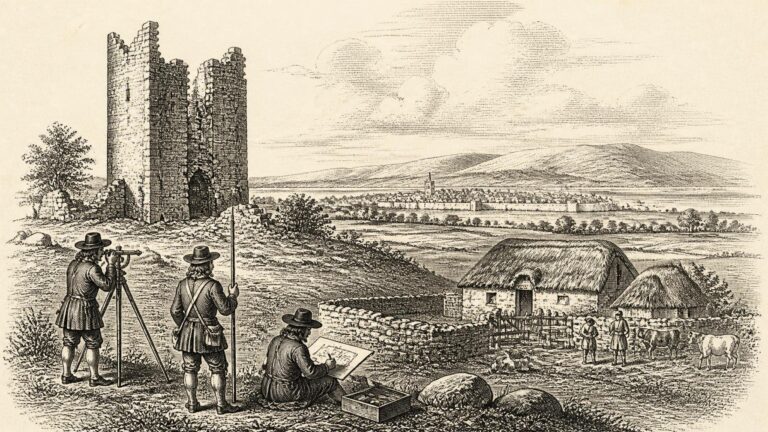
Sir William Petty’s Down Survey lay at the centre of that process. Commissioned to provide a detailed measurement of lands available to satisfy the arrears owed to the Commonwealth army, it was an extraordinary administrative enterprise. Petty’s teams measured land at local level, recording baronies, parishes, townlands, boundaries and the distinction between profitable and unprofitable ground. Maps and accompanying books turned complicated local landscapes into information which Dublin and Westminster could use for allocation.
Erasmus Smith’s Foundation Deed
The central firmly dated development came on 8 June, when the Westminster parliament passed An Act for the Assuring, Confirming and Settling of Lands and Estates in Ireland. The long title reveals its purpose. Since the Act for the Settlement of Ireland of 1652, land had been seized, surveyed, assigned, adjudicated and re-assigned through a dense succession of ordinances, instructions and local decisions. The 1657 act confirmed those earlier proceedings. It was intended to give a more dependable legal foundation to the distribution of Irish land among creditors of parliament, army officers and soldiers, Protestant purchasers, and others whom the regime recognised as entitled to grants.

Petty’s Measured Conquest
The Down Survey was the year’s most durable Irish development. Directed by Sir William Petty, physician, administrator and practical innovator, it had been undertaken from 1656 and was completed in 1658. It was a vast exercise in measuring land on maps rather than merely describing it in written schedules: the first detailed survey carried out on a national scale. Its immediate purpose was not neutral knowledge. It identified land available after forfeiture so that the Commonwealth could meet commitments to Merchant Adventurers, who had financed the war, and to soldiers owed arrears of pay.
Ludlow’s Dublin Command
Richard Cromwell had succeeded his father as lord protector in September 1658. He was formally lord protector of England, Scotland and Ireland, but the arrangement depended upon the cooperation of an army whose officers distrusted civilian parliaments and resented the uncertain constitutional direction of the new regime. In Ireland, Henry Cromwell had supplied much of the practical strength that Richard lacked. He had governed with relative competence and had won the confidence of many Protestant settlers and officials, while remaining committed to the Cromwellian settlement.
The November Land Declaration
The opening political event of the year was the meeting in Dublin of the General Convention of Ireland. It first assembled on 27 February, adjourned for broader attendance, and met again from 2 March. It was not a lawful parliament in the older constitutional sense: the Irish parliament had not been summoned, and the Convention had only one chamber. Nevertheless, it created a forum through which the dominant Protestant political interest could co-ordinate its response to the crisis of the English republic.
Claims at Dublin Castle
On 26 March, a proclamation announced that a parliament would meet in Dublin on 8 May. That date is firmly established. It was the first Irish parliament summoned by Charles II after the Restoration, replacing the Convention that had helped smooth the king’s return in 1660. The new assembly was overwhelmingly Protestant in complexion, reflecting the political changes of the Cromwellian period and the restricted position of Catholics in public life. Sir Audley Mervyn became Speaker of the House of Commons, and the session gave the restored regime an Irish constitutional forum through which to enact its priorities.

Smock Alley and the Claims
The Act of Settlement was the central Irish development of 1662. Its full title promised the “better execution” of the king’s earlier declaration for settling Ireland and satisfying adventurers, soldiers and other subjects. That language concealed a problem which no formula could neatly resolve. Adventurers who had financed the parliamentary war, officers and soldiers paid in confiscated land, Protestant landowners dispossessed during the 1641 rebellion, royalists, and Catholic proprietors who claimed both loyalty and innocence all advanced titles that overlapped. The land available could not meet every obligation.
Blood’s Unmade Coup
The Act of Settlement, passed in 1662, supplied the legal framework, but not a painless solution. It confirmed many adventurers and soldiers in estates acquired after the parliamentary conquest, while offering restoration to specified groups of dispossessed proprietors, especially Catholics who could establish their “innocence” of participation in the rebellion that began in 1641. The word had a highly technical legal meaning. It did not simply distinguish a peaceful person from a violent one; it determined whether a claimant might recover land, house, income and local standing.
St Stephen’s Green Lots
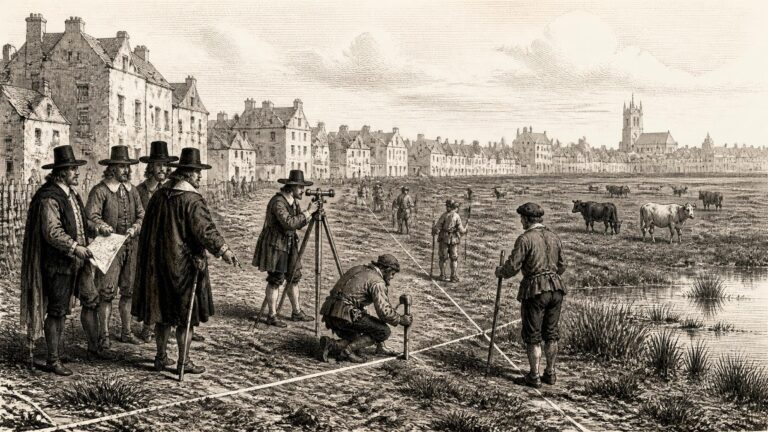
The most visible development associated with 1664 was at St Stephen’s Green, then on Dublin’s southern edge. This was not the leafy Victorian park familiar today, nor yet a completed square of fashionable townhouses. It had been a broad, low-lying common, marshy in places and used for pasture. Dublin Corporation had decided in 1663 to turn the land into a source of revenue. During 1664, the scheme moved into its practical, marketable phase: the ground was divided into ninety-six plots around a much reduced central green.

Reading’s Six Coastal Lights
The Act of Settlement of 1662 had attempted to reconcile claims that could not all be met from the land available. Cromwellian soldiers and financial ‘adventurers’ had received Irish estates after the 1650s conquest. Protestant royalists who had lost out during the Commonwealth also expected recompense. So did some Catholic proprietors who had remained loyal to the Stuart crown, qualified under earlier peace agreements, or could establish legal ‘innocence’ under the exacting post-war rules. Each claim rested on a different account of service, suffering and loyalty; all competed for the same confiscated land.
O’Reilly’s Dublin Synod
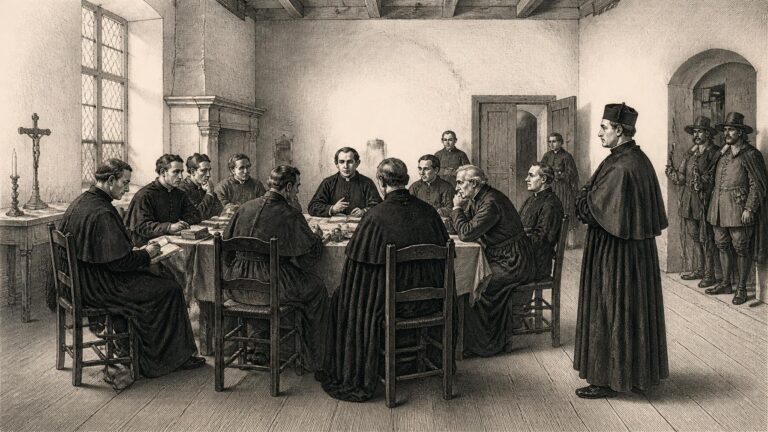
The central domestic business remained the restoration land settlement. The Act of Settlement of 1662 and the Act of Explanation of 1665 had tried to reconcile claims produced by more than two decades of rebellion, Confederate government, Cromwellian conquest and royal restoration. In broad terms, Cromwellian soldiers and Adventurers were confirmed in much of the land assigned to them, while limited classes of former proprietors, including some Catholics judged ‘innocent’ of rebellion, could seek restoration. The arrangement did not undo confiscation. It set rules for distributing its consequences.
Penn’s Cork Arrest
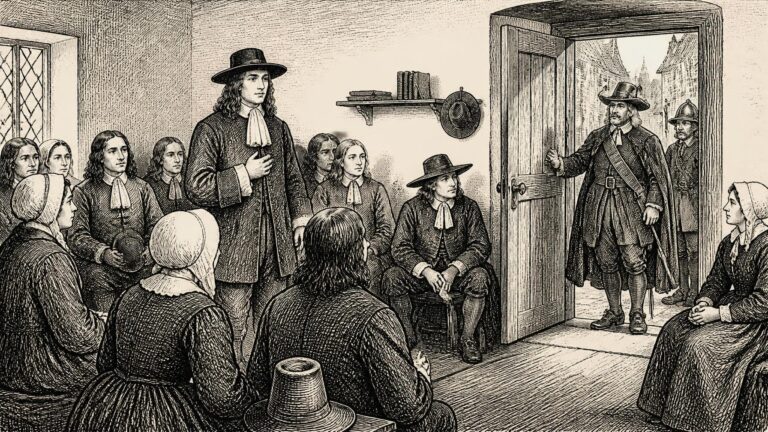
The most important long-term fact behind daily life in 1667 was the post-war redistribution of property. The Restoration had not returned Ireland to the position that existed before the rebellions, Confederate wars and Cromwellian conquest. The Acts of Settlement and Explanation, enacted in 1662 and 1665, attempted to reconcile incompatible claims: those of adventurers who had financed the parliamentary war, Cromwellian soldiers paid in land, Protestant royalists, restored church institutions and Catholic landowners who petitioned for restitution.
Taaffe’s Counterfeit Commission
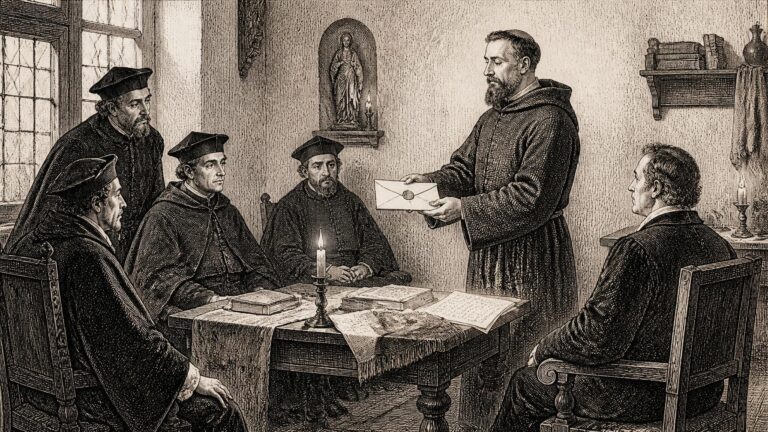
Ireland in 1668 was not marked by a great battle, a meeting of parliament, or a dramatic change of sovereign. Charles II remained king; James Butler, duke of Ormond, remained lord lieutenant; and the Restoration land settlement continued to define who possessed property, influence and security. Yet the year was far from uneventful. Its best-documented Irish drama unfolded in and around Dublin among Catholic clergy, government officials and a Franciscan friar, James Taaffe. Claiming extraordinary papal authority that he did not possess, Taaffe attempted to impose order on a divided Catholic church. His forged commission exposed the precarious place of Catholic religious organisation in Restoration Ireland and made ecclesiastical disagreement a matter of public government.

Robartes at Howth
In 1669, Irish government changed hands, though not in a manner that promised a clean break. On 14 February Charles II announced his intention to remove James Butler, duke of Ormond, from the lord lieutenancy. Ormond had been the dominant figure in Restoration Ireland since taking office in 1662: an exceptionally well-connected Protestant magnate, a royalist survivor of the wars, and the architect of much of the practical settlement that followed them. His replacement was John, Lord Robartes, formally appointed lord lieutenant on 3 May. The transfer matters because it exposed a central fact of Restoration rule: Ireland was governed from Dublin, but decisive political calculations were made at the English court.
Plunkett’s Return and Synods
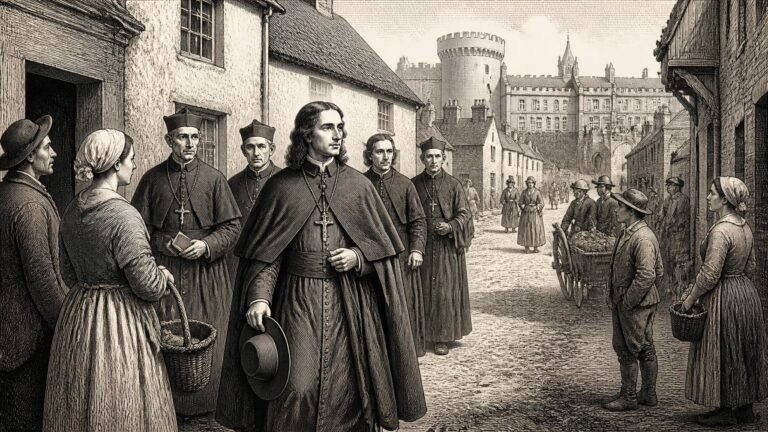
Government changed hands early in the year. On 4 February John Berkeley, Baron Berkeley of Stratton, was appointed lord lieutenant of Ireland; he was sworn in on 12 April, replacing John Robartes. Berkeley came to office after a period of strained politics. The Restoration land acts had, by the middle of the 1660s, largely confirmed the transfers of property made during the Cromwellian period. Some Catholic proprietors had recovered land, but the broad result of conquest remained: political authority and much landed wealth were securely Protestant.
Ranelagh’s Revenue Bargain
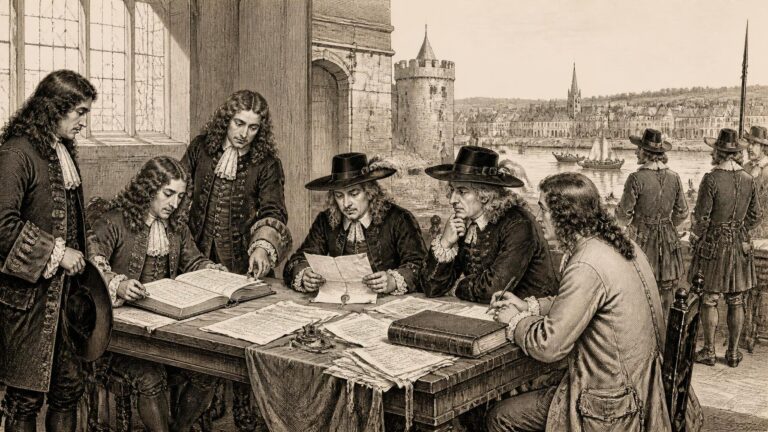
On 18 January, Sir Richard Talbot petitioned Charles II on behalf of Catholic nobles and gentry. The issue was land. The Restoration settlement of the 1660s had confirmed the enormous transfer of property produced by the wars, Cromwellian conquest and transplantation. Some Catholic proprietors had recovered land through the Acts of Settlement and Explanation, but many believed the settlement had been unfairly administered or had left legitimate claims unheard. Talbot’s petition did not undo the existing order. It was, however, an organised attempt to bring the grievances of the dispossessed back before the king.

Essex’s August Arrival
Essex was appointed lord lieutenant on 21 May and sworn in on 5 August. His accession mattered because the office concentrated the crown’s Irish executive authority: the lord lieutenant presided over government at Dublin Castle, directed the army and influenced the handling of revenue, law, corporations and religious policy. He succeeded Lord Berkeley, whose administration had acquired powerful critics. Essex was not an Irish magnate of the scale of James Butler, duke of Ormond, or Roger Boyle, earl of Orrery; that relative detachment may have been part of his usefulness to Charles II.
Essex’s Trade Reckoning
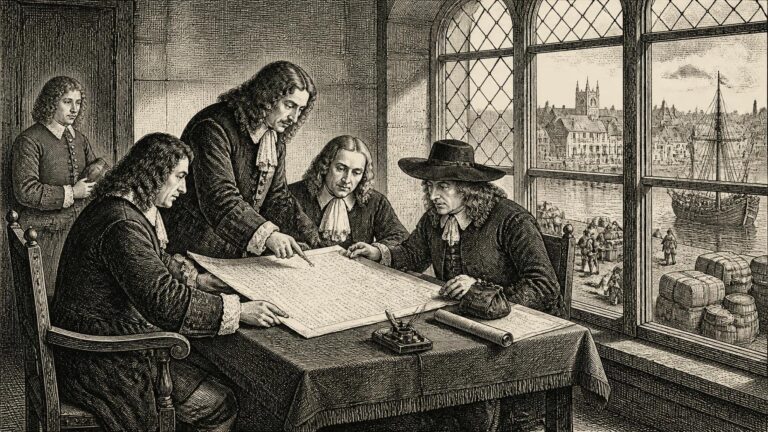
The Council of Trade’s paper offered a striking, if necessarily approximate, survey. It reckoned Ireland to contain about twelve million English acres of arable, meadow and good pasture, with another two million acres of rocky, boggy or scrubby ground considered largely unprofitable. Annual rents were put at £900,000; livestock at £3 million; housing with one or more chimneys at £2.5 million; and corn, household goods, merchandise and shipping together at about £1 million. Coin actually circulating in trade was estimated at only £250,000 to £300,000. Such figures should not be mistaken for a census or a neutral portrait. They were estimates made to guide policy, and their exclusion of cabins without chimneys is itself telling: some of the poorest dwellings, and therefore many of the poorest people, disappeared from this official picture.
Oxmantown’s Blue-Coat Opening
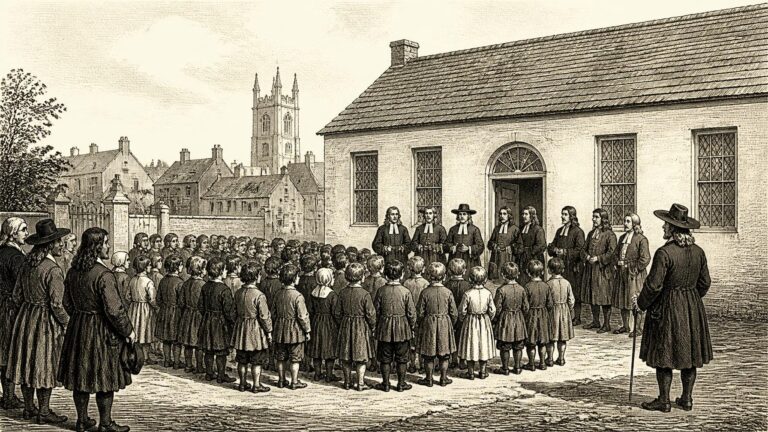
The word “hospital” did not chiefly mean a place of medical treatment in the modern sense. The new foundation was intended as a charitable home and free school for poor children, modelled in part on English urban charities. Its establishment had taken years. Dublin’s civic elite, churchmen and officials had raised subscriptions from the later 1660s, and the building was nearing completion early in 1674. Earlier plans were ambitious: accommodation was envisaged for as many as 350 residents. The opening intake of sixty therefore reveals both a real achievement and the limits imposed by money, building costs and the practical task of maintaining children as well as teaching them.
Connacht’s Unfinished Transplantation
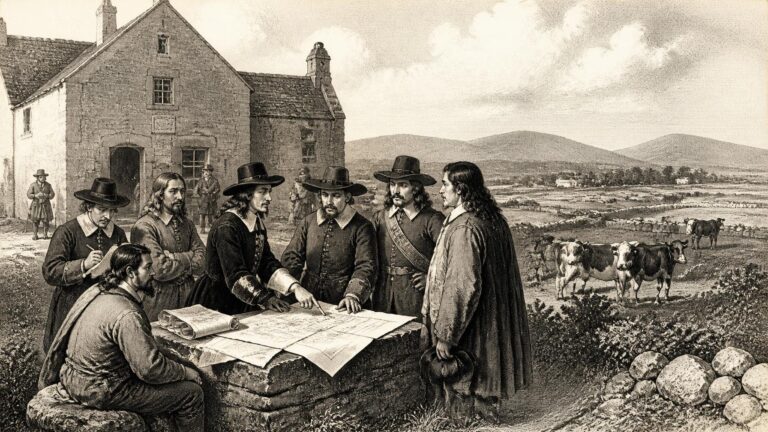
The word “transplanter” carried a long and painful history. Under the Cromwellian settlement of the 1650s, many Catholic landholders and their dependants had been compelled, or pressured, to leave lands in Leinster, Munster and Ulster for assignments in Connacht and County Clare. The slogan commonly associated with that policy, “To Hell or Connacht”, oversimplifies a complicated process, but it captures the coercive geography behind it. Families had to establish rights to new holdings, while soldiers, adventurers, Protestant purchasers, restored royalists and old proprietors advanced overlapping interests elsewhere.
Katherine’s Dublin Cargo
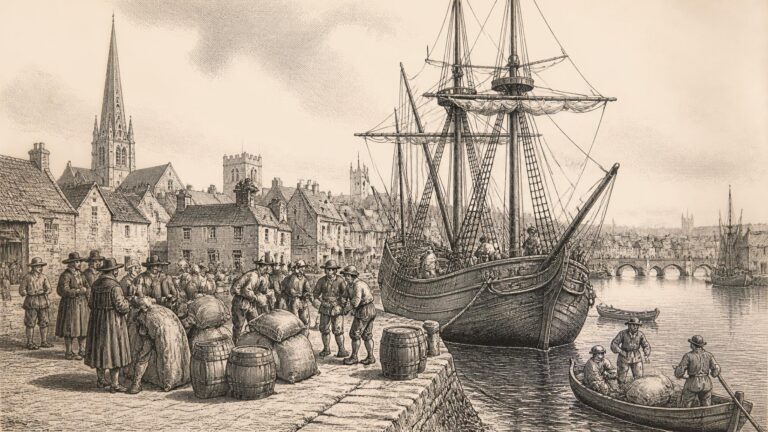
Charles II was king, and Arthur Capel, earl of Essex, was lord lieutenant of Ireland. Essex had first taken office in 1672, but after a period in England he returned to Ireland in May 1676. His restoration administration was preoccupied less with parliamentary politics than with the difficult mechanics of authority: revenue, land titles, local charges, security and the management of competing interests among officeholders, Protestant landowners and the large Catholic population.
Ormond’s August Return
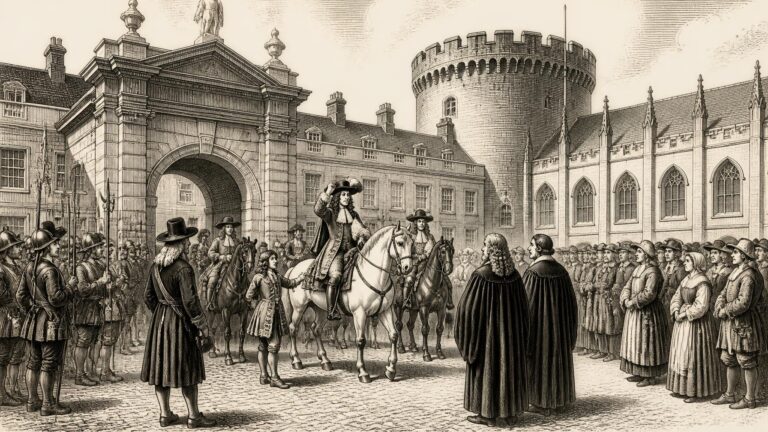
Ormond’s return was neither sudden nor uncomplicated. His reappointment had been announced on 24 May, and royal instructions for him as lieutenant general and general governor were issued on 1 August. At Dublin on 24 August, Arthur Capel, earl of Essex, the outgoing lord lieutenant, personally delivered the sword of office to him. The ceremony marked continuity in royal government, but also the replacement of a viceroy whose relationship with powerful financial interests had become deeply strained.

Talbot’s October Arrest
James Butler, duke of Ormond, governed as lord lieutenant for Charles II. He had returned to office in 1677 after the departure of the earl of Essex, bringing unrivalled experience of Irish politics but also deep personal entanglements in its landowning and religious divisions. His third administration sought fiscal solvency, a better-supported army and a final reassurance of property titles. These aims were connected: a parliament might confirm landholdings, grant revenue and make military expenditure more secure. But the political price of a land settlement was high, since the Restoration arrangements had left many Catholic claimants dissatisfied while Protestant proprietors feared any reopening of the question.
Merchant’s Quay Masshouse
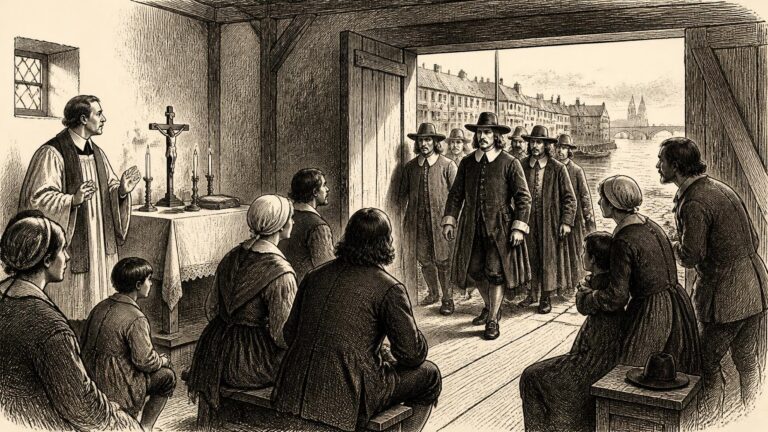
Ormond’s position was complicated. He was a durable royal servant with deep Irish connections, but he was also exposed to attack from English political opponents who accused him of insufficient vigilance. During the Exclusion Crisis, English politicians disputed whether the king’s Catholic brother, James, duke of York, should succeed to the throne. Ireland was inseparable from that wider argument: opponents of Catholic influence could present the kingdom as a potential base for a French-backed invasion or a renewed Catholic rising. Supporters of Ormond, meanwhile, stressed the importance of steady government and an army loyal to the crown.
Dundalk’s Broken Indictment
Ormond’s government faced problems that had accumulated since the Restoration of Charles II in 1660: disputed land titles, the cost and organisation of the army, the Crown’s Irish revenue, and the relationship between the Protestant establishment and the Catholic majority. Ireland had not had a parliament since 1666. Ormond believed that a new one could help settle titles and support military and fiscal measures, but the proposal was contentious. Land settlement remained raw because the confiscations and rearrangements of the 1640s and 1650s had transformed ownership on a vast scale.
Plunkett’s Tyburn Summer
The central firmly dated event was Plunkett’s death at Tyburn on 1 July 1681 in the English and Irish calendar then in use. England and Ireland still followed the Julian calendar; the corresponding Gregorian date was 11 July. The distinction explains why modern accounts sometimes give different July dates for the same execution.

Ormond Bridge, Arran’s Deputyship
On 13 April Richard Butler was appointed lord deputy to act during his father’s absence. Ormond and his duchess sailed from Ireland on 3 May, and Arran was sworn in shortly afterwards. The distinction matters. Ormond did not surrender the lord lieutenancy: he remained the king’s senior representative and the decisive connection between Irish administration and the court. Arran, however, was physically present to chair government, receive petitions, oversee officials and communicate with England. His appointment was also dynastic. Since the death of Arran’s elder brother, Thomas, earl of Ossory, in 1680, Arran had become the principal adult son available to sustain the duke’s political and familial interests.

Molyneux’s Dublin Experiment
Irish government was closely tied to political shocks across the Irish Sea. In June 1683 the Rye House Plot, an alleged plan to kill Charles II and his brother James, duke of York, was uncovered in England. Its discovery unleashed a royalist reaction against political opponents and Protestant dissenters. There is no responsible basis for treating Ireland as a principal theatre of the plot, but its consequences were felt there. The Dublin administration was expected to identify potentially disaffected people, especially those linked by religion, family or correspondence to English nonconformist networks.

Kilmainham’s Soldier Hospital
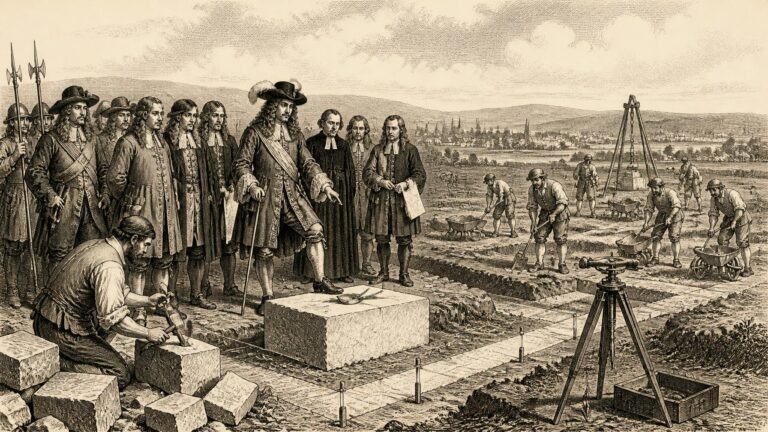
The calendar of 1684 needs to be handled with some care. Older chronologies give 25 March as the completion date of the Royal Hospital at Kilmainham. Other institutional and architectural evidence shows a longer process: the hospital was chartered on 19 February 1684, its governors first met on 21 March, pensioners were admitted during the year, and work on parts of the complex, including its chapel, continued afterwards. The firm conclusion is therefore not that every element of the great building was finished on one spring day, but that 1684 marked its formal establishment and the beginning of its active life as an institution for old and disabled soldiers.

Bedell’s Irish Old Testament
The succession did not itself repeal any Irish law, redistribute an acre, or overturn the established church. Nor should the year be read backwards from the Williamite war which began in 1689. In 1685 James’s authority was recognised across the island, and the administrative machinery built under his brother remained functioning. The duke of Ormond’s long influence over Irish government still framed the political world in which landlords, bishops, judges, merchants and county gentry operated. But confidence in continuity was weakened by the identity of the new monarch and by the men closest to him.
Nagle’s Coventry Letter
On 9 January, Henry Hyde, second earl of Clarendon, was sworn in at Dublin as lord lieutenant. Clarendon was the king’s brother-in-law and a committed Anglican. His appointment initially suggested that James might pursue Catholic relief while retaining an experienced Protestant magnate at the summit of Irish government. Yet the arrangement was unstable from the outset. Clarendon’s authority was constrained by the separate military influence of Richard Talbot, earl of Tyrconnell, a Catholic courtier, soldier and close confidant of the king.
Tyrconnell’s New Charters
Tyrconnell’s appointment as lord deputy was recorded on 8 January 1687, replacing the Protestant lord lieutenant, Henry Hyde, second earl of Clarendon. He was sworn into office in February. The distinction mattered: Tyrconnell held the practical powers of chief governor but the deliberately lesser title of lord deputy signalled James II’s caution. The king wanted Catholic advancement, but did not wish to provoke Protestant subjects unnecessarily or to commit himself immediately to a wholesale revision of the land settlement.
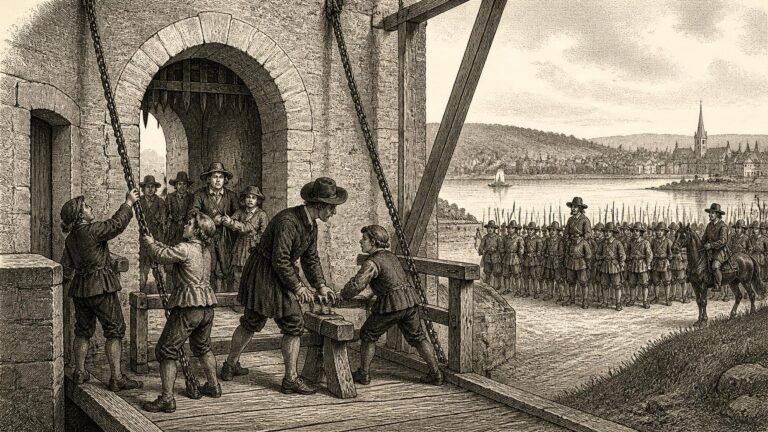
Ferryquay Gate Closes
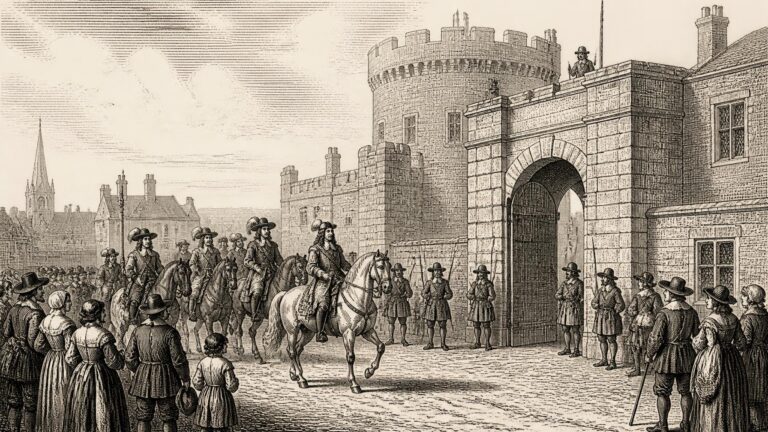
Richard Talbot, earl of Tyrconnell, governed Ireland for James II as lord deputy. A Catholic royalist and an energetic political operator, Tyrconnell had spent the previous years remodelling the Irish administration. Catholics were increasingly appointed to offices in the army, law, local government and county administration from which they had long been excluded. In the army, the change was especially conspicuous: Protestant officers and soldiers had been removed or marginalised, while Catholic recruitment and promotion accelerated.
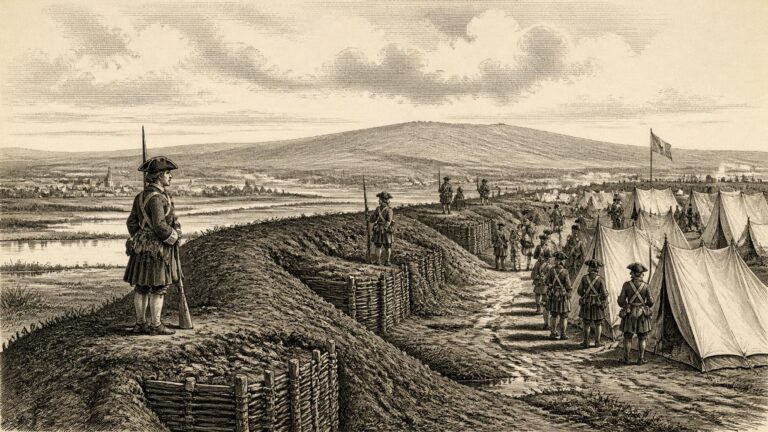
Dundalk’s Fevered Camp
In 1689 Ireland became the principal battlefield in the struggle unleashed by the overthrow of James II in England. The conflict was not simply an Irish religious war, although religious allegiance mattered profoundly. It joined disputes over monarchy, land, law, local security and the international contest between William of Orange and Louis XIV. In Ireland, James still possessed a substantial base of support, particularly among Catholics who had gained influence under his lord deputy, Richard Talbot, earl of Tyrconnell, and who expected a more durable redress of the land settlement imposed after the Cromwellian conquest.
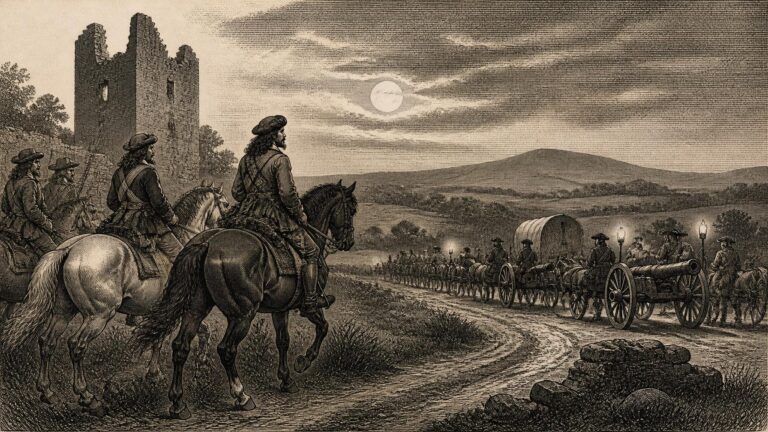
Ballyneety and the Broken Siege
In 1690 Ireland became the principal battlefield in the contest between the deposed James II and William III, the Dutch prince who, with his wife Mary, had been recognised as monarch in England, Scotland and Ireland after the Revolution of 1688–89. The conflict was never merely a private dynastic quarrel. James’s restoration depended on the military and financial support of Louis XIV of France; William’s success was essential to the wider European coalition resisting French power in the Nine Years’ War. Ireland’s ports, rivers and cities therefore mattered to decision-makers in London, Versailles, The Hague and Copenhagen as well as to people living beside the Boyne, Shannon and Lee.
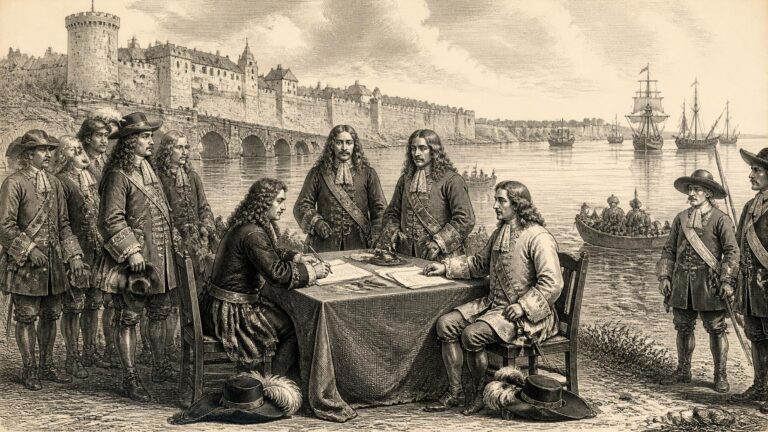
Limerick’s October Articles
The campaigning season opened with the Jacobites holding the principal crossings and towns west of the Shannon. Their cause remained part of the wider Nine Years’ War: William III’s coalition was fighting Louis XIV across Europe, while French officers, equipment and hopes of relief linked the Irish theatre to continental strategy. The arrival at Limerick in May of the French lieutenant-general Charles Chalmont, marquis de Saint-Ruth, brought weapons and supplies but neither the money nor the additional troops that the hard-pressed Jacobites wanted. He found an army whose morale and material condition were poor after the previous winter.
Sydney’s Recognition Parliament
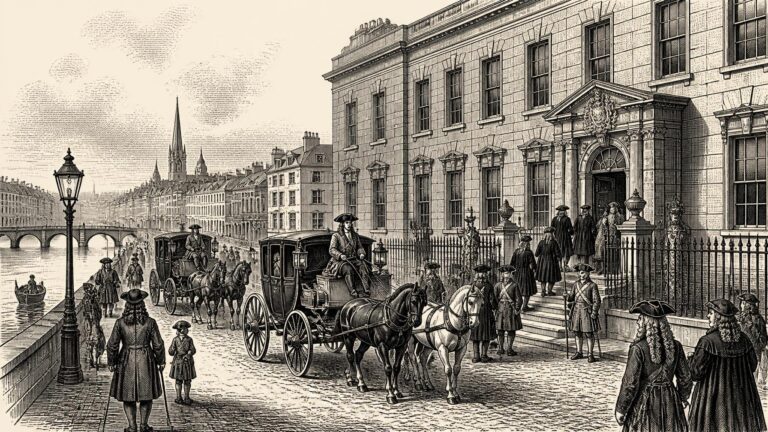
The immediate business of government was implementing the surrender terms agreed at Limerick on 3 October 1691. On 24 February 1692 William and Mary ratified the civil and military articles by letters patent under the Great Seal of England. This was a significant guarantee, but not a simple declaration of general toleration. The civil articles named particular groups—inhabitants of Limerick and other Jacobite garrisons, officers and soldiers, and people in specified western and southern counties—who submitted to the new sovereigns. Within their stated conditions, they were promised the estates, rights and privileges they had lawfully possessed under Charles II, and relief from specified arrears accumulated since Michaelmas 1688.
Sarsfield at Landen
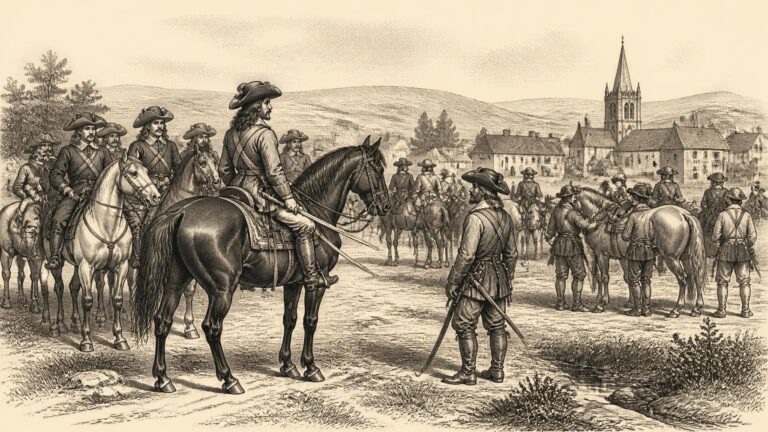
Government itself was unsettled. Henry Sydney, Viscount Sydney, had been lord lieutenant since 1692. In March 1693 the English House of Commons addressed William III about alleged mismanagement in Ireland. The complaint belonged to a wider political struggle over patronage, revenue, military appointments and the handling of former Jacobites after the war. It should not be mistaken for a neutral verdict on Irish conditions: it was an intervention by English parliamentarians, many of whom were suspicious that the Irish administration had been too accommodating towards Catholics and insufficiently protective of Protestant interests.

Portarlington’s French Register
The most consequential firmly dated business of 1694 concerned the settlement promised after the war. On 16 February a proclamation gave directions to the Commissioners for Forfeitures. On 23 May another announced that claims to the benefit of the Articles of Galway and Limerick would begin to be heard on 11 June. These notices did not themselves decide ownership. Their importance lay in bringing individuals into a formal process through which estates, goods and legal protections could be claimed, challenged and defined.
Capell’s Disarming Parliament
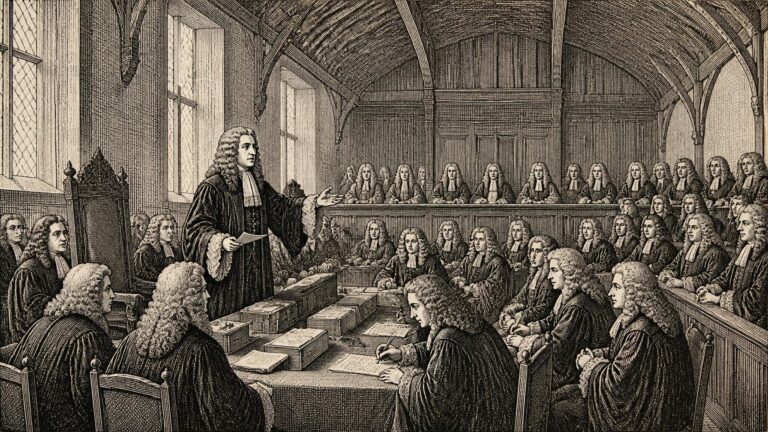
Capell became lord deputy in the spring of 1695 after a period in which Ireland had been governed by lords justices. His appointment was political as well as administrative. The government needed money, dependable institutions and a means of bringing influential Protestant landowners and office-holders into a workable relationship with Dublin Castle. The previous parliament of 1692 had broken down over the Commons’ claimed right to originate money bills. In 1695, however, negotiation produced a compromise: the Crown would retain its constitutional role under Poynings’ Law, while the Commons would be allowed a meaningful part in framing the methods by which revenue was raised.

Clonmel’s Billeted Houses
Ireland was formally quiet, but it was not detached from the wider Nine Years’ War between William III’s coalition and Louis XIV’s France. The French court still sheltered James II and Jacobite exiles, while the possibility of a French-backed restoration remained a serious concern for Williamite governments. In February 1696, a plot in England to assassinate William III intensified official alarm across his kingdoms. On 4 March, the Irish administration issued a proclamation offering £1,000 for the apprehension of James FitzJames, duke of Berwick, James II’s illegitimate son, and his alleged associates. Berwick was a prominent Jacobite commander in French service. The proclamation did not mean that he had landed in Ireland; rather, it shows Dublin Castle treating Irish security as inseparable from the international struggle against France and the Stuart cause.
Athlone’s Thunder and Banishment
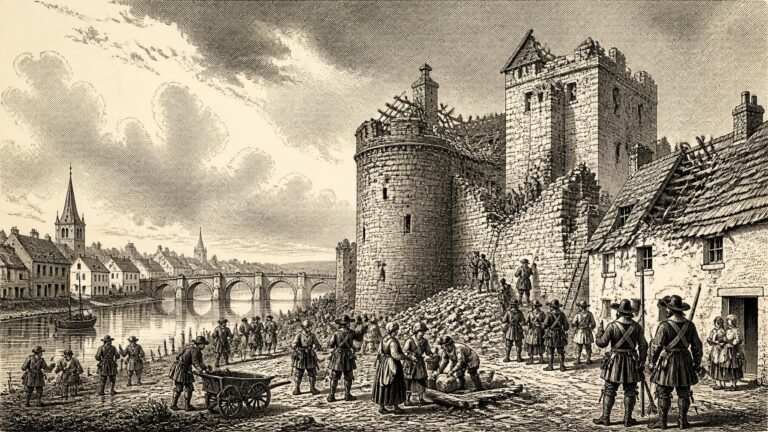
The year opened with official concern about food. On 12 January, the Irish administration prohibited grain exports from Ulster ports; on 29 March the restriction was extended to Leinster. A further proclamation of 18 June prohibited the exportation of corn more generally. Such orders are important evidence of pressure on supplies, but they should not be inflated into proof of an island-wide famine comparable with later Irish catastrophes. They do show that officials feared scarcity and high prices, particularly after large quantities of corn and meal had moved through northern Ireland towards famine-stricken Scotland during the preceding winter.
Molyneux and the May Deadline
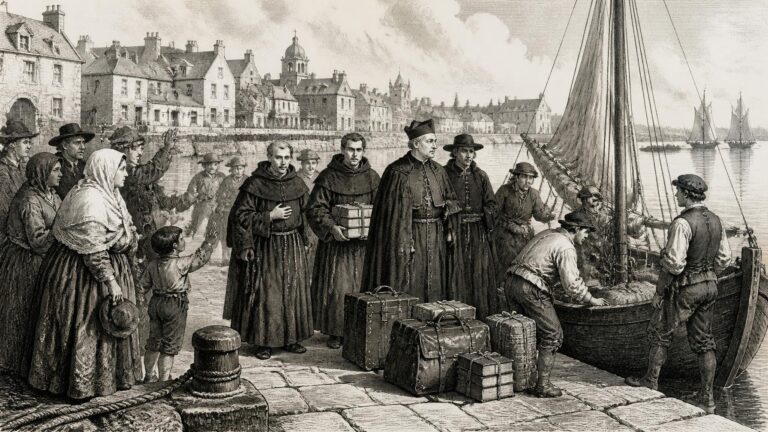
The statute generally known as the Bishops’ Banishment Act targeted a defined, though crucial, part of Catholic religious life. It ordered archbishops, bishops, vicars-general, deans, Jesuits, monks, friars and other regular clergy, together with Catholics exercising ecclesiastical jurisdiction, to leave Ireland. Those still present after 1 May 1698 faced imprisonment and transportation; a person transported under the act who returned could be treated as guilty of high treason. The law also penalised those who sheltered prohibited clergy. Its language was calculated to dismantle the Catholic Church’s leadership and religious orders, rather than immediately remove every secular parish priest.
Wool, Woods and Forfeitures
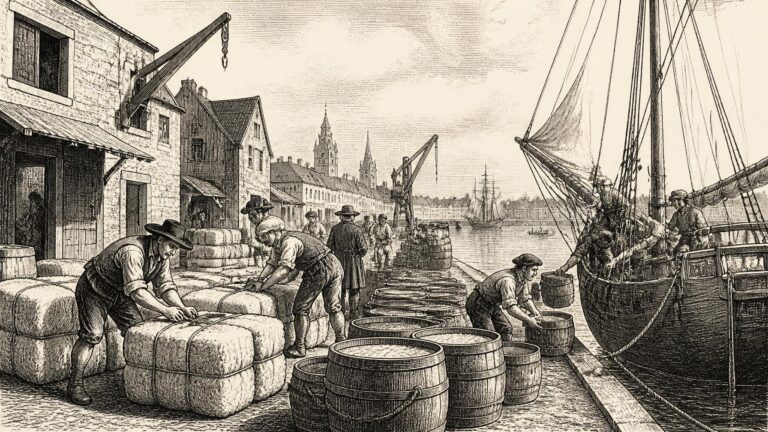
The Irish parliament sitting at the start of 1699 had first assembled in September 1698. Its final legislative business was completed in January 1699, and the parliament was formally dissolved on 14 June. It was not a representative national assembly in the modern sense. Catholics were excluded from parliamentary life by the oaths required for office, while the executive and the machinery of legislation remained closely tied to Dublin Castle, the crown and English approval under Poynings’ Law. Nonetheless, its statutes mattered deeply, especially to the Protestant landowning and mercantile interests who dominated it.
Chichester House Claims
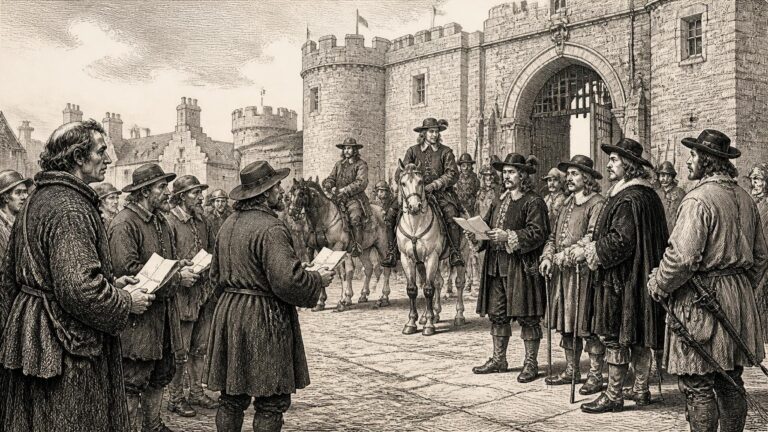
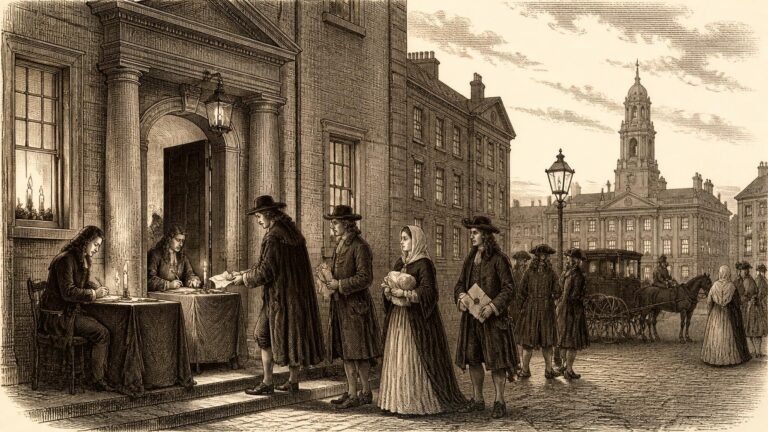
On 10 August 1700, Chichester House on Dublin’s College Green became the setting for one of the most consequential administrative deadlines in post-war Ireland. By midnight, anyone claiming an interest in property forfeited after the Williamite victory had to lodge papers with the trustees created by the English Act of Resumption. Clerks remained at work by candlelight as claimants and their agents delivered deeds, mortgages, leases, judgments and family settlements. More than 3,000 claims were ultimately entered. The scene was not a parliament in session, nor a public trial, but it exposed a central fact of life in Ireland at the opening of the eighteenth century: land, law and political security were inseparable.