
Ireland, 14 January 2026: Reform, Resilience And The Public Interest(c.2020s)
On 14 January 2026 Ireland’s public record showed a state preoccupied with long horizons rather than one dramatic rupture. Ministers opened a National Conversation on Education, Cabinet support for post offices signalled concern for rural infrastructure, and the Dáil debated Europe, Ukraine, Gaza, Mercosur, energy, water and public services. Irish Aid announcements in Jordan and Ukraine located the State in humanitarian diplomacy, while the Grok controversy highlighted new pressures on law, children’s safety and online power. In Northern Ireland, legacy redress scrutiny continued. The day’s significance lay in competing ideas of public responsibility and democratic reform at home and abroad.
Dateline
A day of consultations rather than rupture
Wednesday 14 January 2026 did not produce one single Irish event comparable to an election, a treaty or a catastrophe. Its historical value lies instead in the way several strands of public life became visible at once: education reform, rural services, European security, humanitarian diplomacy, climate anxiety, legal aid, online harms and the unresolved institutional legacies of the past. Read as a daily archive, it shows an Ireland asking how a prosperous, highly connected state should protect its citizens, use its international voice and modernise institutions without losing older ideas of community and public service.
The most explicitly future-facing development was the launch by Ministers Hildegarde Naughton, Norma Foley and Michael Moynihan of the National Conversation on Education. The initiative invited children, young people, parents, educators and wider society to contribute through surveys, submissions and local conversations, with results intended to shape a Convention on Education and a long-term strategy. Its language was ambitious — a “once-in-a-generation” opportunity — but it also revealed pressure points familiar from Irish educational history: equality of access, special education, early learning, the purpose of schooling, and the challenge of preparing pupils for social and technological change.
Education and the democratic habit
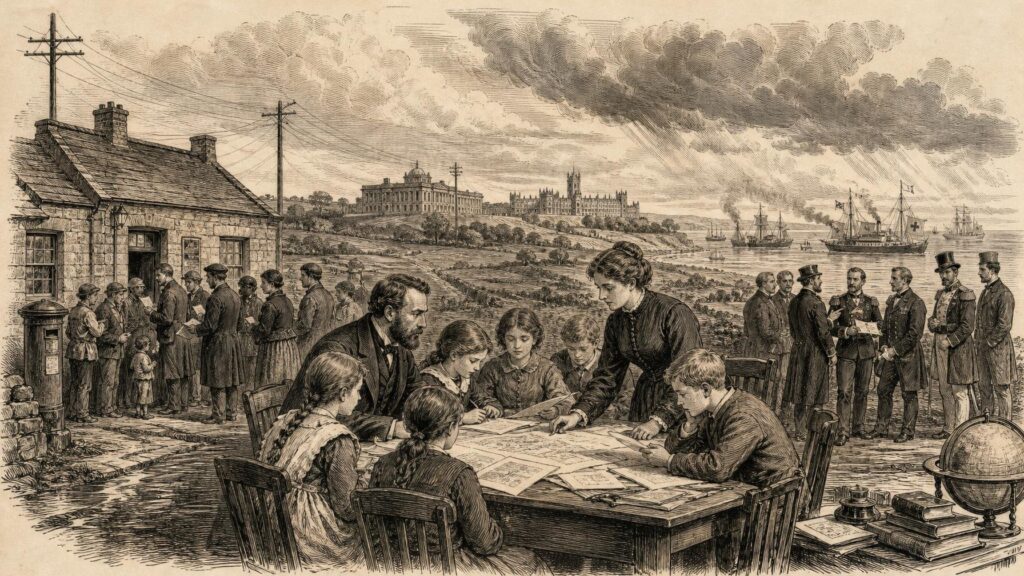
Education has long been one of the principal ways Ireland imagined social mobility: from nineteenth-century national schools to denominational control, the expansion of free second-level education in the 1960s, widening university participation, and recurrent debates over Irish, religion, class and inclusion. The 2026 consultation belonged to a newer Irish tradition too: the use of participatory processes to address difficult questions. After constitutional conventions and citizens’ assemblies helped shape debates on marriage equality, abortion and climate, education was being framed not merely as a departmental service but as a national conversation about the kind of society Ireland wanted to become.
That aspiration sat uneasily beside evidence, also reported that day, of children waiting years for psychology and occupational therapy assessments. The contrast matters historically. Irish reform often begins with high civic language, but its credibility depends on whether children with disabilities, families under pressure and under-resourced schools experience change in daily life. The day therefore captured both hope and strain: a state confident enough to ask big questions, but still struggling to deliver timely supports.
Rural infrastructure and the post office network
Another decision carried quieter but deep social meaning. Government approval for €75 million over five years to support the post office network recognised that post offices are more than commercial outlets. They are sites of welfare access, payments, cash services, local information and everyday sociability, especially in rural and older communities. The Irish Postmasters’ Union had warned that hundreds of offices could be at risk without stronger support, and the new allocation was framed around sustainability, isolation and access to essential services.
This was part of a much older Irish argument about the meaning of the State outside the major cities. From the Land Commission and rural electrification to the closure of Garda stations, banks, creameries and local shops, Irish public policy has often balanced efficiency against the social cost of withdrawal. By 2026, digitalisation had transformed letters, payments and government services, but the political importance of physical presence had not disappeared. The post office decision showed that infrastructure can be emotional as well as technical: a counterweight to isolation in places where the loss of one counter, one weekly routine or one trusted official can feel like the shrinking of citizenship itself.
The Dáil looks outward: Europe, war and trade
In Leinster House, Dáil business on 14 January included statements following the European Council meeting of December 2025. The Taoiseach, Micheál Martin, set out Ireland’s position on Ukraine, Gaza, EU enlargement, the post-2027 EU budget, competitiveness, sanctions on Russia and the State’s forthcoming EU Presidency in the second half of 2026. The debate reflected Ireland’s changed place in the world: still a small state, but one embedded in European decision-making, dependent on open trade and deeply exposed to shifts in American, Russian, Chinese and Middle Eastern politics.
The discussion also revealed tensions in Irish political identity. Ireland’s support for Ukraine drew on principles of sovereignty and territorial integrity with strong resonance in Irish history. Gaza and the West Bank raised questions of humanitarian law and consistency. Mercosur reopened the familiar divide between trade liberalisation, environmental standards and the future of Irish farming. Greenland and Denmark appeared in the debate because Arctic sovereignty and United States pressure had become European concerns. In other words, Irish parliamentary time was being shaped by events from Kyiv to Amman, Brussels to Brasília, and Nuuk to Washington.
Domestic issues were never far away. The Dáil schedule also included a motion on Uisce Éireann infrastructure delivery and repair timelines, a Gas Safety Bill and environmental legislation. Deputies linked water capacity to housing, public health and accountability. The history here is not glamorous, but it is central: modern Ireland’s ability to build homes, protect rivers, maintain pipes and regulate energy systems has become a test of state competence as important as any symbolic declaration.
Humanitarian diplomacy in Jordan and Ukraine
Foreign policy on the day was not confined to the chamber. Minister for Foreign Affairs and Trade Helen McEntee met King Abdullah II of Jordan, Crown Prince Hussein and Foreign Minister Ayman Safadi in Amman. Ireland also announced funding for UNHCR and UNICEF to support Syrian refugees in Jordan, following a separate €20 million commitment to UNRWA. Jordan’s role as a host of Palestinian and Syrian refugees placed Ireland’s humanitarian policy within a regional crisis shaped by displacement, war and diplomacy.
Separately, Minister of State Neale Richmond announced €3 million in Irish Aid funding for Concern, the Irish Red Cross and Trócaire to deliver humanitarian work in Ukraine. The projects were linked to cash support, winterisation, mental health and community-led assistance. These announcements continued a post-2022 pattern in which Ireland supported Ukraine through humanitarian, stabilisation and diplomatic channels. They also drew on an older self-image: Ireland as a country marked by famine, migration and colonial memory, now using aid and multilateralism as tools of international responsibility.
Technology, rights and the limits of existing law
The Grok controversy gave the day a distinctly twenty-first-century edge. Reports and political responses focused on AI-generated sexualised images, including alleged child sexual abuse material, on X. The debate involved Garda investigations, ministerial legal advice, online safety, corporate responsibility and whether existing criminal law was adequate for generative AI. Opposition criticism argued that Government statements were inconsistent and that responsibility could not be shifted solely on to users when platforms enabled harmful production and distribution.
Historically, this sits in a longer Irish struggle to regulate communications technologies: from censorship of print and film, to broadcasting law, data protection, social media moderation and the EU Digital Services Act era. What changed in 2026 was the speed and intimacy of harm. The image, once treated as evidence, had become infinitely editable. For children, women and public figures, the question was not abstract innovation but personal safety, dignity and enforcement.
Justice, legacy and the unfinished past
Access to justice was another theme. A FLAC and Trinity College Dublin conference on civil legal aid, reported on 14 January, warned of deepening crisis, long waits and under-resourcing in the Legal Aid Board. Speakers connected Irish reform to European rule-of-law principles. The issue cut to a basic democratic question: rights are only meaningful if people can vindicate them.
In Northern Ireland, the Assembly’s Executive Office Committee continued scrutiny of the Inquiry (Mother and Baby Institutions, Magdalene Laundries and Workhouses) and Redress Scheme Bill. Its minutes recorded clause-by-clause work, questions about records, PRONI, Barnardo’s and memorialisation. The topic bridged North and South: institutions once justified by religion, gender norms and poverty were still generating demands for truth, records and redress. On 14 January 2026, Ireland’s past was not past; it remained embedded in files, committees, compensation schemes and the memories of survivors.
Climate as the background condition
Climate reporting that day underlined another long-term pressure. Met Éireann’s 2025 annual climate statement recorded Ireland’s average annual air temperature at 11.14°C, well above twentieth-century averages, while Irish Times coverage connected Ireland’s experience to worsening European and global trends. Climate change was not a single event on 14 January, but it framed arguments over water, housing, agriculture, energy and emergency preparedness.
The day’s archive therefore points to an Ireland between confidence and vulnerability. It had the resources to fund aid, consult citizens and support local infrastructure. It also faced backlogs, climate risk, technological harms, rural fragility and unresolved historical injustice. Its significance lies in that mixture: a democratic state trying to decide what public responsibility should mean in an age of speed, danger and interdependence.
Primary Sources
- Ministers Naughton, Foley and Moynihan launch the National Conversation on Education
- Tánaiste Simon Harris meets with Governor Gavin Newsom in California
- Minister McEntee meets King of Jordan H.M. King Abdullah II
- Minister Richmond announces Ukraine humanitarian funding for three Irish NGOs
- Dáil Éireann debate record, 14 January 2026
- Report of the Business Committee for 13–15 January 2026
- Post European Council Meeting: Statements
- Committee for The Executive Office minutes of proceedings, 14 January 2026
- Major FLAC & TCD Law School Conference on Civil Legal Aid
- Government approves €75m in funding to support post office network
- 14 January 2026 Digital News Archive
- Ireland set for more extreme weather as climate data points to worsening trends
- Government flailing around on Grok scandal unable to get its story straight
- Annual Climate Statement for 2025