Membership is completely free, giving members unlimited access to all available resources, services, features, and benefits without any restrictions or fees.
Welcome back. Sign in to continue enjoying unlimited access to all available resources, services, features, and member benefits at no cost.
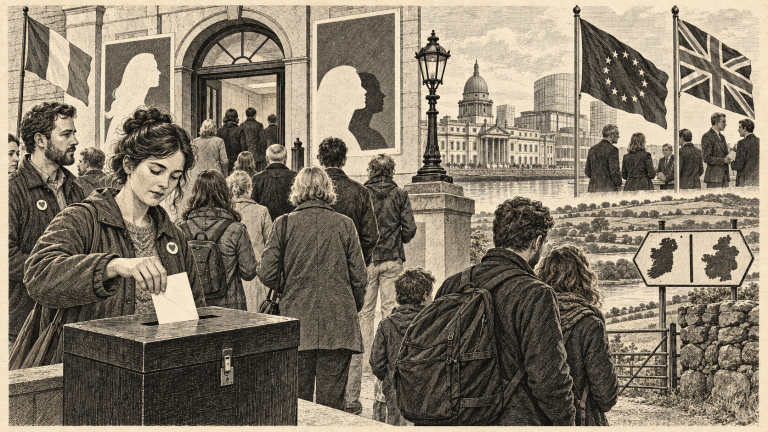
In 2018, Ireland confronted questions of bodily autonomy, national identity, borders and public provision with unusual intensity. The Republic was governed by Leo Varadkar’s Fine Gael-led minority administration, sustained by a confidence-and-supply arrangement with Fianna Fáil. Its agenda was dominated by Brexit and by the referendum on the Eighth Amendment, while the continuing housing emergency exposed the limits of recovery after the financial crash. In Northern Ireland, the absence of devolved ministers at Stormont deepened the political strain surrounding Brexit and public services. The year did not produce a single settled national mood. Rather, it showed a society capable of decisive constitutional change while remaining anxious about inequality, infrastructure and the island’s future relationship with Britain.
Ireland in 2015 was a country emerging unevenly from the financial crash while approaching a general election expected in the following year. Enda Kenny’s Fine Gael–Labour coalition could point to renewed employment, improving tax receipts and an end to the formal EU-IMF bailout programme achieved in late 2013. Yet the political atmosphere was not one of uncomplicated recovery. Years of spending restraint, changes to public services and continued emigration had left a deep mark. The introduction of domestic water charges on 1 January became an especially potent symbol of grievance. Demonstrations continued through the year, including a major Dublin march in April, while local campaigns against meters, bills and Irish Water brought national policy into estates and town streets.
Ireland held the rotating Presidency of the Council of the European Union from January to June. It was the State’s seventh presidency and coincided with the fortieth anniversary of Irish entry into the European Communities. The role gave Dublin a conspicuous platform at a moment when Ireland was still closely identified abroad with the euro-zone crisis. Irish ministers chaired negotiations rather than directing Europe alone, but the presidency helped broker agreement on the EU’s 2014–20 Multiannual Financial Framework, advanced reform of the Common Agricultural Policy, supported the Youth Guarantee, and reached a provisional deal with the European Parliament on the Single Supervisory Mechanism for banks. The latter was a central component of the proposed banking union, intended to weaken the dangerous connection between fragile banks and indebted states.
The central political event in the Republic was the referendum of 31 May on the European Fiscal Compact, formally the Treaty on Stability, Coordination and Governance in the Economic and Monetary Union. Ireland was the only state to put this particular treaty to a popular vote. Its opponents argued that it would entrench austerity and place further limits on democratic economic choice; its supporters maintained that ratification was necessary to demonstrate financial reliability and preserve access to future euro-area assistance. The campaign made the external constraints on Irish policymaking unusually visible. The State’s fiscal decisions were being judged not merely in Leinster House but by European institutions, the International Monetary Fund and lenders in international markets.
The most consequential development came at the end of the year. At midnight between 1 and 2 December, powers were devolved from Westminster to the Northern Ireland Assembly, ending the latest period of direct rule from London, which had begun in 1972. The Northern Ireland Executive then met at Stormont for the first time. It was headed by David Trimble of the Ulster Unionist Party as First Minister and Seamus Mallon of the Social Democratic and Labour Party as Deputy First Minister. Ministers from the UUP, SDLP and Sinn Féin took part; Democratic Unionist Party ministers refused to attend that inaugural meeting because of their opposition to entering government alongside Sinn Féin before IRA weapons had been decommissioned.
In 1990 Ireland experienced an unusually vivid succession of public moments: a European presidency, a breakthrough summer in football, Nelson Mandela’s visit, a presidential election that overturned political expectations, and a landmark change in criminal law. Together they gave the Republic an outward-looking appearance that contrasted with everyday insecurity. Unemployment remained high, emigration was familiar to many households, and the Fianna Fáil–Progressive Democrats coalition under Charles Haughey governed a country still emerging from the fiscal and economic crises of the 1980s. In Northern Ireland, the conflict continued to take lives even as tentative new political thinking appeared.
The Fine Gael–Labour coalition led by Taoiseach Garret FitzGerald entered 1986 struggling to reconcile reforming ambitions with a harsh fiscal environment. Public debt, heavy interest payments, unemployment and renewed emigration constrained policy and fostered a sense that the country’s difficulties were structural rather than temporary. An Economic and Social Research Institute study published in November, The National Debt and Economic Policy in the Medium Term, captured the central preoccupation: debt was not merely an accounting problem but a limit on the State’s room for manoeuvre.
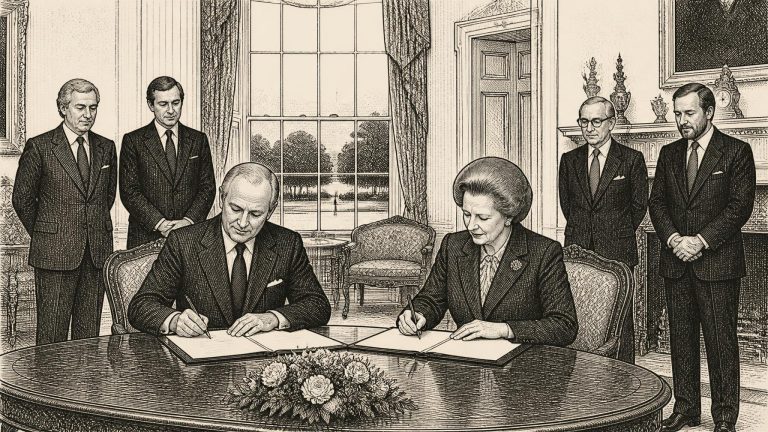
The Agreement’s central political fact was carefully framed. Britain confirmed that Northern Ireland’s constitutional position would not change without the consent of a majority of its people. Ireland, in return, gained a permanent channel through which to express views on political, legal, security and cross-border matters. An Anglo-Irish Intergovernmental Conference, supported by a secretariat based at Maryfield near Belfast, was to meet regularly. In areas where Northern Ireland lacked devolved government, Dublin could make proposals and put forward its concerns, especially on policies affecting the nationalist minority.
Charles J. Haughey remained Taoiseach during the first half of the year, leading Fianna Fáil as it confronted a difficult economic and political environment. Ireland had entered the 1980s with high inflation, rising unemployment and strained public finances. An OECD survey published early in 1981 noted that unemployment had risen sharply during 1980, especially among younger people, while consumer prices had increased by more than 18 per cent in that year. These were conditions inherited by 1981 rather than figures that describe the whole calendar year, but they explain the intensity of debate over taxation, public spending and jobs.
In 1977, political life on the island moved in sharply different directions. In the Republic, the general election of 16 June gave Fianna Fáil and its leader, Jack Lynch, an emphatic democratic mandate. In Northern Ireland, still governed directly from Westminster, an attempted loyalist general strike demonstrated both the continuing capacity for disruption and the limits of a strategy that had succeeded only three years earlier. Violence, prison protest and profound communal division remained facts of daily life in the North; south of the Border, voters rewarded promises of relief from taxation and a more confident response to economic difficulty.
The opening days of the year demonstrated the terrible speed with which sectarian violence could generate retaliation. On 4 January, loyalist gunmen killed six members of the Reavey and O’Dowd families in County Armagh and County Down. The following evening, ten Protestant workmen were murdered after their minibus was stopped at a bogus checkpoint near Kingsmill, County Armagh. The assault was claimed by the Republican Action Force, widely understood to have been a cover name used by elements associated with the IRA. One passenger survived despite being shot.
Ireland held the rotating Presidency of the Council of the European Communities from January to June 1975, only two years after joining the EEC alongside Britain and Denmark. Taoiseach Liam Cosgrave’s Fine Gael–Labour government thereby acquired an international convening role out of proportion to the country’s size. Garret FitzGerald, the Minister for Foreign Affairs, was an important public face of an outward-looking policy at a moment when the Community was coping with recession, inflation and the aftermath of the 1973 oil shock.