
Schools Rights And Shared Futures(c.2020s)
On 23 March 2026, Irish public life was shaped by consultation, inclusion and practical resilience. The Education Convention brought children, parents and educators into long-term policy making, while funding announcements supported LGBTIQ+ services, Shared Island language projects and conservation advice for traditional homes. TidyTowns renewed the link between local pride and environmental action. Financial regulation moved from the older Consumer Protection Code towards a digital-age framework, as energy and fertiliser shocks threatened household budgets and food prices. Health leadership and Kate O’Connor’s athletics success added human markers to a day of steady institutional change across the State and island society
Dateline
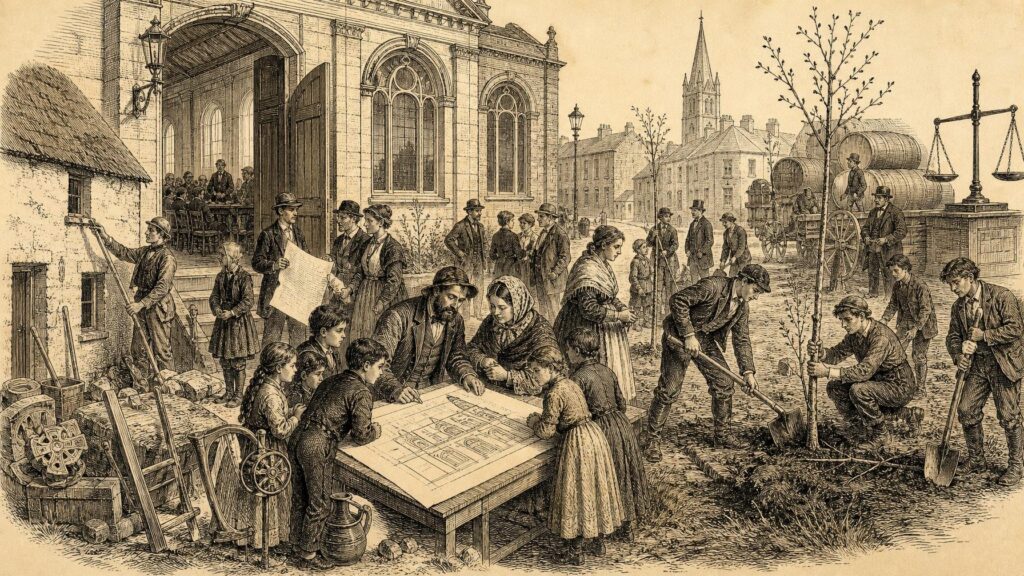
For 23 March 2026, the historical significance in Ireland lay less in a single dramatic rupture than in a cluster of public decisions that revealed how the State was trying to govern long-term pressures: education, equality, cross-border identity, housing stock, consumer rights, public health leadership and the cost of living. It was a day of announcements, starts and near-starts rather than revolutions. Yet such days matter in the archive because they show ideas becoming institutions: children treated as policy participants, older houses as climate assets, minority services as public infrastructure, and all-island cultural work as a practical rather than purely symbolic peace process.
Education As Deliberative Democracy
The central civic development was the first meeting of the Convention on Education in Athlone, formally publicised as a milestone in shaping the future of primary and post-primary schooling. The convention brought together 150 participants, including children and young people, parents, school employees, early-years educators and education stakeholders. Its programme was to meet over four weekends during the year and feed into a long-term departmental strategy, Our Schools, Our Future.
Two features made the exercise historically notable. First, the preparatory National Conversation on Education had engaged more than 40,000 people through surveys, submissions and school-community processes. Secondly, children and young people aged 8 to 24 were full members rather than witnesses or consultation subjects. Ireland has used citizens’ assemblies to examine constitutional and social change, but applying deliberative methods at this scale to schooling signalled a changing idea of education policy: not simply a matter for ministers, unions, churches and departmental officials, but a social contract negotiated with those who live inside the system every day.
That did not remove familiar tensions. Irish schools still carried disputes about patronage, special educational needs, teacher supply, curriculum overload, assessment, inequality and mental health. A convention could not solve those immediately. Its historical value was different: it made explicit that education reform was being framed as intergenerational democratic planning, rather than a sequence of crisis responses.
Equality, Language And The Island
Several announcements on the day linked public funding to inclusion and identity. The Department of Children, Disability and Equality opened the 2026 LGBTIQ+ Community Services Funding Call, making €1.5 million available to national, regional and local groups. The scheme was connected to the National LGBTIQ+ Inclusion Strategy II and was aimed at services, visibility, rights, wellbeing and community support.
In a country whose constitutional and social history includes the decriminalisation of homosexuality, marriage equality, gender recognition and continuing disputes over sex education and trans rights, the funding was not merely administrative. It represented the normalisation of LGBTIQ+ support as part of public service provision. Supporters would read that as a practical expression of equality; critics of aspects of gender and sexuality policy would see another sign of contested cultural change. A balanced archive must note both: the State was not ending debate, but it was placing inclusion within its ordinary grant-making machinery.
The Shared Island Initiative announcement had a different but related significance. Minister Dara Calleary announced €6.2 million in capital funding for Irish-language and Ulster-Scots projects, including support for An Ciste Infheistíochta Gaeilge and the North West Cultural Partnership’s Cultural Embrace project in Derry. That pairing mattered. For generations, language and culture on the island were often treated as boundary markers. The day’s announcement presented them instead as fields for co-operation, community development and mutual recognition, especially in Northern Ireland and the border counties.
Homes, Heritage And Local Pride
The built environment also appeared as a public concern. The expanded Conservation Advice Scheme for Traditional Houses opened for applications, offering grants of up to €5,000, or up to 67% of the cost, for specialist advice on conservation, fire safety and energy upgrades. The expansion widened eligibility beyond vacant homes to occupied traditional houses, above-shop conversions and traditional farmhouses, including some vernacular buildings without statutory protection.
This was a small scheme beside Ireland’s housing crisis, but it belonged to a larger historical shift. Older buildings were once often seen as obstacles to modern comfort or commercial redevelopment. By 2026, policy increasingly treated them as possible homes, town-centre assets and carriers of local identity, provided energy efficiency and safety were handled carefully. The scheme sat at the intersection of housing supply, climate retrofitting and heritage protection — three pressures that often collide in Irish towns and villages.
The launch of the 2026 SuperValu TidyTowns competition in Carrick-on-Shannon continued a more familiar form of civic Ireland. Running since 1958, TidyTowns had become one of the State’s most durable community rituals, mixing voluntary labour, environmental care, local competition and national recognition. Its longevity tells a story about post-war modernisation: the desire to improve public space without waiting entirely for central government. By 2026, its language had shifted towards sustainability and resilience, but the underlying ethic remained local stewardship.
Consumers, Fuel And Food Prices
The Central Bank signed the revocation of the Consumer Protection Code 2012, with the modernised Consumer Protection Code 2025 taking effect the following day. The timing made 23 March the hinge between two regulatory eras. The older code had belonged to the post-crash world of rebuilding trust in financial services; the newer framework addressed digital delivery, scams, vulnerable consumers, complaints, mortgage arrears consolidation and the expectation that firms secure customers’ interests.
That transition was sharpened by the economic news. RTÉ reported Bank of Ireland warnings that sharp rises in energy prices could push inflation towards 3.5% to 4%, while separate reporting described rising fertiliser and farm-input costs, including warnings of eventual food-price increases. The immediate cause was international conflict and disruption, but the Irish historical context was familiar: a small, open economy exposed to external shocks, with households, farmers and Government forced to absorb pressures generated far beyond the island.
The juxtaposition was striking. On one side, regulators were strengthening consumer protections in an increasingly complex financial marketplace. On the other, consumers faced price movements that regulation alone could not prevent. The archive should therefore read the day as both protective and anxious: the State was modernising rights while confronting the limits of national control over energy, food and global markets.
Health Leadership And Sporting Memory
The day also marked a change at the top of the public health service. HSE communications welcomed Anne O’Connor as chief executive, following her appointment after an open selection process. O’Connor had previously served in senior HSE roles, including Chief Operations Officer during the Covid-19 pandemic and the 2021 cyberattack, before moving to Vhi Health & Wellbeing. Her return mattered because the HSE, created in 2005, remained one of the State’s most scrutinised institutions, responsible for translating large budgets and reform promises into daily care.
Sport supplied a different form of national memory. Kate O’Connor’s bronze medal in the pentathlon at the World Indoor Championships, won the previous evening and celebrated across Irish sport on 23 March, confirmed her place in a growing lineage of elite Irish female athletes. Athletics Ireland described a national record performance and noted her rare status among Irish global medallists. In historical terms, such achievements help widen the story of Irish sport beyond the dominant field games, linking contemporary professionalism, women’s sport and international visibility.
A Day Of Institutional Signals
Taken together, the day’s events were modest in spectacle but revealing in direction. Education policy leaned towards deliberation. Equality policy continued through targeted services. Shared Island funding treated cultural difference as a basis for connection. Housing and heritage policy tried to make old buildings part of future supply. Consumer regulation moved into a digital age, even as inflation fears showed how vulnerable everyday life remained to war and commodity markets. Public health leadership turned a page, and sporting success offered a brighter marker of national confidence.
For historians, 23 March 2026 is best read as a day of institutional signals. It showed an Ireland trying to manage prosperity’s strains, social diversity, climate obligations, inherited buildings, all-island relationships and global exposure. None of those stories began or ended on the day. But each left a trace of how Irish public life was changing: gradually, argumentatively, and through the ordinary machinery of announcements, grants, codes, conventions and appointments.
Primary Sources
- Significant milestone for future of Ireland’s education system as first meeting of the Convention on Education takes place
- Minister Foley announces €1.5 million in funding to support LGBTIQ+ people through the opening of the 2026 LGBTIQ+ Community Services Funding Call
- Minister Calleary announces €6.2 million for Irish language and Ulster-Scots projects under Shared Island Initiative
- Expanded grant scheme to fund conservation advice for traditional homes opens for applications
- Minister Dara Calleary Launches 2026 SuperValu TidyTowns Competition celebrating 68 years of environmental and community effort
- Revocation of Consumer Protection Code 2012 23 March 2026
- Consumer Protection Code 2025
- Bank of Ireland warns inflation could reach 4%
- 60% increase in fertiliser costs reported amid warning over food prices
- Anne O’Connor appointed as new CEO of the HSE
- Welcome to Anne O'Connor, who takes up the role of CEO from today
- Historic Bronze for O’Connor at World Indoors
- In The News – 23 March 2026
- 23 March, 2026 Digital News Archive