British Absence
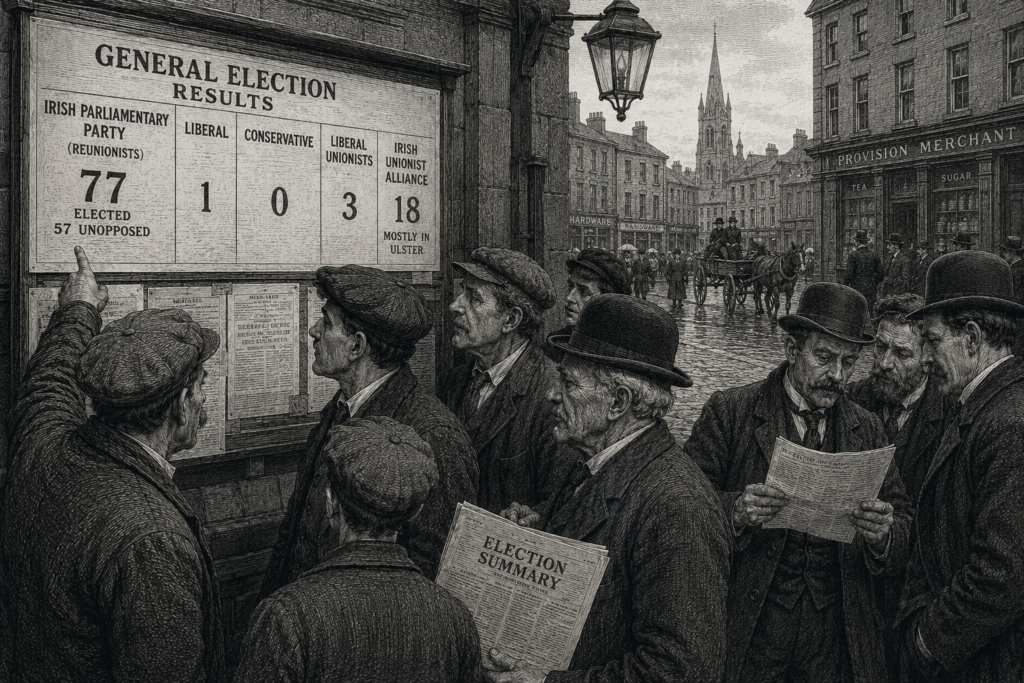
The completed general election has again demonstrated the weakness of the principal British political parties throughout nationalist Ireland. John Redmond’s reunited Irish Parliamentary Party has taken seventy-seven of Ireland’s 103 seats, while candidates standing directly for the British Liberal and Conservative parties made little impression across the south, west and much of the midlands. In Limerick, voters returned nationalist representatives without any prospect of an ordinary contest between the parties governing and opposing at Westminster. Irish political organisation remains shaped principally by the constitutional struggle between nationalism and unionism rather than by the divisions governing electoral life in Great Britain.
The British Liberals once attracted substantial Irish support through promises of reform, religious equality and sympathy for Home Rule. That relationship changed after Charles Stewart Parnell created a disciplined parliamentary movement capable of representing Irish constituencies independently. Gladstone’s conversion to Home Rule encouraged cooperation between Liberals and nationalists at Westminster, but it did not restore a separate Liberal organisation throughout nationalist districts. Conservative hostility to an Irish legislature made that party still less attractive. By 1900, most electors outside Unionist areas regarded British party candidates as unable or unwilling to represent Ireland’s demands for self-government, land reform and more direct control over domestic administration.
Only one Liberal candidate secured an Irish seat, while three Liberal Unionists were returned in constituencies opposed to Home Rule. The principal pro-Union representation came through the Irish Unionist Alliance, which retained eighteen seats, concentrated overwhelmingly in north-eastern Ulster and Dublin University. Across nationalist Ireland, however, the contest was usually between rival nationalists rather than between Liberal and Conservative organisations. Fifty-seven Irish Parliamentary Party members were returned without opposition, revealing the absence of a sustained British-party challenge in many constituencies. Even where elections were contested, local disputes concerning nationalist unity, candidate selection, land agitation and clerical influence frequently overshadowed the conventional British division between government and opposition.
The weakness of British organisation did not mean that Westminster politics had become unimportant. Nationalist MPs depended upon divisions between Liberals and Conservatives when seeking concessions, legislation or influence over governments lacking secure majorities. Many Irish nationalists continued to view the Liberals as potential allies because of their association with Home Rule, while Conservatives and Liberal Unionists governed through a coalition defending the Union. Yet neither British side possessed a broad electoral machine capable of replacing the Irish Parliamentary Party in nationalist constituencies. The election confirmed that cooperation at Westminster could coexist with electoral separation, leaving Irish voters represented by a distinct national party.
For Limerick, the result strengthened the position of local nationalist branches, clergy, public representatives and political organisers associated with Redmond’s movement. Liberal or Conservative candidates could not readily compete where elections were understood as contests over Irish government, tenant ownership and national representation. Unionist residents retained their political convictions, but they lacked the concentrated numbers that sustained Unionist representation in parts of Ulster. Limerick’s parliamentary politics consequently remained Irish rather than conventionally British in organisation and purpose. The governing parties at Westminster might determine legislation, but neither commanded the local allegiance necessary to challenge the nationalist movement for possession of the city and county’s parliamentary seats.
- Parliamentary Election Returns, General Election of 1900, House of Commons Parliamentary Papers, constituency returns for Ireland. These official returns verify the successful candidates, party affiliations, uncontested seats, polling dates and constituency results. Exact volume and page references should be confirmed before formal citation.
- The Times, September and October 1900, general-election reports and completed constituency returns. These contemporary reports can verify the national British result and the comparative strength of Conservative, Liberal, Unionist and Irish nationalist candidates. Exact page and column should be confirmed before formal citation.
- Freeman’s Journal and Daily Commercial Advertiser, September and October 1900. Its election reports can verify nationalist candidatures, uncontested returns, local campaigns and contemporary explanations for the weakness of British party organisation in Irish constituencies. Exact page and column should be confirmed before formal citation.
- The Irish Times, September and October 1900, election reports, constituency summaries and editorials. These issues can verify the performance of Liberal, Conservative, Liberal Unionist, Irish Unionist and nationalist candidates. Exact page and column should be confirmed before formal citation.
- United Irish League, Constitution and Rules Adopted by the Irish National Convention, 19 and 20 June 1900, Dublin, Swan & Co., 1900; National Library of Ireland, Pamphlet Volume A17405; Thomas Bradley Papers, MS 33,561/2(12). This document verifies the nationalist organisation that supported Irish Parliamentary Party candidates and helped displace conventional British party structures.