Unity Fractures(c.1890s)
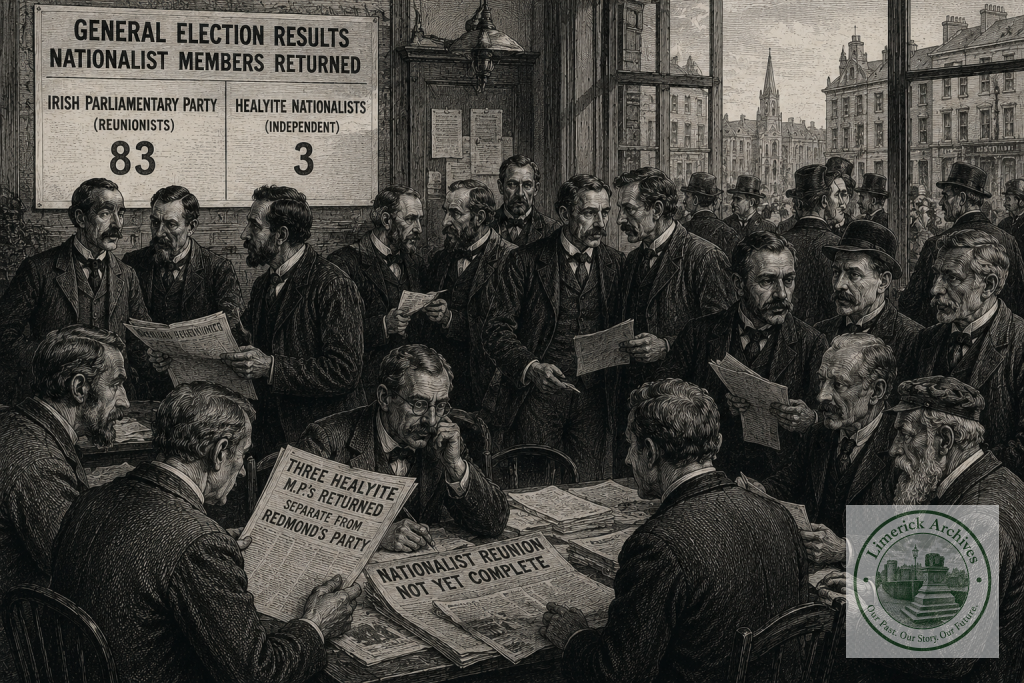
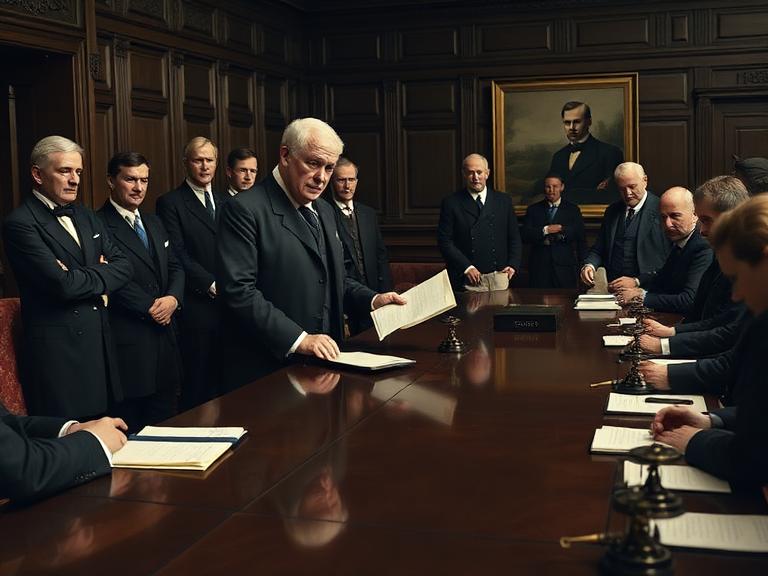
The completion of the general election has shown that the reunion of Irish parliamentary nationalism remains incomplete. Although John Redmond’s Irish Parliamentary Party has secured the overwhelming majority of nationalist seats, six supporters of Timothy Michael Healy have been returned outside the disciplined party organisation. The result will attract close attention among nationalists in Limerick city and county, where unity has been presented as essential to advancing Home Rule and land reform. Healy’s surviving parliamentary following demonstrates that the personal, clerical and local rivalries created during the bitter divisions of the 1890s have not been entirely overcome.
The nationalist split began after Charles Stewart Parnell’s leadership collapsed in 1890, dividing Irish MPs into competing Parnellite and anti-Parnellite organisations. Healy, initially prominent among the anti-Parnellites, became increasingly estranged from John Dillon and other leaders, cultivating an independent following through the People’s Rights Association. His supporters emphasised local control, clerical influence and hostility towards centralised party management. The formal reunion of the main parliamentary factions in January 1900 placed Redmond at their head, but it did not reconcile every personal grievance or political disagreement. Candidate selection during the election exposed the continuing distrust between party headquarters and Healy’s adherents.
The returned Healyite group included Tim Healy for North Louth, John Campbell for South Armagh, John Hammond for County Carlow, Peter Ffrench for South Wexford, James Laurence Carew for South Meath and Patrick Kennedy for North Westmeath. Their victories were achieved against candidates associated with Redmond’s party or through strong independent local organisation. Healy remained the central figure, combining parliamentary experience, legal ability and combative public speaking with a reputation for fierce personal controversy. His alliance with influential Catholic clergy, particularly Cardinal Michael Logue, gave his movement additional strength in districts where clerical opinion remained important to nationalist electoral organisation.
The result creates an awkward difficulty for Redmond. A reunited nationalist party must demonstrate discipline at Westminster, yet attempts to exclude or silence Healy’s followers may deepen the divisions that reunion was intended to end. Healyites support Home Rule and land reform, but dispute who should control the movement and how parliamentary candidates should be chosen. Their return also reveals the continuing power of local loyalties over national directives. The Irish Parliamentary Party can claim broad electoral supremacy, but the presence of an organised nationalist opposition means that Redmond cannot yet speak without qualification for every constitutional nationalist represented in the House of Commons.
In Limerick, where nationalist associations, clergy, tenant interests and local political organisers all influence public life, the Healyite success may revive debate over obedience to party leadership. Supporters of Redmond will argue that unity is necessary if Ireland is to exert effective pressure at Westminster. Others may sympathise with the claim that constituencies should resist candidates imposed by a central organisation. No Healyite captured a Limerick seat, but the faction’s survival elsewhere carries a clear warning. Nationalist reunion has restored much of the parliamentary strength lost during the previous decade, yet personal allegiance, local independence and disputes over authority remain capable of dividing the movement.
Primary Sources
- Parliamentary Election Returns, General Election of 1900, House of Commons Parliamentary Papers, constituency returns for Ireland. These official returns can verify the elected candidates, constituencies, voting figures and polling dates. Exact volume and page references should be confirmed before formal citation.
- Freeman’s Journal and Daily Commercial Advertiser, September–October 1900 election coverage. Contemporary reports can verify Healyite candidatures, speeches, disputes over party endorsement and reactions to the results. Exact page and column should be confirmed before formal citation.
- The Irish Times, September–October 1900 election reports and editorials. These issues can verify constituency contests, candidate classifications and contemporary criticism of continuing nationalist factionalism. Exact page and column should be confirmed before formal citation.
- United Irish League, Constitution and Rules Adopted by the Irish National Convention, 19–20 June 1900, Dublin, Swan & Co., 1900; National Library of Ireland, Pamphlet Volume A17405; Thomas Bradley Papers, MS 33,561/2(12). This document can verify the organisational structure against which independent Healyite candidatures were contested.
- Timothy Michael Healy correspondence and political papers relating to the 1900 general election, National Library of Ireland and associated manuscript collections. These papers may verify Healy’s candidate negotiations, complaints concerning party management and relations with Redmond, Dillon and clerical supporters. Exact manuscript items and archival references should be confirmed before formal citation.