Sessions Rejected
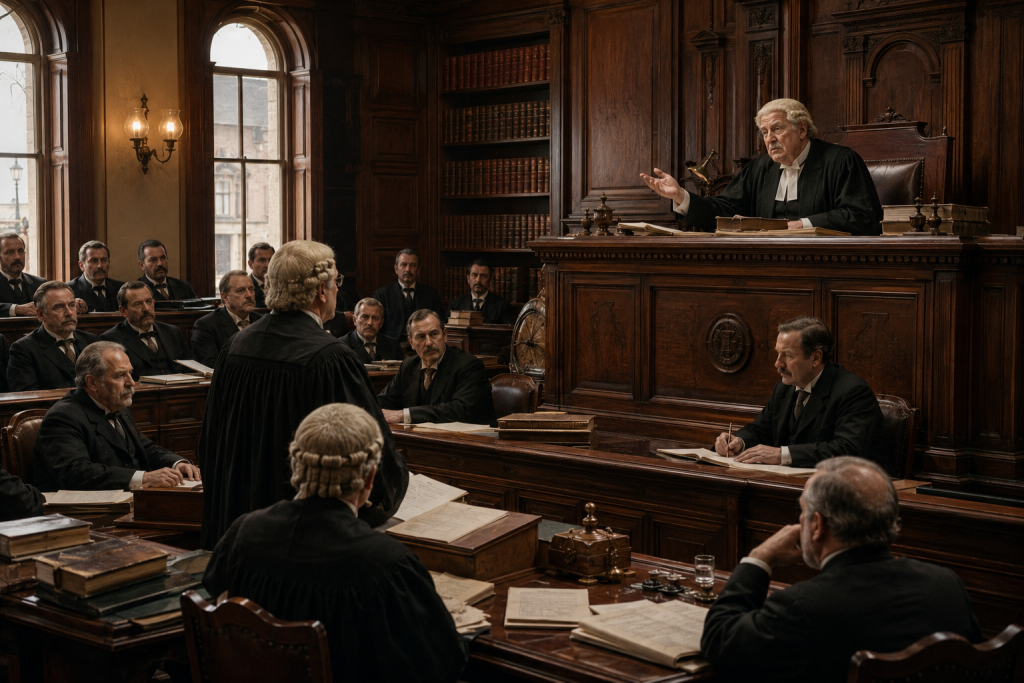
Judge Richard Adams firmly resisted a proposal to double the number of annual Quarter Sessions held in Limerick from four to eight. At the opening of the Hilary sittings, reported on 3 January 1900, the County Court judge asked whether any members of the legal profession present supported the suggested increase. Receiving no affirmative response, he declared that the demand did not come from local barristers, solicitors or the wider public. Adams presented the proposal as the work of a small deputation seeking attention rather than as a reform arising from demonstrated pressure upon the court.
The Limerick County Court combined civil jurisdiction with the judge’s responsibilities as chairman of Quarter Sessions. These sittings dealt with civil bills and criminal business beyond the lesser matters heard at Petty Sessions, making their frequency important to litigants, witnesses, solicitors and court officials. Four annual sessions followed the traditional quarterly pattern. Supporters of additional sittings could argue that more frequent courts might reduce delays and distribute legal business more evenly, but Adams questioned whether Limerick possessed either the workload or the professional demand necessary to justify doubling the established schedule.
Adams referred sarcastically to efforts made before the Lord Chancellor and contrasted Limerick with Galway, where the Recorder had reportedly agreed to conduct eight sessions annually. His remarks displayed the independence and humour for which he became well known, but they also asserted a serious constitutional position. He maintained that he would not hold more than four sessions unless compelled by legislation. Even if Parliament attempted such a change, he suggested that opposition would be organised in both Houses. The judge therefore treated the proposed reform as an intrusion requiring statutory authority rather than an informal administrative adjustment.
The disagreement mattered directly to Limerick people whose property disputes, debts, compensation claims, tenancy matters and criminal cases entered the County Court system. Additional sessions might have offered earlier hearing dates, yet they would also have required more jurors, officials, legal attendance and public expenditure. The absence of support voiced by the professionals present strengthened Adams’s contention that the existing arrangement remained adequate. His response also exposed tension between local judicial experience and reform campaigns conducted through deputations to Dublin, where the Lord Chancellor exercised considerable influence over Irish court administration.
No immediate increase followed the confrontation, and the four-session arrangement remained the position defended by Adams. The episode offers a revealing picture of Limerick’s legal world at the beginning of the twentieth century: a powerful local judge, a courtroom attentive to public controversy and a central administration attempting to consider changes across different Irish towns. Adams’s refusal was characteristically outspoken, but it rested upon his claim that reform should answer a genuine public or professional need. Until Parliament directed otherwise, he intended to preserve the established rhythm of justice in Limerick.
- Munster News, “Limerick Quarter Sessions: ‘Soldiers of the Queen’—An Epidemic of Window Breaking,” 3 January 1900; page not confirmed.
- National Archives of Ireland, Court Records Pre-1922, Courts of Crown and Peace, finding aids and records relating to Quarter Sessions and County Courts.
- County Officers and Courts (Ireland) Act 1877, 40 & 41 Vict., c. 56, governing County Court judges, Quarter Sessions and Civil Bill Courts in Ireland.
- Cork Examiner, 6 April 1908, obituary and career appreciation of Limerick County Court Judge Richard Adams.