Roberts Arrives
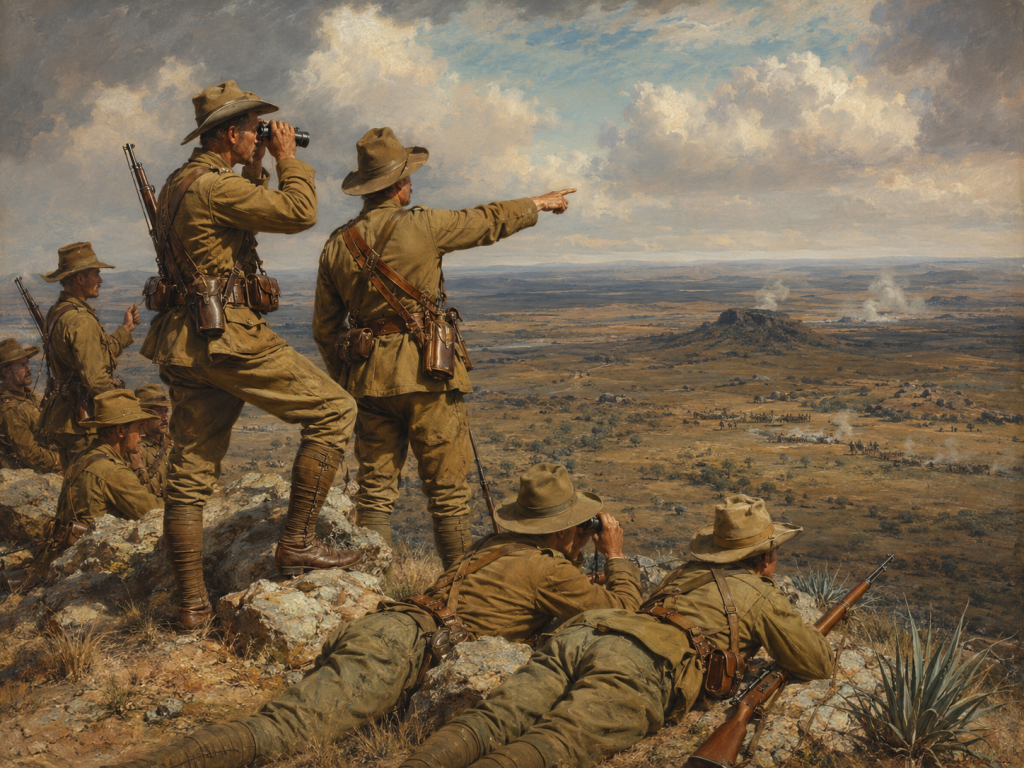
Field Marshal Lord Roberts arrived at Cape Town on 10 January 1900 and assumed supreme command of British forces in South Africa. He travelled aboard the Dunottar Castle with Lord Kitchener, who became his chief of staff. Their appointment followed the defeats of “Black Week,” when British reverses at Stormberg, Magersfontein and Colenso exposed serious weaknesses in command, intelligence and battlefield preparation. Roberts received a formal welcome at the harbour, but the ceremony could not conceal the gravity of his task. British garrisons remained besieged, casualties were rising and reinforcements arriving from across the Empire required organisation.
Roberts replaced General Sir Redvers Buller as the senior British commander, although Buller continued directing operations in Natal and the attempts to relieve Ladysmith. The new command arrangement divided responsibilities while placing overall strategy under Roberts. His immediate priority was not a dramatic attack but the reorganisation of a large and disordered army. Transport, supply, intelligence, staff work and mounted forces all demanded attention before a sustained advance could begin. Lord Kitchener’s administrative energy complemented Roberts’s authority and experience, creating a headquarters intended to restore confidence after months in which Boer mobility and marksmanship had repeatedly frustrated British numerical superiority.
The arrival also signalled a major expansion of the war. Additional regular troops, reservists, militia battalions, colonial units and mounted volunteers were being assembled for service. Roberts planned to shift the principal British effort towards the western theatre, relieve Kimberley and advance upon Bloemfontein before moving deeper into the Boer republics. This approach reduced dependence upon repeated frontal assaults along the Natal railway. The change did not bring immediate relief to Ladysmith, Mafeking or Kimberley, but it indicated that Britain intended to replace improvised reactions with a coordinated offensive supported by overwhelming manpower, railway transport, artillery and supplies.
For Limerick readers, the appointment had an immediate human significance. The Royal Munster Fusiliers recruited throughout Limerick, Cork, Kerry and Clare, while other Irish regiments, reservists and individual soldiers were already serving in South Africa. Families awaiting letters or casualty lists understood that a change in command could determine where those men marched and fought. Some nationalists sympathised with the Boers and regarded Roberts as the instrument of a renewed imperial campaign. Yet political opposition to the war existed beside concern for relatives whose military wages supported households and whose survival depended upon decisions made at the new Cape Town headquarters.
Roberts’s arrival did not by itself transform British fortunes, but it marked the beginning of a more systematic phase of the campaign. During the following weeks he concentrated troops, improved mounted capacity and prepared the advance that relieved Kimberley and forced General Piet Cronje’s surrender at Paardeberg. The later occupation of Bloemfontein and Pretoria grew from the strategy developed after his arrival. News of the new supreme commander therefore carried both reassurance and foreboding to Limerick. Britain had acknowledged the inadequacy of its original plans, but its answer was not withdrawal. It was a larger army and a more determined prosecution of the war.
- Major-General Sir Frederick Maurice, History of the War in South Africa, 1899–1902, vol. I, chapter XXV, “Lord Roberts at Cape Town,” London: Hurst and Blackett, 1906.
- British Film Institute, The Arrival and Reception of Lord Roberts at Capetown, film recorded by Edgar Hyman for the Warwick Trading Company, 10 January 1900.
- Imperial War Museums, The Arrival and Reception of Lord Roberts at Cape Town, 10 January 1900, film collection object 1060000074.
- The Times, 11 January 1900, contemporary reporting on Lord Roberts’s arrival and assumption of command; page not confirmed.
- War Office, The Monthly Army List, January 1900, entries concerning British command and regimental establishments in South Africa.
- Military Archives of Ireland, Information Document on the Irish Regiments of the British Army, entry for the Royal Munster Fusiliers.
- National Army Museum, “The Royal Munster Fusiliers,” regimental history and South African War collection.