Tabanyama Assault(c.1900s)
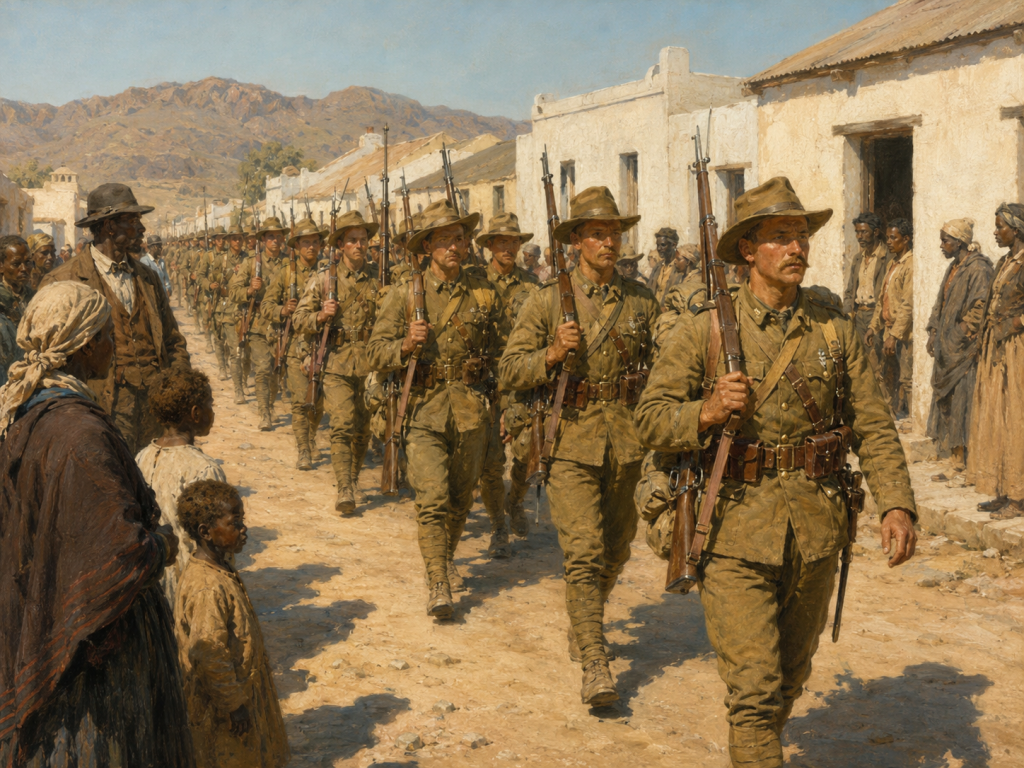
News of the fighting on the Tabanyama ridges carried particular weight in Limerick, where families with connections to British Army service followed the Natal campaign and the fortunes of Irish regiments abroad. Between 20 and 22 January 1900, Lieutenant-General Sir Charles Warren’s force attempted to break the Boer defensive line west of Spion Kop and open a route towards besieged Ladysmith. Major-General FitzRoy Hart’s 5th, or Irish, Brigade formed part of the attacking army, alongside Major-General Edward Woodgate’s Lancashire Brigade. The operation placed Irish soldiers within a difficult imperial campaign whose conduct and purpose remained politically contentious at home.
The principal assault began before dawn on 20 January, when Woodgate’s brigade climbed towards the forward crests and Hart’s troops followed. The lower slopes were partly concealed from Boer observation, allowing the British infantry to reach the first heights with comparatively little interference. Once there, however, the true strength of the position became apparent. The main Boer trenches lay farther across exposed ground on the higher ridge. Warren brought forward his field artillery and subjected the defensive line to a prolonged bombardment, but the burghers remained protected among prepared trenches, stone positions and folds in the terrain commanded by General Louis Botha.
During the afternoon, Lancashire units advanced with support from the Royal Dublin Fusiliers, Royal Inniskilling Fusiliers and Border Regiment. They captured advanced ground but then faced roughly a thousand yards of open veld before the principal Boer line. Rifle fire struck from the front and flanks, while Boer guns near Spion Kop began throwing shrapnel across the assaulting formations. The advance slowed and was halted before evening, leaving the troops to shelter among rocks and hastily constructed defences. The Royal Dublin Fusiliers recorded four men killed, twenty wounded, Captain Hensley mortally wounded and Major English wounded during the day’s action.
Rifle fire resumed at daylight on 21 January. Hart’s men moved across exposed ground to support the 2nd Brigade, but no decisive attack followed. Battalions gathered behind the southern crest, where bullets passed overhead and intermittent Boer shellfire struck the ridge. The fighting from 20 to 22 January was therefore not one uninterrupted charge. The first day brought the strongest advance; the following days were marked by skirmishing, bombardment, entrenchment and prolonged exposure. By the evening of the 22nd, the troops still held forward ground, but Warren’s attempt to turn the Boer right had stalled without securing the main crest.
The failure to force the Tabanyama position led British commanders towards the night assault on Spion Kop, ordered after the troops had spent days under fire on the ridges. That decision produced the far better-known battle of 23 and 24 January, but the earlier struggle explains why Spion Kop appeared to offer a way through the Boer line. For Limerick readers, the campaign joined military anxiety with Ireland’s divided response to the war: Irish soldiers served in British uniform while nationalist opinion often sympathised with the Boer republics. Tabanyama therefore belonged both to the battlefield outside Ladysmith and to a wider Irish argument over empire, service and allegiance.
- The London Gazette, issue 27183, 17 April 1900, pp. 2497–2503, War Office despatches concerning the Tugela operations and Spion Kop.
- Cecil Francis Romer and Arthur Edward Mainwaring, The Second Battalion Royal Dublin Fusiliers in the South African War, London: A. L. Humphreys, 1908, Chapter VI, “Venter’s Spruit.”
- Arthur Conan Doyle, The Great Boer War, London: Smith, Elder & Co., 1900, Chapter XV, “Spion Kop.”
- Frederick Maurice, ed., History of the War in South Africa, 1899–1902, vol. II, London: Hurst and Blackett, 1907.
- Donal P. McCracken, Forgotten Protest: Ireland and the Anglo-Boer War, Belfast: Ulster Historical Foundation, 2003.