Unity Resolutions
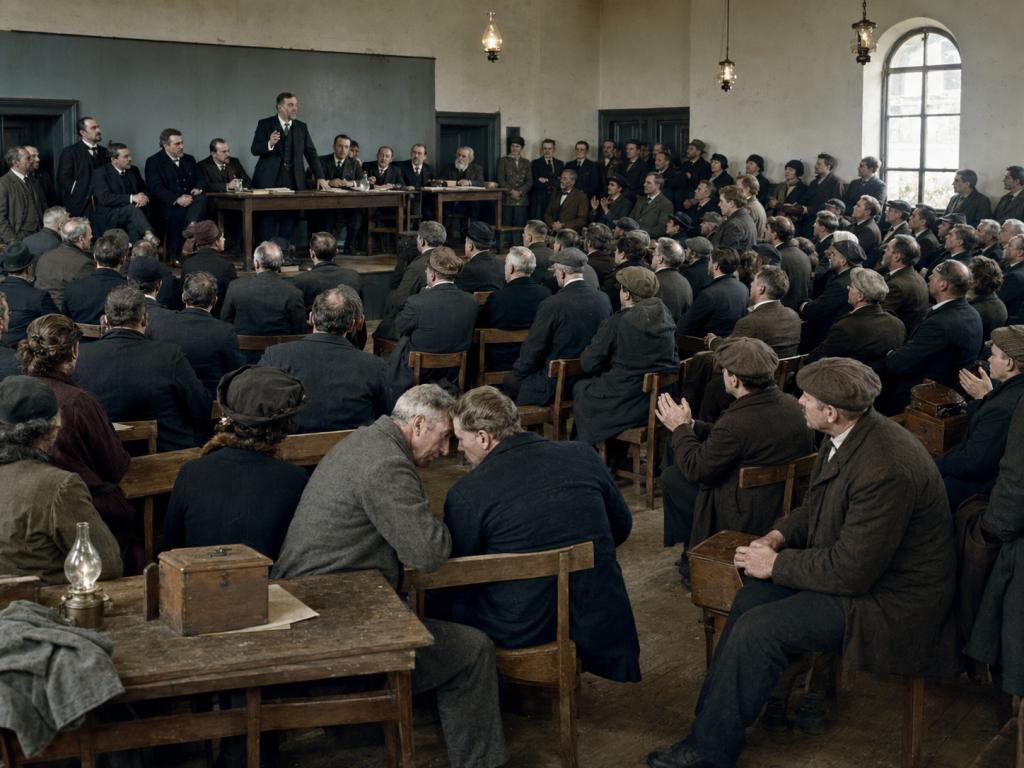
Local political organisations passed resolutions supporting a united Irish parliamentary representation as impatience grew with the divisions inherited from the fall of Charles Stewart Parnell. United Irish League branches, nationalist associations and constituency bodies increasingly argued that rival parliamentary groups should place national interests above personal quarrels. Their declarations carried no direct authority over individual MPs, but they reflected the opinion of activists who organised meetings, raised subscriptions and supplied much of the labour required during elections. Continued factionalism therefore threatened not only parliamentary effectiveness but the willingness of local supporters to sustain representatives who refused to cooperate.
The resolutions were directed towards political leaders divided among several organisations. John Redmond headed the principal Parnellite body, John Dillon remained the most influential anti-Parnellite leader, and Timothy Healy commanded an independent following. William O’Brien’s United Irish League sought to force these figures towards reunion by building pressure from constituencies rather than waiting for agreement at Westminster. Local bodies demanded a common leadership, coordinated voting and disciplined support for agreed candidates. Their language of unity also contained an electoral warning: MPs who remained attached to factional rivalry might find themselves opposed by candidates enjoying the backing of a vigorous popular organisation.
Supporters connected parliamentary reunion with practical political objectives. Home Rule, land reform, the restoration of evicted tenants and improvements in local administration required Irish MPs to act together if they were to influence governments at Westminster. Separate factions allowed ministers to disregard nationalist claims or negotiate selectively with competing leaders. Local resolutions consequently presented reunion as the machinery through which public demands could be translated into legislation. They did not necessarily imply admiration for every proposed leader. Instead, they expressed the belief that elected representatives should accept collective discipline and use their combined voting strength on behalf of Irish constituencies.
The campaign had clear relevance for Limerick, whose city and county representatives depended upon wider parliamentary cooperation to advance local and national interests. The surviving evidence does not justify attributing a particular resolution to every Limerick political organisation, but local voters participated in the same culture of meetings, deputations and formal declarations. Questions involving land purchase, labourers’ housing, railway policy, harbour trade and Home Rule could not be pursued effectively by isolated MPs. For Limerick nationalists, a reunited party offered the prospect that constituency concerns would form part of a coordinated Irish programme rather than become weakened by disputes among rival leaders.
The accumulating pressure contributed to the formal reunion of the Irish parliamentary factions in January 1900. John Redmond became chairman of the reconstructed Irish Parliamentary Party, while Dillon, Healy, O’Brien and their followers entered a common organisation without abandoning every disagreement. Local resolutions had not settled disputes over leadership, finance, candidate selection or control of the United Irish League, but they had made continued division politically costly. Reunion therefore emerged from more than negotiation among prominent parliamentarians. It also reflected organised pressure from branches, associations and constituency workers who insisted that Ireland should again possess one disciplined representation at Westminster.
- Philip Bull, “The United Irish League and the Reunion of the Irish Parliamentary Party, 1898–1900,” Irish Historical Studies, vol. 26, no. 101, May 1988, pp. 51–78.
- John Redmond to John Dillon and T. M. Healy, 24 July 1899, John Redmond Papers, National Library of Ireland, MS 15,182/2/1.
- John Dillon to John Redmond, 26 July 1899, John Redmond Papers, National Library of Ireland, MS 15,182/2/2.
- Freeman’s Journal, 18 April 1899.
- Freeman’s Journal, 6 May 1899.
- Freeman’s Journal, 20 May 1899.
- Freeman’s Journal, 22 May 1899.
- Mayo News, 27 January 1900.
- William O’Brien, An Olive Branch in Ireland and Its History, London: Macmillan, 1910.
- F. S. L. Lyons, The Irish Parliamentary Party, 1890–1910, London: Faber and Faber, 1951.