Press Demands(c.1890s)
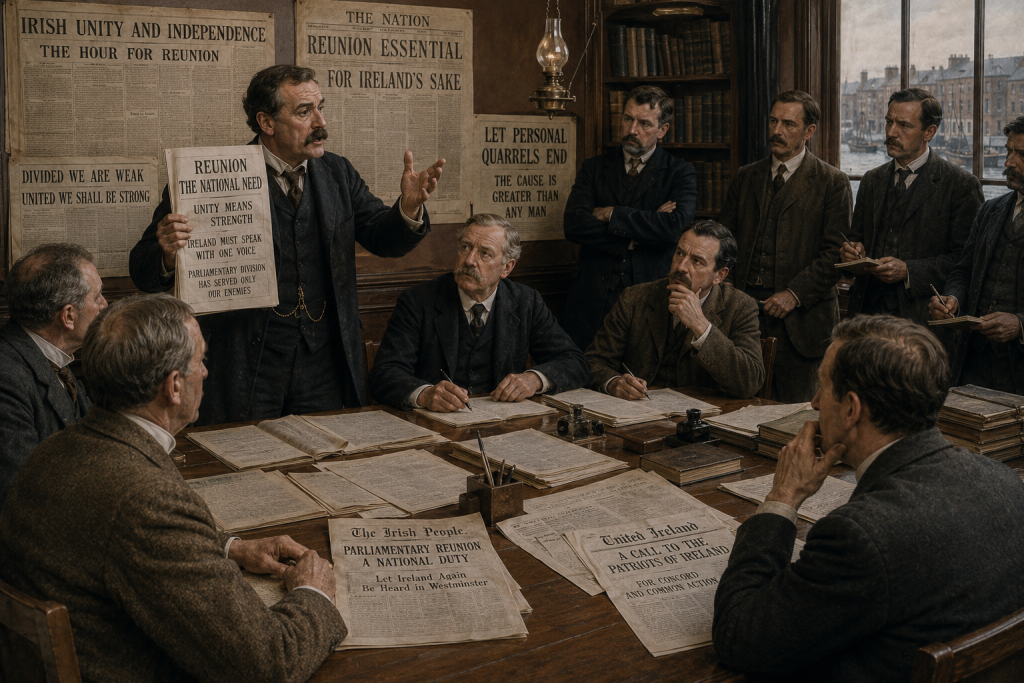
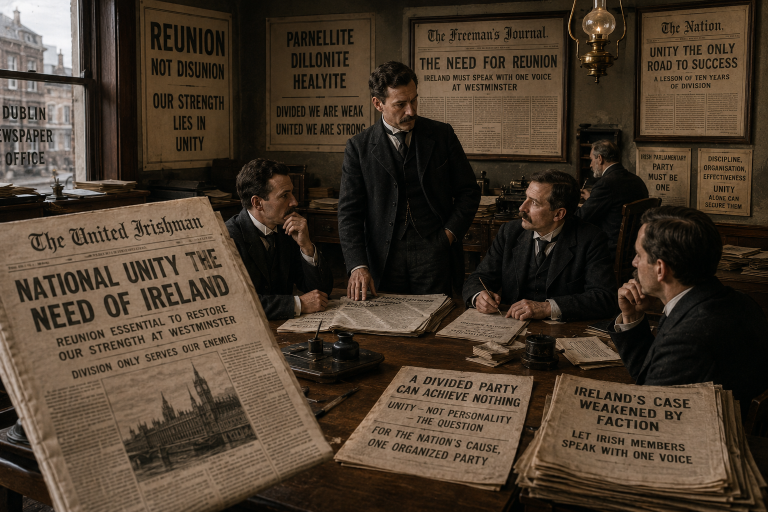
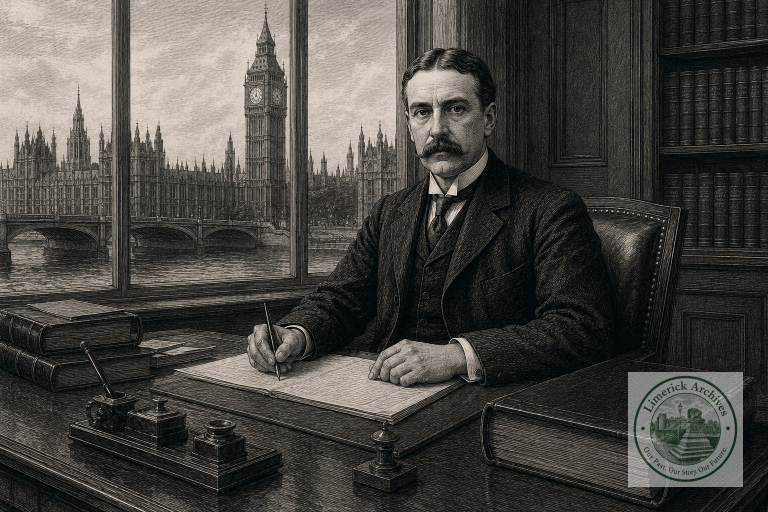
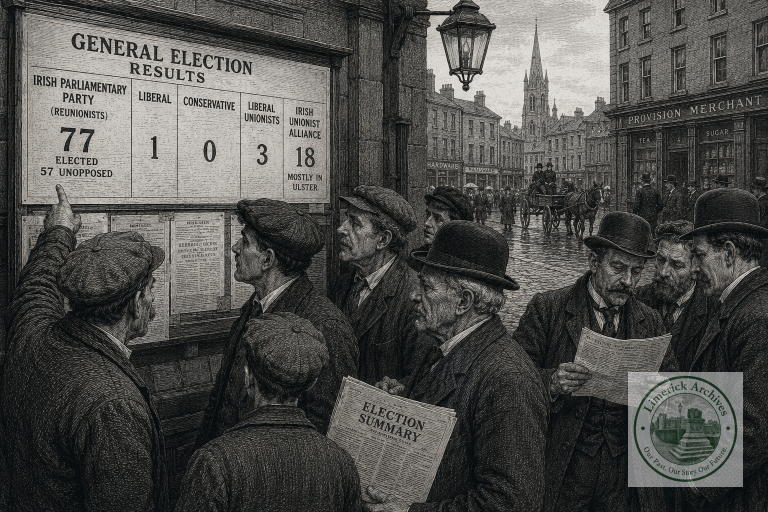
Nationalist newspapers increasingly presented reunion as essential if Ireland was to recover influence at Westminster after almost a decade of parliamentary division. Since the split over Charles Stewart Parnell’s leadership in 1890, rival Parnellite, anti-Parnellite and Healyite groups had competed for authority, funds and constituencies while claiming allegiance to the same national cause. Editorials and political reports warned that British governments could disregard Irish demands when nationalist MPs lacked common leadership and discipline. Reunion was consequently framed not simply as reconciliation between prominent personalities, but as the practical means by which Ireland might again act as a recognisable parliamentary force.
The Freeman’s Journal remained one of the most influential voices within constitutional nationalism, although its position reflected the complicated loyalties created by the split. Other titles associated with nationalist opinion, including the Mayo News and William O’Brien’s Irish People, gave extensive attention to the United Irish League and the pressure for political reconstruction. These newspapers did not always agree about John Redmond, John Dillon, Timothy Healy or O’Brien, but their coverage helped establish a shared argument: factional rivalry had weakened the representation of Ireland at the precise place where legislation, taxation and administrative policy were decided.
The force of that argument depended upon the arithmetic and customs of the House of Commons. Irish MPs could bargain with governments, obstruct business and influence close divisions only when they voted together under an accepted leadership. Separate factions permitted ministers and opposition leaders to negotiate selectively or ignore nationalist demands altogether. Newspapers connected reunion with Home Rule, land reform, evicted tenants and administrative change, reminding readers that public meetings and constituency organisation could achieve little if elected representatives neutralised one another at Westminster. Parliamentary unity was therefore portrayed as political machinery rather than an act of personal forgiveness.
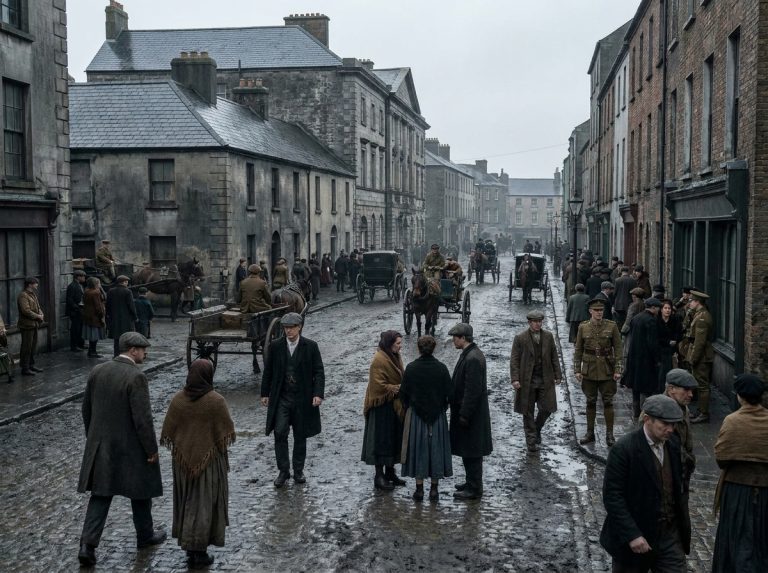
The debate mattered directly to readers in Limerick city and county, whose nationalist representatives required support from a disciplined Irish party to advance local and national concerns. Newspapers arriving through rail, postal and commercial networks carried reports of negotiations into homes, reading rooms, public houses and political organisations. The surviving evidence does not justify attributing one opinion to every Limerick reader, but the practical argument was readily understood. Land purchase, labourers’ housing, harbour interests, railway policy and Home Rule all depended upon coordinated representation capable of placing sustained pressure upon ministers rather than a collection of MPs divided by inherited personal loyalties.
Press advocacy contributed to the atmosphere surrounding the reunion meeting of 30 January 1900, when the parliamentary factions formally came together and later selected Redmond as chairman. Newspapers could celebrate the restoration of a common organisation, but they could not remove the mistrust accumulated since the Parnell crisis. Dillon, Healy, O’Brien and Redmond continued to disagree over leadership, electoral organisation and the authority of the United Irish League. Nevertheless, reunion gave nationalist journalism a single parliamentary body whose actions could be defended, criticised and measured against national expectations. Ireland again possessed a coordinated representation at Westminster, even though unity remained dependent upon compromise.
Primary Sources
- Freeman’s Journal, 6 May 1899.
- Freeman’s Journal, 20 May 1899.
- Freeman’s Journal, 3 August 1899.
- Freeman’s Journal, 8 August 1899.
- Mayo News, 27 January 1900.
- The Times, 31 January 1900.
- Philip Bull, “The United Irish League and the Reunion of the Irish Parliamentary Party, 1898–1900,” Irish Historical Studies, vol. 26, no. 101, May 1988, pp. 51–78.
- F. S. L. Lyons, The Irish Parliamentary Party, 1890–1910, London: Faber and Faber, 1951.
- National Library of Ireland, The Freeman’s Journal, historical account identifying the newspaper’s relationship with the Irish Parliamentary Party at Westminster.