
Chalice Replica(c.1900s)
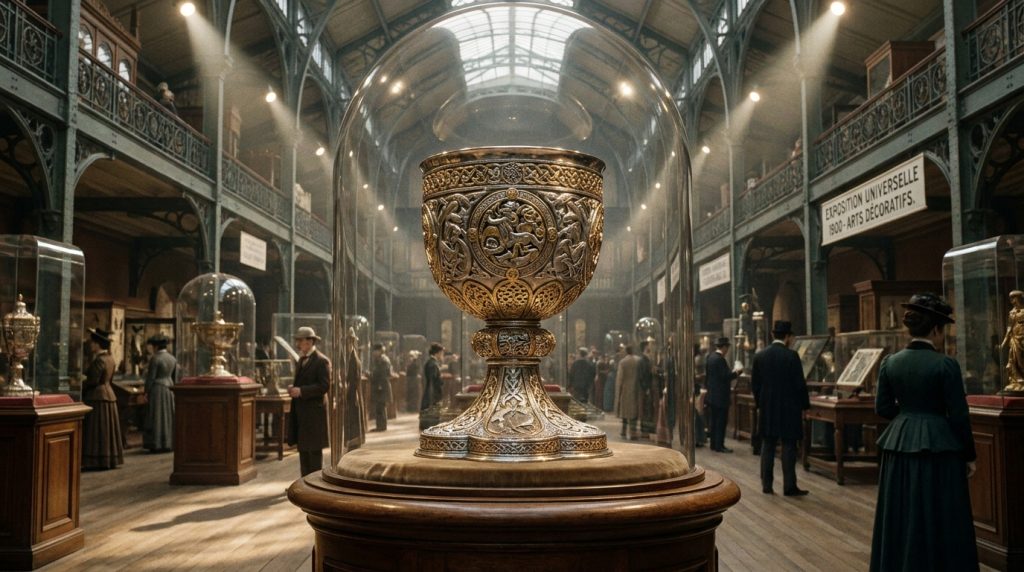
An elaborate reproduction of the Ardagh Chalice, rather than the original early medieval vessel, brought County Limerick’s artistic inheritance before the public in April 1900. The copy formed part of a collection assembled by the Goldsmiths’ and Silversmiths’ Company for the Exposition Universelle in Paris and was shown at the firm’s London premises before travelling to France. Contemporary coverage therefore does not support the claim that the object received a preliminary display in Limerick. Its relevance to the county remained unmistakable, however, because the celebrated original had been discovered at Reerasta, near Ardagh, in 1868.
The original chalice had been concealed beneath a stone within an earthen fort and recovered alongside a smaller bronze cup and four ornate brooches. Fashioned principally from silver and enriched with gold, gilt metal, glass, amber and intricate decorative work, it represented one of the finest survivals of early Irish ecclesiastical craftsmanship. Scholars have generally dated it to about the eighth century and associated its form with the celebration of the Eucharist. Its discovery transformed an ordinary County Limerick field into the source of an object recognised as internationally important to the study of early medieval Irish art.
By 1900 the original chalice had passed into the national collection in Dublin, while carefully made reproductions allowed its design to reach audiences elsewhere. The Goldsmiths’ and Silversmiths’ Company included such a copy among the silverwork and jewellery prepared for Paris. A contemporary account in The Art Journal described the “Ardagh Cup” as a reproduction of the ancient object and drew attention to its Irish origin. Visitors examining the London preview were therefore seeing modern craftsmanship based closely upon an archaeological treasure, not the fragile original removed temporarily from its museum display.
The Paris Exposition opened on 14 April 1900 and continued until 12 November, attracting millions of visitors to displays of industry, technology, design and fine craftsmanship. Within that immense spectacle, the Ardagh reproduction connected modern silver manufacture with the artistic achievements of early Ireland. Its interlaced ornament, carefully modelled handles and richly decorated surfaces belonged to a wider Celtic Revival that had made medieval Irish forms increasingly influential in jewellery and decorative art. The replica presented County Limerick’s archaeological inheritance not as a provincial curiosity, but as a source from which contemporary craftsmen could draw international inspiration.For Limerick people, the episode offered legitimate pride, though the surviving evidence requires the story to be stated accurately. The object exhibited before departure was a modern reproduction, and the preliminary viewing took place in London rather than locally. Nevertheless, the design carried the identity of Ardagh and County Limerick into one of the largest international exhibitions yet organised. Amid displays celebrating modern progress, the chalice demonstrated that Irish artistic accomplishment possessed a history extending far beyond the nineteenth century, while its reproduction helped make that achievement visible to audiences who might never encounter the original in Dublin.
Primary Sources
- The Art Journal, “The Paris Exhibition, 1900,” London: Virtue and Company, 1900, pp. 187–188.
- National Museum of Ireland, collection record AC 53, The Ardagh Chalice, found at Reerasta Rath, near Ardagh, County Limerick.
- Royal Irish Academy, “History of the Academy,” account of the Academy’s antiquities collection and its transfer to the National Museum of Ireland in 1890.
- Bureau International des Expositions, “Expo 1900 Paris,” official historical record of the Exposition Universelle, 14 April–12 November 1900.