Yeomanry Depart
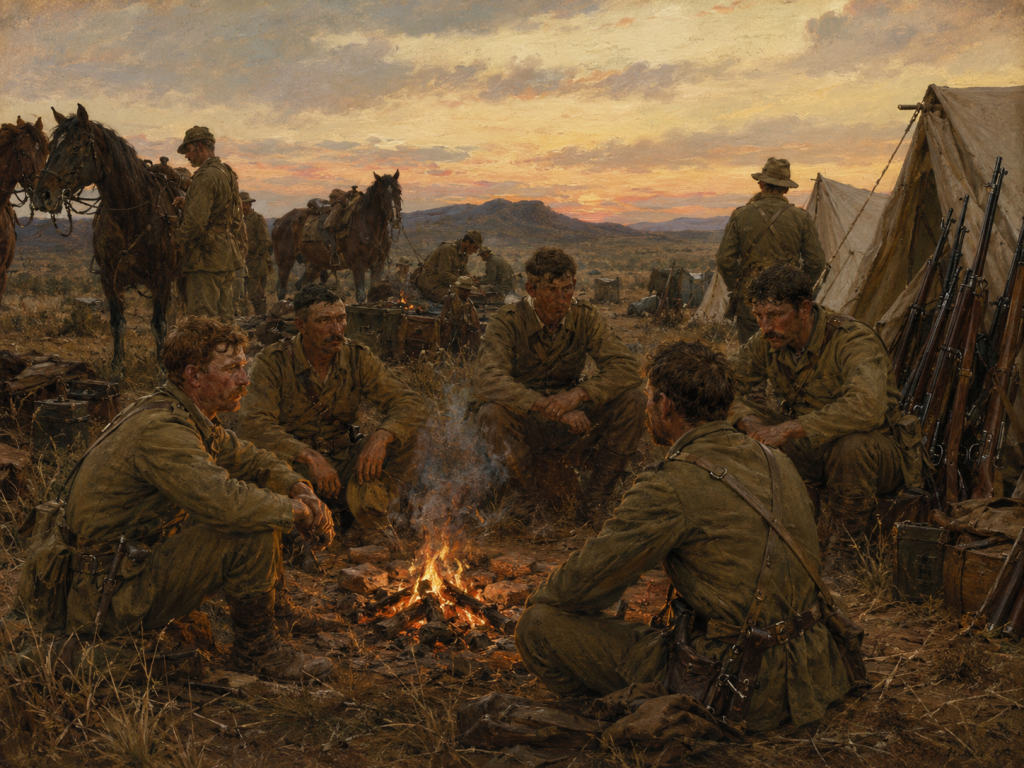
Reports from Cape Town in early March 1900 carried the movement of the Leicestershire Yeomanry into Limerick homes already preoccupied with the South African War. The 7th (Leicestershire) Company of the 4th Battalion, Imperial Yeomanry, had reached the Cape near the end of February and was ordered inland with its battalion on 4 March. Although this county contingent had not been recruited in Limerick, its departure held local meaning because the Royal Munster Fusiliers drew heavily from Limerick city and county, while their 1st Battalion was already serving in South Africa.
The Imperial Yeomanry had been created by Royal Warrant on 24 December 1899 after severe British reverses demonstrated the need for additional mounted troops. Existing yeomanry regiments were invited to provide volunteer service companies for overseas duty, a departure from their traditional home-defence role. The Leicestershire contingent became the 7th Company and joined the 4th Battalion under Colonel F. G. Blair of the Leicestershire Yeomanry. Its men were intended to operate as mounted infantry, travelling on horseback but ordinarily dismounting to fight with rifles rather than charging as conventional cavalry.
After arriving at Cape Town on 26 February, the Leicestershire men passed through the military organisation surrounding the port and nearby Maitland Camp. Horses, saddlery, ammunition, personal equipment and transport arrangements had to be assembled before the contingent could move towards the interior. On 4 March the battalion was directed towards Naauwpoort, an important railway and military position in the northern Cape Colony. The departure therefore marked the end of the volunteers’ ocean journey and the beginning of active campaigning, where distances, difficult ground, sickness and uncertain intelligence could prove as dangerous as direct encounters with Boer commandos.
In Limerick, the news carried a political tension extending far beyond the fortunes of one English county unit. Irishmen served throughout the British forces, and military families depended upon irregular newspaper reports and official messages for information. At the same time, many Irish nationalists sympathised with the Boer republics and viewed the conflict as an imperial struggle against smaller communities defending their independence. No distinct Limerick participation in the Leicestershire company has been established, but its movement illustrated the machinery of a war that directly involved regiments, recruits and households connected with the city and county.
The volunteers leaving Cape Town could not know the character or duration of the service ahead. The 4th Battalion would later join Lieutenant-General Sir Leslie Rundle’s operations in the Orange Free State, undertaking reconnaissance, escort and mounted-infantry duties across a demanding landscape. In March 1900, however, the immediate story was one of departure: men and horses moving away from the comparative security of the Cape towards an expanding campaign. For Limerick readers, such reports joined distant military movements to familiar anxieties about absence, loyalty, survival and the uncertain fate of Irishmen already serving under the same imperial command.
- War Office, Royal Warrant establishing the Imperial Yeomanry for active service in South Africa, 24 December 1899.
- The National Archives, Kew, WO 128, War Office: Imperial Yeomanry, Soldiers’ Documents, South African War, 1899–1902; records relating to the 7th (Leicestershire) Company, 4th Battalion.
- L. S. Amery, ed., The Times History of the War in South Africa, 1899–1902, vol. III, London: Sampson Low, Marston and Company, 1905.
- Louis Creswicke, South Africa and the Transvaal War, vol. III, Edinburgh and New York: T. C. and E. C. Jack, 1900.
- Donal P. McCracken, Forgotten Protest: Ireland and the Anglo-Boer War, Belfast: Ulster Historical Foundation, 2003.
- Stephen Griffin, The Royal Munster Fusiliers 1881–1922, online exhibition commissioned by Limerick Museum, Limerick City and County Council, 2023.