Rockbarton Burning
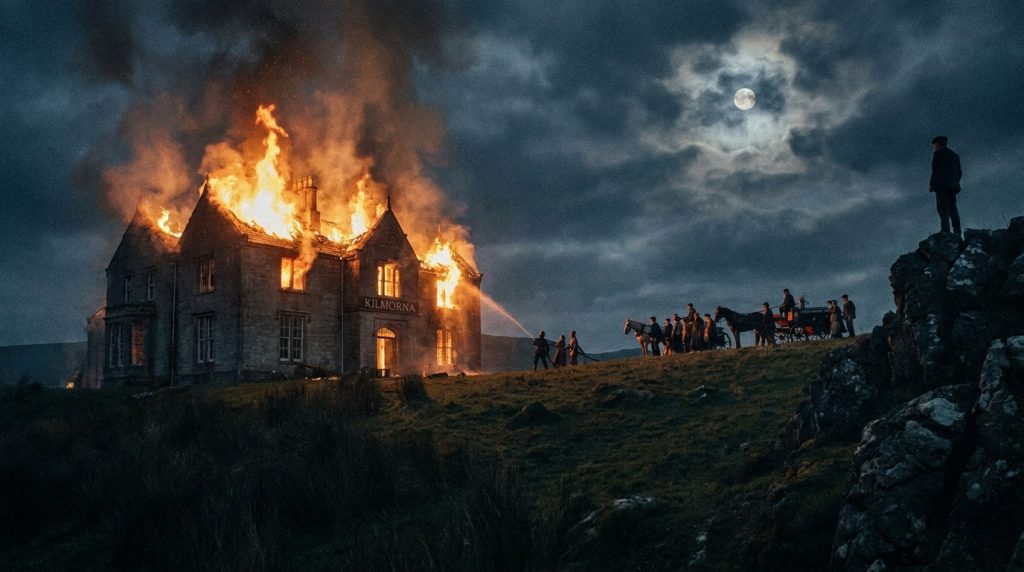
Limerick society was disturbed in 1900 by reports of a suspicious fire at Rockbarton, the imposing country residence near Bruff associated with wealth, landownership and titled families. Contemporary reporting described the outbreak as an alleged act of arson, but the surviving evidence presently available does not establish who started it, what motive was involved or whether anyone was prosecuted. The distinction matters. The fire was a serious incident at one of County Limerick’s best-known estate houses, yet suspicion cannot be treated as proof, and the language of accusation must remain separate from any confirmed judicial finding.
Rockbarton, also known historically as Mount Prospect, had long been connected with the O’Grady family and the Viscounts Guillamore. By the closing decades of the nineteenth century it had passed into the orbit of the Roche family through the marriage of Cecilia O’Grady to the second Baron Fermoy. The residence represented more than domestic comfort. Its demesne, tenants, servants, agricultural interests and social connections placed it within the structure of landed authority that continued to shape rural Limerick. An attack upon such a property was therefore likely to be interpreted through the wider political and social divisions surrounding Irish landownership.
The available account identifies the outbreak as suspected arson, but it does not justify claims about an organised conspiracy, an agrarian faction or a named offender. Nor did the fire destroy Rockbarton completely. Later valuation evidence records the house as occupied by Lord Fermoy in 1906, and the mansion survived into the twentieth century before its eventual demolition in 1941. The 1900 incident should consequently be understood as a damaging and alarming outbreak rather than the final destruction of the residence. Any fuller description of the rooms affected, the financial loss or the means of ignition requires direct confirmation from the original report.
Suspicion nevertheless carried powerful meaning in rural County Limerick. The land question remained central to political life, while tenant purchase, disputed holdings, grazing lands and resentment of inherited privilege continued to divide communities. Newspapers and property owners frequently interpreted attacks upon houses, hay, livestock or farm buildings as agrarian intimidation, although individual incidents could arise from many causes. No surviving evidence presently located proves that the Rockbarton fire formed part of an organised land campaign. Its significance lies partly in the speed with which a blaze at a great house could become associated with the unsettled relationship between estates and the surrounding countryside.
Rockbarton’s fire exposed the insecurity beneath the outward confidence of landed society at the beginning of the twentieth century. A country mansion could embody family prestige and political influence while also standing as a visible reminder of unequal ownership and social distance. For labourers, tenants, estate employees and neighbouring farmers, the house belonged to a system affecting rents, work, access to land and local authority. For its owners, the alleged attack threatened property, personal safety and social order. The event deserves remembrance not as a proven political outrage, but as an unresolved fire whose surrounding suspicion revealed the tensions within rural Limerick.
- Limerick Leader, 1900, contemporary report concerning the suspicious fire and alleged arson at Rockbarton, near Bruff; exact publication date and page remain to be confirmed from the original issue.
- Thom’s Irish Almanac and Official Directory for the Year 1900, Dublin: Alexander Thom and Company, 1900, entries relating to the Baron Fermoy and Rockbarton.
- Return of Owners of Land of One Acre and Upwards in Ireland, Dublin: HMSO, 1876, County Limerick returns relating to the O’Grady and Guillamore estates.
- Valuation Office, Dublin, valuation and revision records relating to Rockbarton House and demesne, County Limerick.
- University of Galway, Landed Estates Database, “Rockbarton,” historical property record drawing upon Griffith’s Valuation, the 1906 valuation and the Irish Tourist Association survey.