Bardan, resident druid of Limerick Archives

Summon Bardan

Summon Bardan, our resident druid, and ask him any question about Limerick.
His ancient wisdom will answer you instantly.

Siege_of_Limerick_1690_army_202607131036

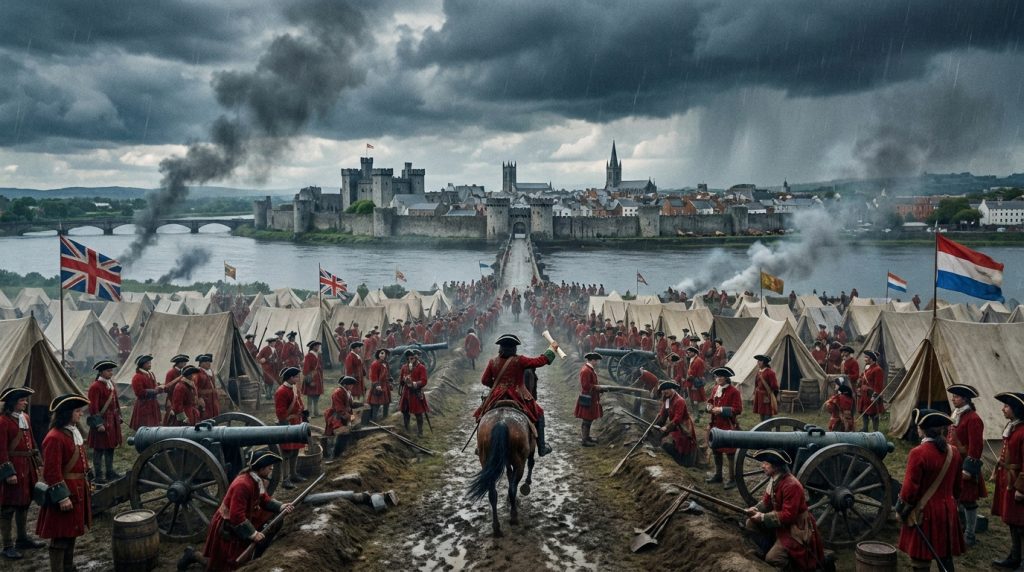
Limerick formally entered a state of siege on 9 August 1690 when William III’s army moved from its camp near Cahirconlish and established itself before the city. William sent a summons demanding surrender to Alexandre de Rainier de Droué, Marquis de Boisseleau, the French officer entrusted with commanding the Jacobite infantry within Limerick. The decision placed the city’s inhabitants, soldiers and defences at the centre of the war following the Boyne. William expected the remaining Jacobite resistance to collapse, but Limerick’s position behind the Shannon and the presence of a substantial garrison offered the defenders a final opportunity to continue the campaign.

Boisseleau returned his answer through Sir Robert Southwell, William’s secretary of state, rather than addressing William directly as king. George Story’s contemporary Williamite account records that Boisseleau expressed surprise at the summons and maintained that a determined defence offered a better means of earning the Prince of Orange’s respect than surrendering the place entrusted to him. The language was diplomatically careful but politically unmistakable. Boisseleau would not acknowledge William’s royal title, because he remained an officer of James II, yet he answered without insult and made clear that Limerick would resist rather than capitulate without an attempt at defence.

The refusal did not follow a final council attended by every figure named in later literary versions of the episode. Tyrconnell had already departed from Limerick after an earlier council at which he and most of the French officers had favoured accepting whatever terms William might offer. Boisseleau alone among the senior French officers opposed that recommendation and was left to command the city’s infantry. Patrick Sarsfield remained central to the Jacobite effort, but his principal responsibility lay with the cavalry stationed beyond the Shannon in County Clare. The summons therefore confirmed a division already established within the Jacobite leadership.

William’s encampment reflected the multinational character of the army assembled against Limerick. Dutch and English guards served alongside English, Scottish, Danish, German, Brandenburg and French Huguenot formations, supported by cavalry, artillery, engineers and supply units. These troops occupied positions across the ground east and south-east of the city while preparations began for trenches and batteries. Contemporary evidence supports the presence of these national contingents, although the precise right-to-left arrangement described in later popular accounts is less secure. The familiar claim that Danish soldiers were deliberately stationed inside an ancient Irish earthwork called a “Danish fort” appears to belong to later literary embellishment.

Boisseleau’s answer transformed William’s summons into an active siege. The defenders had already strengthened the vulnerable Irishtown sector by digging a shallow ditch and using the excavated earth to form a rampart protected by palisades. Williamite engineers opened their trenches during the night of 9 August, beginning the methodical approach towards the city walls. For Limerick people, the refusal meant exposure to bombardment, shortages, military labour and the threat of assault, but it also preserved the Jacobite position in western Ireland. The struggle that followed would establish Boisseleau as the practical commander of one of the most important urban defences of the Williamite War.

  1. George Warter Story, An Impartial History of the Wars of Ireland, with a Continuation Thereof, London: Richard Chiswell, 1693.
  2. John Stevens, The Journal of John Stevens, Containing a Brief Account of the War in Ireland, 1689–1691, edited by Robert H. Murray, Oxford: Clarendon Press, 1912.
  3. John White, Descriptio Obsidionis Urbis Limericensis, 1690; translated and discussed by M. Lloyd and E. O’Flaherty, “A Descriptive Poem of Limerick in 1690,” Old Limerick Journal, no. 28, Winter 1990.
  4. John Childs, The Williamite Wars in Ireland, 1688–1691, London: Hambledon Continuum, 2007.
  5. Pádraig Lenihan, “The Marquis de Boisseleau and the ‘Battle of the Breach’ at the First Siege of Limerick, 1690,” History Ireland, vol. 28, no. 5, September–October 2020.

Associated Archives

War and Revolution in LimerickWar and Revolution
Politics and Government in LimerickPolitics and Government
Historic News from LimerickHistoric News

Related Articles

16909ThArmyAugustBoisseleauCahirconlish

Share Your Thoughts

We welcome your thoughts, memories and local knowledge about this article. Perhaps you recognise a person, place, building or event, remember a related story, or can provide additional names, dates or details. Every contribution helps improve the historical record and may reveal information that would otherwise be lost. Please share your comments, corrections and personal recollections with us, whether they are brief observations or detailed accounts. Your knowledge can help connect families, communities and generations while strengthening Limerick Archives for future visitors. By taking part, you become an important contributor to preserving and sharing Limerick’s history with everyone worldwide today.

Your email address will not be published. Required fields are marked *

Books Supporting the Archive

Profits from every book help fund the continuing preservation, restoration and free public sharing of Limerick’s history.

Cover of Ashes

Ashes

The Ashes Trilogy, Book One

Ashes begins the story of a group of children growing up in the streets and lanes of Limerick, where poverty and hardship are balanced by humour, imagination and fierce friendship. Their city is more than a setting: it watches, remembers and gives voice to lives often absent from official history. As the children explore their neighbourhood, they encounter family pressures, faith, hunger, danger and the first signs of a changing world. Through their adventures and loyalties, the novel captures the resilience of ordinary people and introduces the characters whose lives will unfold across the three volumes of The Ashes Trilogy.

All Books Available As Instant E-Books, Paperbacks & Hardbacks Worldwide.

Cover of Gurriers

Gurriers

The Ashes Trilogy, Book Two

Gurriers continues the lives of the Limerick children introduced in Ashes as childhood freedom begins to give way to work, responsibility and harsher choices. Their friendships remain strong, but poverty, family expectations, faith and the pressures of growing older test loyalties once taken for granted. The streets and lanes still offer humour, adventure and belonging, yet the wider world increasingly intrudes upon their lives. Through vivid dialogue, memorable characters and the watchful voice of Limerick itself, the novel explores resilience, identity and change while showing how even the closest companions can be drawn towards futures by circumstances beyond their control.

All Books Available As Instant E-Books, Paperbacks & Hardbacks Worldwide.

Cover of Scattered

Scattered

The Ashes Trilogy, Book Three

Scattered concludes The Ashes Trilogy as the friends who once shared Limerick’s streets and lanes face adulthood, work, hunger, faith, family duty and emigration. Time has altered their ambitions, tested their loyalties and carried some beyond the city that formed them. Yet memory continues to bind Louie, Seamus, Joe, Sean, Peter, Tony, Bardy, Maura, Eileen, Nora, Lingo and the mysterious Gleamer. Narrated through the enduring presence of Limerick itself, the novel explores separation, sacrifice and survival while recognising the humour and affection that remain. Together, their scattered lives complete a moving portrait of friendship, community and change across changing generations.

All Books Available As Instant E-Books, Paperbacks & Hardbacks Worldwide.

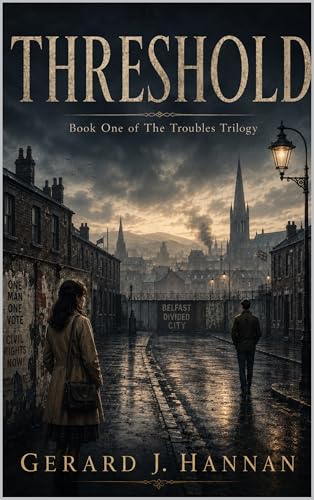
Cover of Threshold

Threshold

The Troubles Trilogy, Book One

Threshold opens in Belfast in 1968, where the Catholic Devlins and Protestant Morrows confront a city divided by religion, memory and fear. Civil rights marches, police violence, riots and internment transform ordinary streets into dangerous frontiers while political conflict enters homes, workplaces and schools. At the centre are Aileen Devlin and Thomas Morrow, whose relationship challenges the boundaries their families regard as essential to survival. As loyalty hardens into suspicion, both must decide whether inherited allegiance excuses injustice. Through family arguments, upheaval and private courage, the novel explores love, conscience, division and survival during the opening years of the Troubles.

All Books Available As Instant E-Books, Paperbacks & Hardbacks Worldwide.

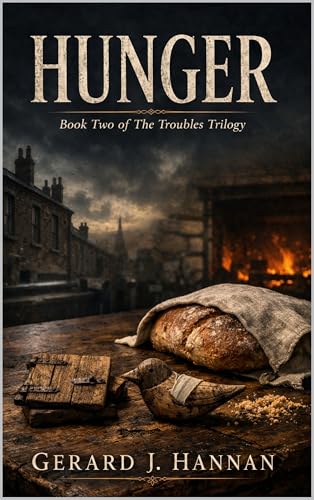
Cover of Hunger

Hunger

The Troubles Trilogy, Book Two

Hunger is Book Two of The Troubles Trilogy, set in Belfast during the 1980s. Aileen Devlin and Thomas Morrow have built a fragile life across the city’s sectarian divide, but the conflict threatens the home they created for their daughter, Claire. As hunger strikes, the Anglo Irish Agreement and violence reshape Northern Ireland, republican Declan and loyalist Billy exploit fear, grief and vulnerable young men. Against them stand Aileen, Kathleen and Elsie, whose quiet strength keeps their families human. This is a story of love, survival and the courage to place people before causes in a divided society under pressure.

All Books Available As Instant E-Books, Paperbacks & Hardbacks Worldwide.

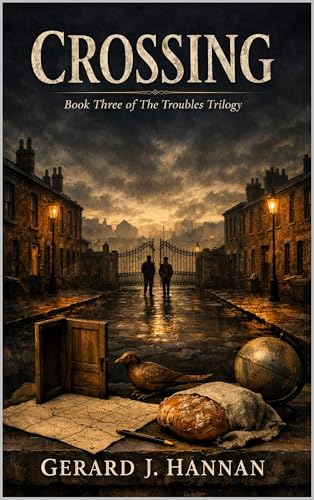
Cover of Crossing

Crossing

The Troubles Trilogy, Book Three

Crossing concludes The Troubles Trilogy during the decade from 1990 to 2000, as Belfast moves from violence towards negotiation, ceasefires and uncertain peace. The Devlin and Morrow families face political change alongside grief, ageing, divided loyalties and the consequences of choices made across three decades. Relationships once threatened by religious boundaries are tested by memory, mistrust and the fear that compromise may betray the dead. As the peace process gathers momentum, ordinary people must decide whether reconciliation is possible. The trilogy closes with a story of endurance, forgiveness, loss and hope beyond inherited division, proving that peace begins with courage.

All Books Available As Instant E-Books, Paperbacks & Hardbacks Worldwide.

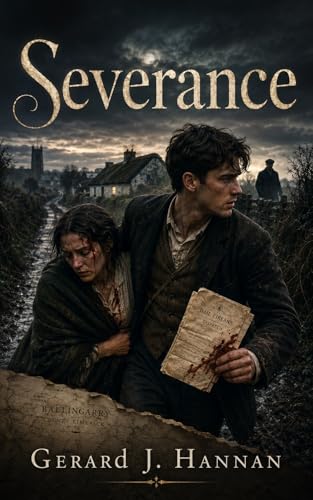
Cover of Severance

Severance

Historical Novel

Severance is a historical novel set in Ballingarry, County Limerick, during Ireland’s struggle for independence. A torn and bloodied dispatch passes through fields, kitchens, lofts and hidden routes, placing everyone who handles it in danger. Michael Enright carries the burden of trust, while Mary, Molly and their neighbours struggle to preserve the message and protect one another. Against them, Captain Edward Harcourt studies every delay, wound and fragment for clues. As loyalty, fear and betrayal tighten around the hidden network, ordinary people must decide what they are willing to risk when history enters their homes and silence itself becomes dangerous.

All Books Available As Instant E-Books, Paperbacks & Hardbacks Worldwide.

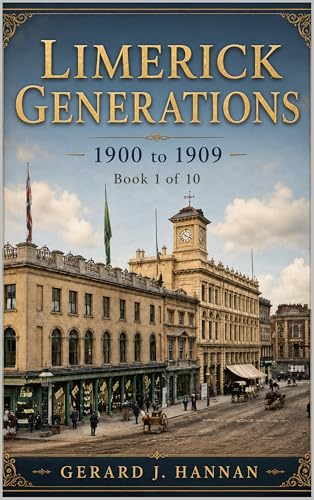
Cover of Limerick Generations: 1900 to 1909

Limerick Generations

1900 to 1909

Limerick Decalogy, Book One

Limerick Generations: 1900 to 1909 opens the decade by documenting a city and county entering the twentieth century amid political debate, commercial activity, poverty, faith and technological change. Month by month, the book connects major Irish developments with local events, institutions, streets and communities. Public meetings, labour, transport, education, sport, business and everyday life reveal how national questions were experienced in Limerick. Historical reports and carefully reconstructed narratives bring forgotten moments and ordinary people into focus. As Book One of Limerick Decalogy, it establishes the foundation for a ten volume journey through one hundred years of local history and memory.

All Books Available As Instant E-Books, Paperbacks & Hardbacks Worldwide.

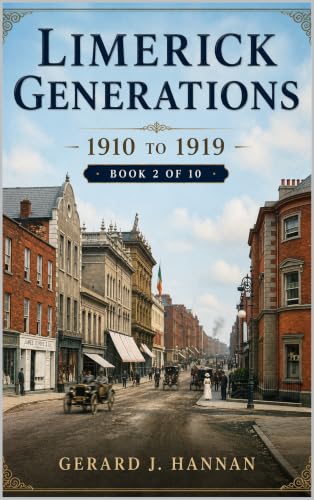
Cover of Limerick Generations: 1910 to 1919

Limerick Generations

1910 to 1919

Limerick Decalogy, Book Two

Limerick Generations: 1910 to 1919 traces a decade of political transformation, labour conflict, war, revolution and social change across Limerick city and county. Home Rule, unionist resistance, trade union organisation and the First World War entered streets, farms, schools, workplaces and family life. The Easter Rising, conscription crisis, influenza pandemic and general election altered public loyalties and expectations. The decade culminated in the Limerick Soviet of 1919, when workers challenged military restrictions through organised collective action. As Book Two of Limerick Decalogy, the volume preserves local experiences of hardship, courage, grief, endurance and change during years of intense historic upheaval.

All Books Available As Instant E-Books, Paperbacks & Hardbacks Worldwide.