
Shamrock Resolve(c.1900s)
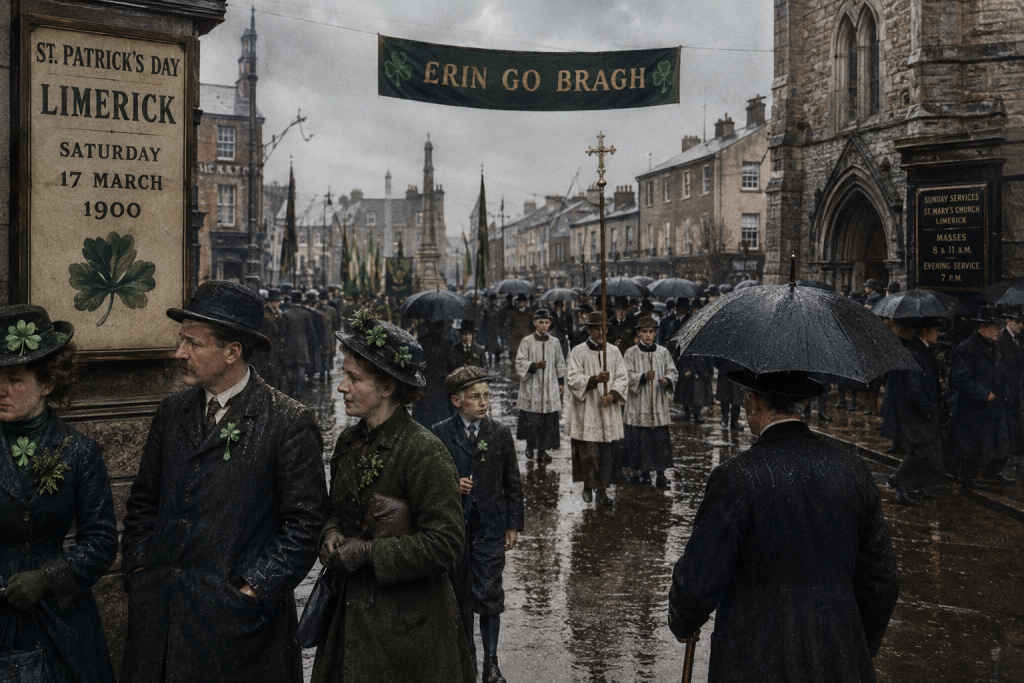
Limerick observed St Patrick’s Day on Saturday, 17 March 1900, beneath dark skies, persistent rain and an unwelcome chill. The difficult weather reduced the comfort of those moving through the city but did not erase the feast from public life. Residents attended religious services, wore shamrock and gathered wherever music, companionship and shelter could be found. The occasion belonged less to the organised civic spectacle familiar in later generations than to churches, families, neighbourhoods and voluntary associations. Its importance lay in the determination to honour Ireland’s patron saint despite conditions that might otherwise have emptied the streets.
Religious observance remained central to the day. Congregations entered Limerick’s churches in wet coats and heavy footwear, carrying the feast into buildings where prayers, sermons and sacred music gave order to an otherwise bleak Saturday. Shamrock appeared on lapels and hats as a familiar emblem of national and devotional attachment. Music also formed part of the wider celebration, whether provided by organised players or heard in more informal gatherings. The surviving account emphasises the contrast between the hostile weather and the persistence of celebration, presenting the people’s attendance not as an act of defiance, but as an ordinary expression of inherited custom.
St Patrick’s Day had not yet become a statutory public holiday in Ireland, and the city did not enjoy the uniform closures later associated with the feast. Work, trade and religious observance therefore existed beside one another, while participation depended upon occupation, opportunity and personal conviction. This made the public presence of shamrock, music and churchgoing especially significant. The celebration emerged from community practice rather than official direction. Limerick’s streets revealed a society in which devotion to the saint could unite people temporarily, even as differences of class, religion and political allegiance remained deeply embedded in the life of the city.
The observance also took place during the South African War, when Irish military service and Irish political opinion were pulling in different directions. Queen Victoria had recently permitted Irish soldiers to wear shamrock on St Patrick’s Day, giving the emblem a new official visibility within the British Army. That gesture carried particular resonance in Limerick, a city and county with long connections to military recruitment, while nationalists continued to debate Britain’s imperial war against the Boer republics. The same sprig could consequently signify Catholic tradition, Irish nationality, regimental pride or political unease, depending upon the wearer and the setting.
The cold and rain of 1900 did not produce the large modern parade now associated with the feast, but the day belonged to the gradual transformation of St Patrick’s Day into a more public expression of Irish identity. Three years later, legislation promoted by Limerick-born MP James O’Mara established the day as a bank holiday in Ireland. The celebrations of 1900 therefore stood at a point between older religious custom and the emerging civic holiday. Limerick’s persistence beneath the rain showed how firmly the feast was already rooted before Parliament gave it formal recognition, public closure and a larger national stage.
- Limerick Chronicle, 17 March 1900, contemporary coverage of St Patrick’s Day observance and weather in Limerick; exact page and column remain to be confirmed from the original issue.
- Limerick Leader, March 1900, contemporary local coverage surrounding St Patrick’s Day; exact issue, page and column remain to be confirmed from the original newspaper.
- British Newspaper Archive, digitised holdings of the Limerick Chronicle, 1768–1918, and the Limerick Leader, including issues from 1900.
- Royal Irish Regiment Museum, “Saint Patrick’s Day and the Sprig of Shamrock,” historical account of Queen Victoria’s 1900 direction permitting Irish soldiers to wear shamrock.
- Bank Holiday (Ireland) Act 1903, 3 Edward VII, c. 1, establishing St Patrick’s Day as a bank holiday in Ireland following the parliamentary initiative associated with James O’Mara.