Winter of Rival Kings1115 CE
Dateline
In 1115 Ireland was shaken by an exceptional winter, a renewed struggle for Munster and a series of campaigns that exposed the growing power of Tairdelbach Ua Conchobair of Connacht. The year did not produce a single contest for a recognised national crown. Instead, kings sought supremacy through provincial lordship, hostages, alliances, cattle-raids and control of important towns and churches. Muirchertach Ua Briain briefly recovered from the illness that had undermined his authority, but the political order he had constructed was visibly beginning to fragment.
A Winter of Hunger
The most widely recorded event was not a battle but the weather. The Annals of Ulster describe severe frost and snow from 28 December until about 15 February, or slightly longer. Because the cold began in the closing days of 1114, it cannot be confined wholly to 1115, but its worst consequences dominated the opening weeks of the year. The Chronicon Scotorum adds that great herds could cross major lakes as though over dry ground.
Birds, livestock and people died. The resulting scarcity affected the whole island but was remembered as particularly severe in Leinster. For most households, this was a direct assault on survival. Cattle supplied milk, meat, hides and the movable wealth upon which social obligations depended. Grain, stored fodder and access to pasture were equally vulnerable. Frozen ground, blocked routes and livestock mortality would have weakened communities before the campaigning season began. The annalists’ emphasis on birds and beasts as well as humans conveys an environmental disaster rather than an isolated period of uncomfortable weather.
The Return of Muirchertach
Muirchertach Ua Briain had been one of the leading Irish kings for decades. From Munster he had projected power into Leinster, Dublin and the Irish Sea, while competing with Domnall Ua Lochlainn, king of the Northern Uí Néill, for wider supremacy. His grave illness in 1114 encouraged rivals and kinsmen to abandon him. His brother Diarmait Ua Briain seized the kingship of Munster, while northern and Connacht forces moved against the weakened Uí Briain position.
In 1115 Muirchertach recovered sufficiently to act. Diarmait was captured, apparently through the participation of the Hiberno-Norse inhabitants of Limerick, and Muirchertach resumed the kingship. The involvement of Limerick mattered. The town was not merely a passive possession: its inhabitants, ships, defences and commercial resources could influence dynastic struggles. Their support helped restore a king whose authority had seemed finished only months earlier.
Muirchertach then led an army into Leinster and Brega. This expedition announced his return, but it also revealed the coercive character of renewed Uí Briain rule. At Ardbraccan in Brega, Munster forces burned the great stone church while people were inside it and damaged other churches in the district. Such violence was politically dangerous as well as destructive. Churches were sanctuaries, landholders and centres of local identity, while rulers depended upon clerical support to legitimise agreements and kingship.
Battle at Dublin
Leinster’s rulers had taken advantage of Muirchertach’s weakness and challenged Uí Briain control of Dublin. They were met by Domnall, Muirchertach’s son, with the Hiberno-Norse forces of the town. This Domnall should not be confused with Domnall son of Tadc Ua Briain, another dynastic claimant who was killed later in the year.
The resulting battle, placed at Dublin by the Annals of Tigernach and the Chronicon Scotorum, ended in a decisive defeat for the Leinstermen. Donnchad mac Murchada, ruler of Uí Cheinnselaig and described in some accounts as king of Leinster, was killed. Conchobar Ua Conchobair Fhailge, the elderly king of Uí Failge, also fell with his sons and many followers. Their deaths removed prominent leaders from southern and central Leinster and demonstrated that Dublin’s townsmen remained an effective military force.
The victory preserved Uí Briain influence in Dublin for the moment. It also underlined the town’s strategic value. Dublin was a fortified port, a source of ships and revenue, and a gateway to commerce across the Irish Sea. Its Hiberno-Norse population possessed a distinct urban tradition while participating fully in Irish dynastic politics. By supporting Domnall, the townsmen were defending both an alliance and their own place within a shifting regional order.
Connacht Advances
The strongest challenge to the Uí Briain recovery came from Tairdelbach Ua Conchobair. Once promoted in Connacht with Muirchertach’s assistance, Tairdelbach was now acting independently and exploiting Munster’s divisions. The annals record a major Connacht raid through Thomond as far as Limerick, carrying away innumerable cattle and many captives. This was more than opportunistic theft. Cattle-raiding deprived opponents of food, wealth and prestige while rewarding followers and demonstrating that a king could penetrate territory claimed by a rival.
The Annals of Tigernach give a more complicated account of Tairdelbach’s intervention in Thomond. They state that he took hostages and granted its kingship to a son of Tadc Ua Briain. That man subsequently turned against him and was killed. Other annals identify the casualty simply as Domnall son of Tadc, designated heir of Munster, killed by the Connachta. The exact sequence cannot be reconstructed with certainty, but Domnall’s death removed another possible Uí Briain successor and strengthened Tairdelbach’s influence over Munster’s internal rivalries.
Tairdelbach himself narrowly survived an attack at Áth Bó. Members of his own wider dynastic circle, identified as descendants of Aed son of Ruaidrí, wounded him so severely that reports presented him as close to death. He recovered, but the episode shows that his authority within Connacht was not uncontested. His wife Órlaith, a daughter of Murchad Ua Máelshechlainn, also died during the year, ending a marriage that had linked the Connacht and Mide ruling families.
Ships, Alliances and Gifts
Tairdelbach also brought a fleet onto the Shannon. The expedition struck the territory of Domnall Ua Fergail and projected Connacht power into the central waterways. River fleets moved warriors and supplies more effectively than many overland routes and enabled kings to attack settlements, pasture and political centres along the river system.
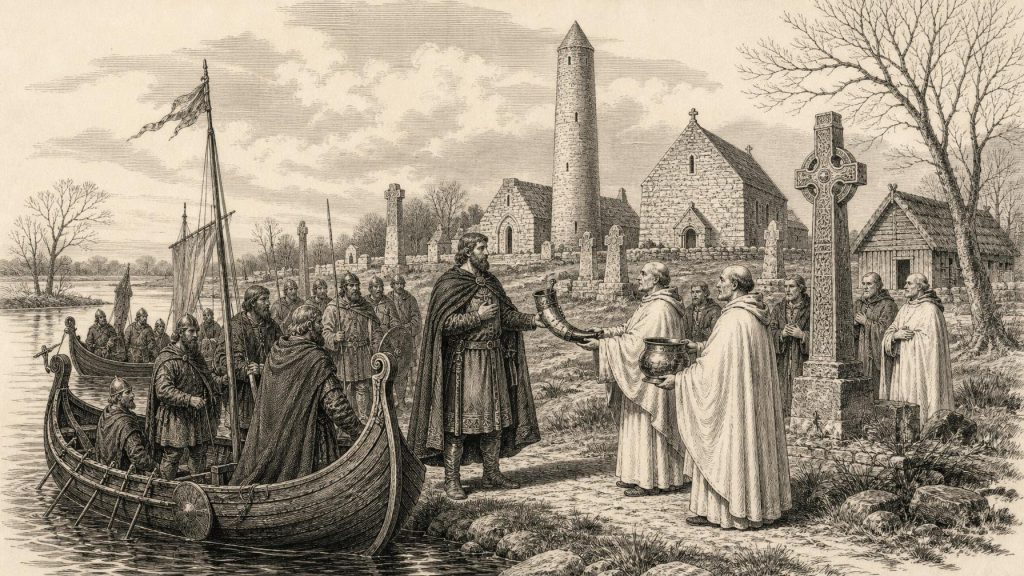
At Clonmacnoise, Tairdelbach met Murchad Ua Máelshechlainn of Mide. One account describes the meeting as a peace settlement and alliance. Tairdelbach presented treasures to St Ciarán: a drinking-horn ornamented with gold, a gilded silver vessel and a bronze object embellished with precious metal. These gifts joined devotion to political display. By honouring Ciarán at one of Ireland’s greatest ecclesiastical centres, Tairdelbach advertised wealth, piety and a claim to act beyond Connacht.
Mide was itself unstable. It was divided between Murchad and his brother Máel Sechlainn, sons of Domnall Ua Máelshechlainn. Máel Sechlainn was soon killed by Murchad, leaving the latter in the stronger position. The episode illustrates the fragility of arrangements based upon divided kingship: brothers could be partners, competitors and mortal enemies within the same season.
Sacred Places in a Violent Landscape
Clonmacnoise embodied the close relationship between religion, learning, trade and royal power. Its position where the Shannon met major east–west routes made it an important settlement as well as a monastery. Yet sacred status offered imperfect protection. The Chronicon Scotorum places a Munster plundering of Clonmacnoise in 1115 and reports that men of Tethbae killed some of the raiders. The contrast is striking: during the same year one king enriched Ciarán’s community while another army despoiled it.
The Irish Church was also living through institutional reform. The Synod of Ráith Bressail, held in 1111 under Muirchertach’s patronage, had attempted to define territorial dioceses beneath the metropolitan centres of Armagh and Cashel. No comparable national synod is firmly recorded for 1115, and older monastic structures did not suddenly disappear. Nevertheless, bishops, great churches and reforming clerics were becoming increasingly important to royal government. The attacks on Ardbraccan and Clonmacnoise demonstrate how warfare could undermine the sacred protections upon which both ecclesiastical reform and political agreements depended.
Life Beyond the Annals
The annals concentrate on kings, churches and catastrophes, but their language reveals the material foundations of society. Armies sought cattle, grain, hostages and access to waterways. Most people lived in rural farmsteads, including ringforts and other enclosed settlements, where families tended livestock, cultivated cereals and practised crafts such as weaving, leatherworking, woodworking and ironworking. A raid that removed a herd or destroyed stored food could therefore damage an entire network of households and clients.
Dublin and Limerick offered a different concentration of activity. Craftspeople, merchants, mariners and political retainers occupied timber-built urban quarters connected to Britain and continental Europe. Silver coinage circulated in Dublin, although cattle, goods, hospitality and tribute remained fundamental measures of wealth across much of Ireland. Imported objects and Irish ecclesiastical metalwork show that political conflict did not isolate the island from wider commercial and artistic exchange.
Learning likewise continued amid violence. Clonmacnoise was associated around this period with the production of Lebor na hUidre, the oldest surviving manuscript substantially written in Irish. It cannot be dated specifically to 1115, but it represents the scholarly environment in which annals, religious writings, poetry and heroic narratives were copied and preserved. The year’s gifts of decorated vessels also belong to the flourishing metalworking tradition that blended Irish forms with Scandinavian artistic influences.
By the end of 1115 Muirchertach Ua Briain had regained his throne but not his former security. His family had won at Dublin, yet lost a potential heir to Connacht forces. Tairdelbach Ua Conchobair had survived an internal attack, raided Thomond, operated a Shannon fleet and cultivated an alliance in Mide. The balance of power was moving westwards. Against that political transformation stood the year’s bleakest reality: a prolonged freeze, dead livestock and hunger, borne chiefly by people whose names never entered the chronicles.
Primary Sources
- The Annals of Ulster — Year U1115
- Chronicon Scotorum — Annal CS1115
- The Annals of Tigernach
- Mac Carthaigh's Book
- Annals of the Four Masters — Annal M1115
- Ua Briain, Muirchertach
- Ua Briain, Domnall
- Ua Conchobair, Tairdelbach (O'Conor, Turlough)
- Ua Lochlainn (Mac Lochlainn), Domnall
- Ua Máelshechlainn, Murchad
- Ua Conchobair Fhailge, Conchobar
- Cellach (Celsus)
- ‘Regulating the Dioceses of the Bishops of Ireland’
- The History of Ireland — Section XXVIII
- Crisis and Recovery: Church and Society in Twelfth-Century Ireland
- Clonmacnoise Visitor Guide
- Clonmacnoise, County Offaly
- Irish School of Illumination, c. 650–1100
- Viking
- 950–1450: Vikings, Normans and Medieval Mints
- Early Medieval
- Early Medieval Farmsteads
- High Crosses
- Clonmacnoise Monastic Site