Membership is completely free, giving members unlimited access to all available resources, services, features, and benefits without any restrictions or fees.
Welcome back. Sign in to continue enjoying unlimited access to all available resources, services, features, and member benefits at no cost.
Two precisely dated events linked Ireland to the grave political crisis then enveloping King John. On 15 May 1213, at Dover, John formally surrendered England and Ireland to Pope Innocent III and received them back as papal fiefs. His charter explicitly named both realms. Ireland was therefore included in a settlement designed principally to end John’s destructive quarrel with the papacy and to avert the threat of French-backed intervention. The change did not transfer the daily conduct of Irish affairs to Rome, nor did it make the king’s claims effective in every Irish region. It did, however, give the lordship a newly emphatic place in John’s relationship with the papacy.
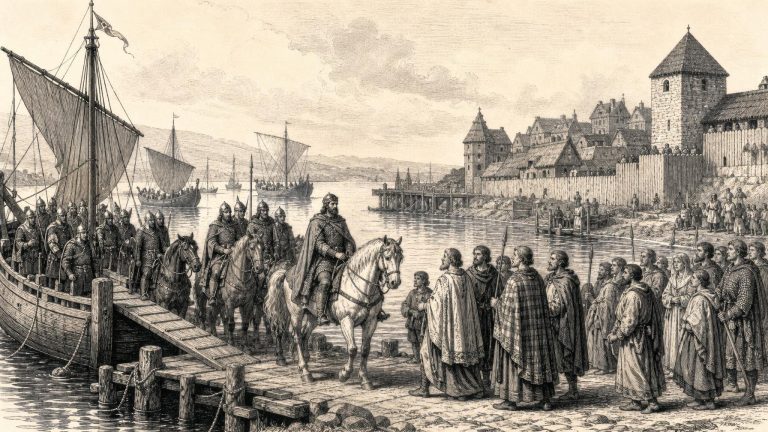
John had been granted the lordship of Ireland by his father in 1177, although he had exercised no personal authority there. Henry now intended to strengthen royal government, restrain over-mighty colonists and establish his son as an effective ruler. Shortly before the expedition John was knighted, and on 25 April he landed at Waterford. Gerald of Wales, who accompanied him, describes about 300 men-at-arms together with mounted soldiers and archers. The Annals of Ulster instead emphasise the fleet, reckoning it at sixty ships or more. These figures are not necessarily contradictory: they describe different parts of a considerable movement of troops, horses, administrators, clergy, servants and supplies.
The Ireland of 1175 was not divided simply between ‘Irish’ and ‘Norman’ camps. Gaelic kings fought one another, allied with foreign settlers and changed sides according to local interests. Anglo-Norman leaders were likewise divided by rivalry and dependence upon their followers. Strongbow possessed Leinster under Henry II, but his military position relied heavily on experienced commanders such as Raymond le Gros and on cooperation with Irish rulers including Domnall Mac Gilla Pátraic of Osraige. Henry, meanwhile, sought to prevent any magnate from becoming independent while avoiding the expense of personally reconquering Ireland.
Henry spent the early part of the year in and around Dublin. Contemporary descriptions place his temporary residence outside the existing town, probably because the fortified Hiberno-Norse settlement could not comfortably accommodate the king’s large household, soldiers, horses and stores. The resulting complex was remembered as a substantial structure of timber or wattles rather than a permanent stone palace. It formed a stage upon which Henry could display the wealth, ceremony and administrative power of the Angevin monarchy.
The most celebrated firmly dated event was the consecration of the church at Mellifont, near Drogheda. No trustworthy source supplies an exact day. Founded in 1142 through the cooperation of St Malachy and Donnchad Ua Cerbaill, king of Airgialla, Mellifont was Ireland’s first Cistercian monastery. Its buildings embodied a form of organised monasticism closely connected to Clairvaux and the wider reforming Church of western Europe.
Ireland had no single monarch exercising uniform government. Tairdelbach Ua Conchobair, king of Connacht, remained one of its strongest rulers, but Muirchertach Mac Lochlainn of Cenél nÉogain had emerged as a formidable northern claimant to the high-kingship. Provincial kings, lesser dynasties, Hiberno-Norse towns and major churches retained their own interests. Authority depended upon alliances, hostages, tribute and repeated military expeditions rather than permanent control. Agreements could be confirmed before clergy and relics, yet political necessity might soon overturn them.
The most widely recorded event was not a battle but the weather. The Annals of Ulster describe severe frost and snow from 28 December until about 15 February, or slightly longer. Because the cold began in the closing days of 1114, it cannot be confined wholly to 1115, but its worst consequences dominated the opening weeks of the year. The Chronicon Scotorum adds that great herds could cross major lakes as though over dry ground.