Boyne Viaduct, Duffy’s Farewell1855 CE
In 1855, post-Famine Ireland combined reconstruction with enduring demographic loss, poverty and emigration. The Boyne Viaduct opened on 5 April, completing rail travel between Dublin and Belfast and strengthening commerce, while offering no cure for insecure livelihoods. Agriculture increasingly favoured livestock, larger holdings and grazing; Encumbered Estates Court sales, workhouses and migration continued to reshape communities. Charles Gavan Duffy’s August farewell and departure for Australia, followed by Frederick Lucas’s death, symbolised the Tenant League’s collapse. Irish people served in the Crimean War. St Mary’s Cathedral, Killarney, was consecrated; George Petrie published traditional melodies; library legislation and Dublin Zoo reflected institutions.
Dateline
In 1855 Ireland was neither simply emerging from catastrophe nor standing still. The years of mass starvation, disease, eviction and emigration during the Great Famine lay immediately behind it, but their effects governed ordinary decisions about land, work, family and departure. Railways and new public institutions suggested material improvement; a major Catholic cathedral was consecrated; and an important collection of traditional music reached print. Yet the political movement that had tried to unite tenant farmers across religious and regional lines was visibly failing. The year’s landmarks therefore belonged to a country being rebuilt, but rebuilt amid profound demographic loss and insecurity.
A Railway Across the Boyne
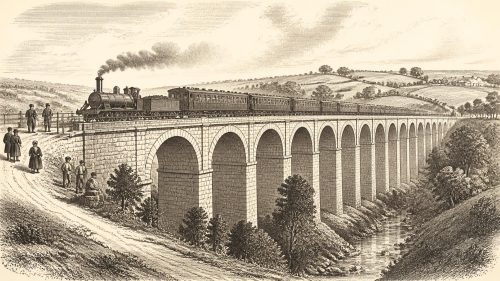
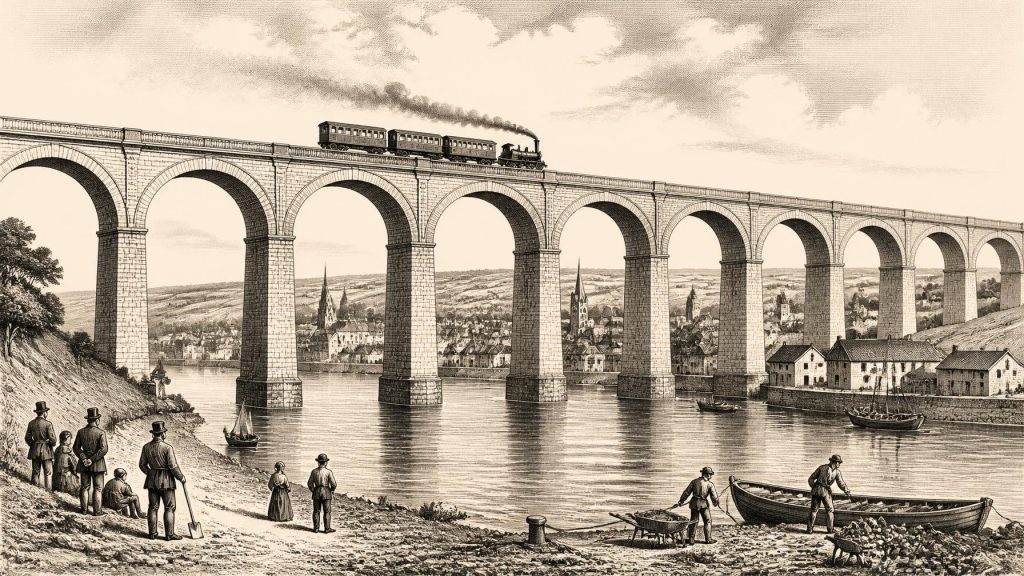
The most conspicuous firmly dated event came on 5 April, when the permanent Boyne Viaduct at Drogheda entered use. Built for the Dublin and Belfast Junction Railway, it completed an all-rail connection between Dublin and Belfast. This was more than a local bridge opening. The Boyne had long been a physical interruption in the route between the island’s two principal cities; a temporary crossing had carried traffic while the permanent metal viaduct was constructed. Once the latter opened, passengers and goods could travel continuously by rail between the capitals of Leinster and Ulster.
The connection mattered in an Ireland where commerce, administration and migration were increasingly organised around transport corridors. Dublin remained the seat of the Irish administration and an important port, while Belfast’s industrial and mercantile growth was accelerating. Drogheda, placed between them and linked to its hinterland by river, road and rail, became a more useful interchange rather than merely a stopping point. Faster movement did not erase the sharp contrast between the industrialising north-east and much poorer western and southern districts, but it made that uneven economy more closely connected.
Railway construction also offered work, though often temporary and physically demanding, and rail travel altered the scale on which people imagined distance. For traders, livestock dealers, merchants and travellers, the line could reduce time and uncertainty. For rural families already accustomed to relatives leaving for Britain, North America or Australia, the railway was part of a wider transport system leading to ports rather than an answer to emigration. It connected places; it did not by itself secure a livelihood in them.
Post-Famine Land and Livelihood
The decisive background to 1855 was the social landscape disclosed by the 1851 census: Ireland’s population had fallen dramatically from its 1841 level, through death and emigration. That census was not a count taken in 1855, and its final published reports continued to appear through the middle of the decade; nevertheless, the population loss it documented was the immediate reality of the year. Many townlands had fewer inhabitants, fewer cabins and fewer subdivided potato plots than before the Famine. The absence of those who had died or departed shaped households as much as the presence of those who remained.
Agriculture was recovering on altered terms. Official agricultural returns for 1855 recorded roughly 2.847 million cattle, 3.393 million sheep and 994,000 pigs. Those figures indicate the centrality of livestock to the rural economy, but should not be mistaken for universal prosperity. Cattle and sheep could support exports and commercial farming while providing relatively little employment compared with densely settled tillage. The post-Famine movement towards larger holdings, grazing and a less crowded countryside brought opportunities to some substantial farmers and graziers, but left labourers, cottiers and small tenants exposed to seasonal work, rent pressure and the continuing temptation or necessity of migration.
The Encumbered Estates Court, created in 1849 to sell heavily indebted properties, remained an important agent of change in 1855. Famine-era arrears and collapsing rental incomes had left many proprietors unable to meet their obligations. Sales through the Court transferred estates to purchasers who commonly sought clearer titles, regular rents, drainage, improved farms and more rational management. Such ambitions could mean investment, but they could also mean consolidation of small holdings and the removal of tenants judged unable to pay. The Court was not a single event of 1855; it was an active post-Famine process whose consequences were being experienced in communities across the island.
Poor Law unions and workhouses likewise remained part of everyday life. They had been overwhelmed during the worst famine years, but their continuing existence testified that destitution had not vanished with the blight crisis. Ratepayers, guardians, clergy, doctors and local officials still had to decide who qualified for assistance and how its cost should be raised. For the poor, entry into the workhouse could separate family members and carried a heavy social stigma. Recovery, where it occurred, was therefore unevenly felt: a better harvest, a railway contract or a livestock sale could coexist with enduring dependency and departure.
Tenant Right Loses Its Champions
Politics in 1855 exposed the limits of post-Famine parliamentary nationalism. Charles Gavan Duffy, Young Ireland veteran, editor of The Nation and MP for New Ross, had helped to establish the Irish Tenant League in 1850. Its programme sought protections later condensed into the “three Fs”: fair rent, fixity of tenure and free sale of a tenant’s interest. Crucially, it had attempted an alliance between Catholic tenant activists in the south and west and Protestant tenant-right reformers, especially in Ulster. In a society divided by religion, region and constitutional loyalty, that alliance was ambitious.
By 1855 it was unravelled. Tenant-right MPs elected in 1852 had failed to maintain a disciplined independent bloc at Westminster, and some prominent figures had accepted government office. Landlord power, disagreements among reformers and conflict over the proper political role of Catholic clergy all weakened the movement. Archbishop Paul Cullen was hostile to Duffy’s political approach, while Duffy and his allies resented restraints placed upon clerical agitation. The division was not merely personal: it concerned whether a Catholic political movement should be led by lay activists, how far priests should intervene in elections, and whether tenant reform could be separated from more radical national aspirations.
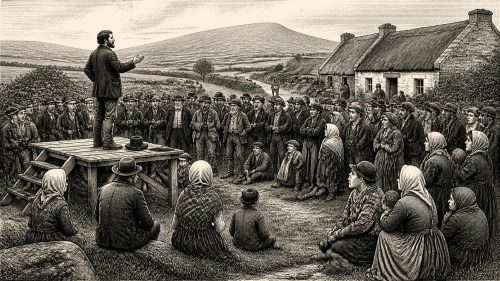
On 18 August, The Nation printed Duffy’s final message to his New Ross constituents. It was a bleak valediction, written by a man who judged the immediate parliamentary cause to be defeated. In the autumn he left Ireland for Australia, having resigned his seat and sold the newspaper. His departure did not formally end the Tenant League, which lingered for several more years, but it removed one of its most energetic organisers and clearest public voices.
The death of Frederick Lucas on 22 October sharpened the sense of collapse. Lucas, an English-born Catholic convert and MP for Meath, had been Duffy’s fellow founder in the League and a determined advocate of tenant rights. His unsuccessful appeal to Rome against Cullen’s restrictions on clerical political activity had deepened the controversy before illness overcame him. Duffy’s departure and Lucas’s death were firmly placed in 1855; together, they marked the exhaustion of a movement that had briefly offered a cross-community programme of agrarian reform.
Crimea in Irish Homes
Ireland was also connected to a distant war. The Crimean War, fought by Britain, France, the Ottoman Empire and Sardinia-Piedmont against Russia, was a major public event in the mid-1850s. Irishmen served throughout the British forces, including in regiments bearing Irish titles and in many other units. Recruitment in Ireland remained substantial in 1855. For some men, soldiering offered wages, food, status or an escape from limited local prospects; it also tied Irish families directly to imperial warfare.
The siege of Sebastopol dominated the campaign. On 18 June, the 18th (Royal Irish) Regiment took part in the unsuccessful British assault, gaining ground near the Woronzoff Road and cemetery before the attack failed. The city fell to the allies in September after the Russians withdrew from the southern side. Irish regiments received the battle honour “SEVASTOPOL”, while Irish Sisters of Mercy were among those involved in nursing and hospital care in the Crimea. Newspapers, letters and casualty reports brought this remote conflict into Irish towns and parishes, adding military anxiety to a decade already marked by bereavement and dispersal.
Faith, Music and Public Culture
There were also striking signs of cultural and religious confidence. On 22 August, St Mary’s Cathedral, Killarney, was consecrated. Designed originally by Augustus Welby Northmore Pugin and continued after his death under James Joseph McCarthy, the Gothic Revival building had begun before the Famine, halted during it, and resumed in 1853. Its consecration did not mean that all work was complete, but it made the building available for worship. The interruption in its construction is itself revealing: a cathedral project could be delayed by catastrophe, then revived as local circumstances stabilised.
The cathedral represented the increasingly visible institutional life of the Catholic Church after emancipation and the restoration of the hierarchy. Its lancets, stonework and ecclesiastical furnishings proclaimed permanence in a county traumatised by famine and emigration. In the same year, the Leasing Powers Act for Religious Worship in Ireland made it easier in certain circumstances for limited owners of land to grant legally secure leases for religious purposes. Such legislation was technical, but it belonged to the practical framework through which congregations could acquire sites and sustain buildings.
Music provided another form of preservation. George Petrie’s The Ancient Music of Ireland appeared in 1855 under the Society for the Preservation and Publication of the Melodies of Ireland. Petrie, an artist, antiquary and meticulous collector, presented melodies with commentary and piano arrangements. Among them was an anonymous tune supplied by Jane Ross of Limavady, later widely known as the “Londonderry Air”. The publication did not freeze an unchanged ancient past: collecting, selecting, harmonising and printing necessarily shaped what audiences received. But after the Famine had disrupted Gaelic-speaking and rural communities, the effort to record living musical traditions carried particular cultural weight.
Parliament also extended public-library legislation to Ireland in 1855. It did not create an immediate island-wide library network, and local adoption was limited. Even so, it offered towns a legal route towards rate-supported libraries, an indication that access to reading and civic improvement had entered public policy. In Dublin’s Phoenix Park, the Zoological Society acquired its first pair of lions during the year, a small but memorable sign of the city’s developing institutions of science, recreation and spectacle.
Connection Without Security
By year’s end, Ireland had gained a great railway crossing, a consecrated cathedral and a landmark musical publication. Yet the more sobering record was equally important: continued land transfers, diminished communities, institutional poverty, outward migration and the collapse of a tenant-right political coalition. The Boyne Viaduct joined Dublin and Belfast more securely than before. Duffy’s farewell showed how difficult it remained to join the interests of Ireland’s tenants into a durable national force.
Primary Sources
- An Industrial Heritage Survey of Railways
- Duffy, Sir Charles Gavan
- Biography – Sir Charles Gavan Duffy
- Lucas, Frederick
- The Census of Ireland for the Year 1851
- Census 1851
- General table (population, housing, occupations, education)
- Agriculture: Crops and Livestock
- Farming on the Eve of the Great Famine: Output and Productivity
- Certificates of Sale (Incumbered Estates Court), 1849–1855
- First Reading
- Ireland and the Crimean War
- Irish Regiments and Soldiers in the Crimean War
- Battle Honour, ‘SEVASTOPOL’
- Three Letters From Sebastopol
- The Crimean Journals of the Sisters of Mercy 1854–56
- County Kerry, Killarney, Cathedral Place, Cathedral of St Mary (RC)
- George Petrie’s Ancient Music of Ireland, 1855 & 1882
- In Tune: A Millennium of Music in Trinity College Library
- Petrie, George
- Public Libraries Act
- Leasing Powers for Religious Worship in Ireland Act, 1855
- Dublin Zoo: 1960–1961
- About Us